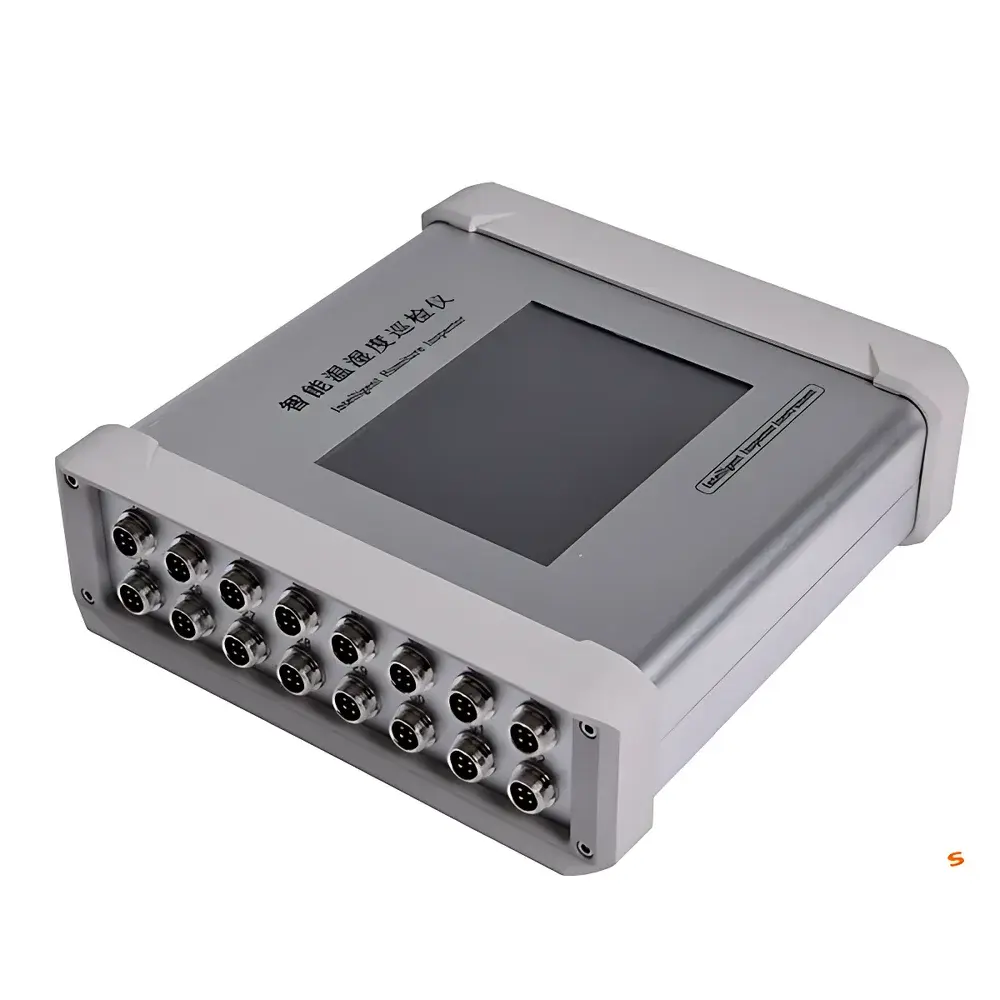
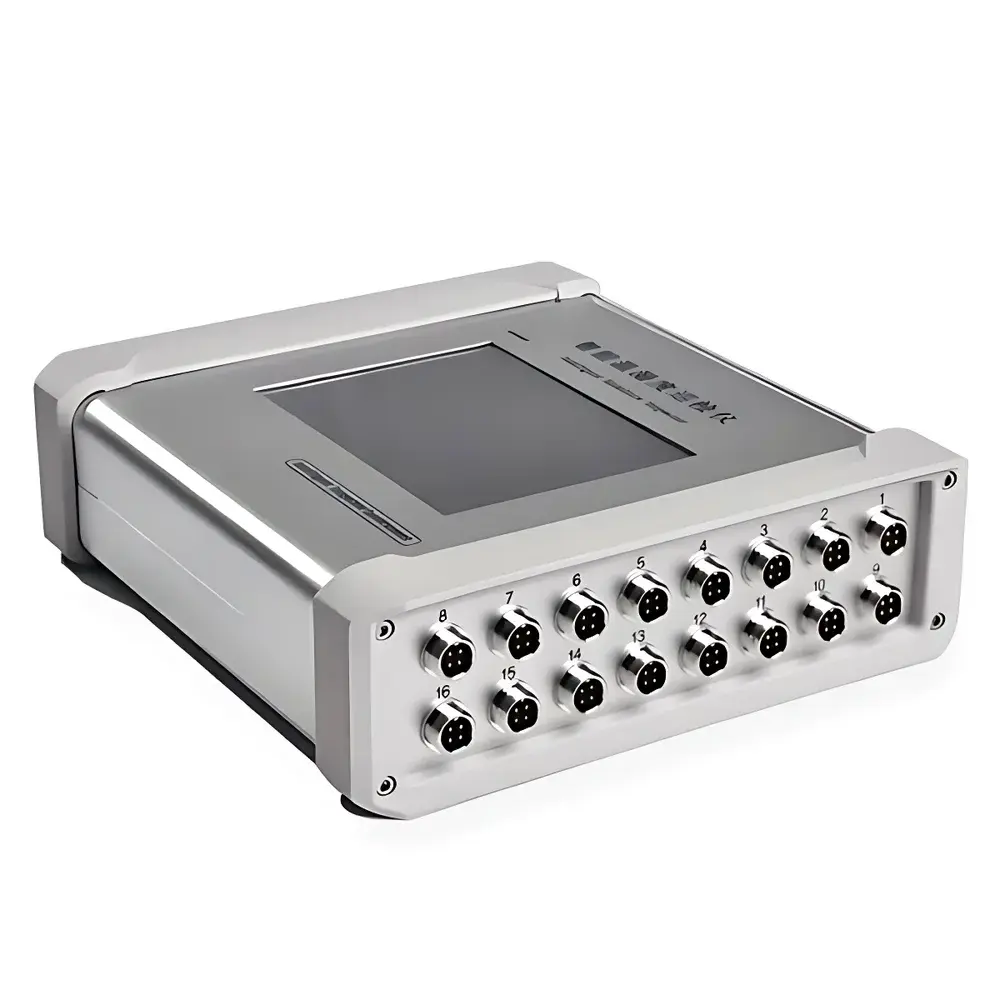
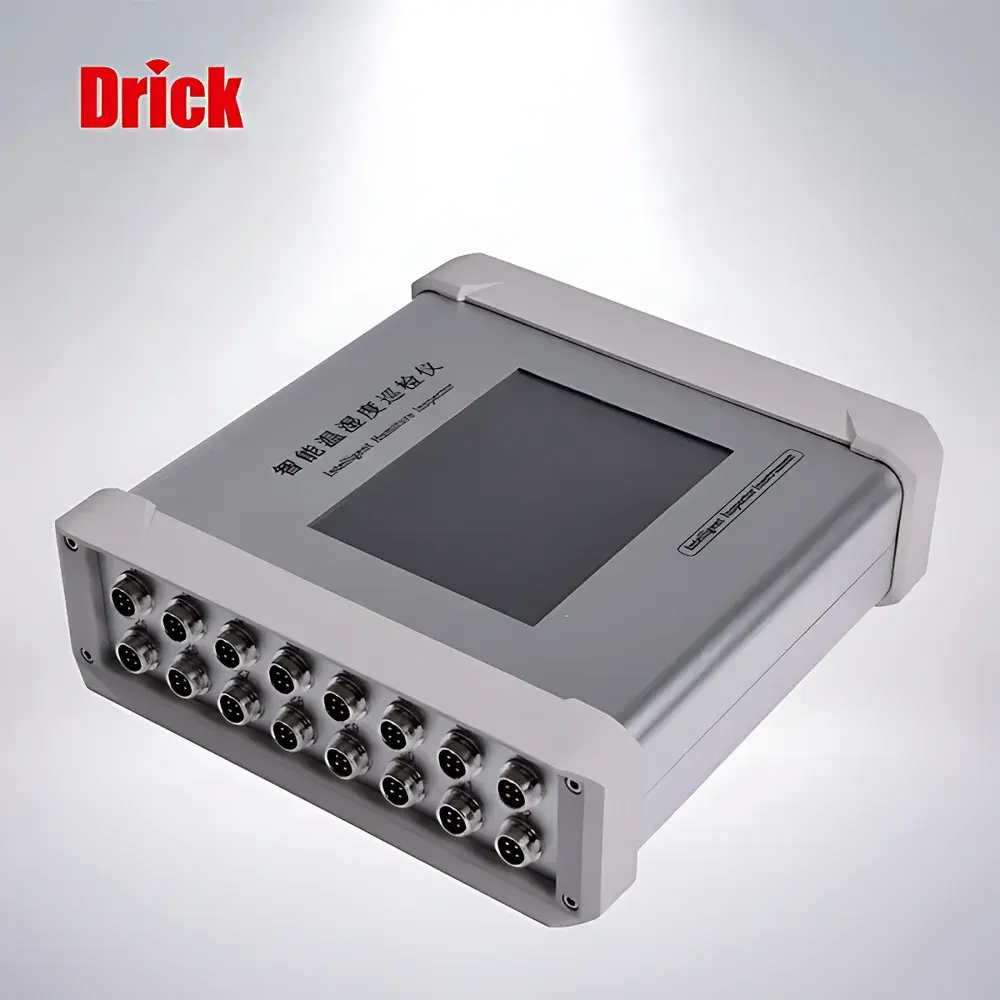
Drick CF88 Intelligent Multi-Point Temperature & Humidity Survey Calibrator
| Brand | Drick |
|---|---|
| Origin | Shandong, China |
| Manufacturer Type | Direct Manufacturer |
| Model | CF88 |
| Temperature Range | (−200 to 1100) °C |
| Humidity Range | (0 to 100) %RH |
| Resolution | 0.01 °C / 0.01 %RH |
| Accuracy (Pt100) | ±(0.1 + 0.001 |
| Accuracy (K-type TC) | ≤ ±0.4 % of reading (0 to 1100 °C) |
| Accuracy (Humidity) | ≤ ±1.5 %RH |
| Channels | 32 temperature + 32 humidity (independent parallel acquisition) |
| Sampling Speed | Full 32-channel acquisition in ≤2 s |
| Environmental Operating Conditions | 15–50 °C, <75 %RH (non-condensing), 86–106 kPa |
| Dimensions (D×W×H) | 260 mm × 200 mm × 85 mm |
| Weight | 1.2 kg |
| Power | AC 220 V ±10 %, 50 Hz ±5 % |
| Display | 5.6-inch color touchscreen |
| Data Storage | Internal memory for hundreds of calibration sessions |
| Compliance | JJF1101–2019, JJF1564–2016, JJF1376–2012, GB 9452–1988, JB/T 5502–1991 |
Overview
The Drick CF88 Intelligent Multi-Point Temperature & Humidity Survey Calibrator is a metrology-grade portable system engineered for high-reproducibility field and laboratory verification of environmental test chambers, incubators, ovens, autoclaves, cold rooms, and other regulated thermal-hygrometric equipment. It operates on the principle of parallel, simultaneous acquisition across 32 independent analog input channels—each capable of accepting either Pt100 resistance thermometers (RTDs), K-type thermocouples, or digital capacitive humidity sensors—without channel-specific calibration mapping. This architecture eliminates sensor-to-channel binding, enabling flexible probe swapping while maintaining traceable accuracy per ISO/IEC 17025 and national metrological standards. The instrument integrates microprocessor-controlled signal conditioning, digital sensor compensation algorithms, and gold-plated connectors to ensure full-scale analog-to-digital fidelity and long-term stability under variable ambient conditions.
Key Features
- True parallel 32-channel acquisition: completes full temperature/humidity snapshot in ≤2 seconds, minimizing thermal drift during dynamic chamber profiling.
- Universal sensor interface: accepts A-class Pt100 RTDs (−200 to 300 °C), I-grade K-type thermocouples (0 to 1100 °C), and Rotronic digital humidity probes (0–100 %RH) interchangeably across any channel.
- Embedded smart sensor memory: thermal offset coefficients and humidity nonlinearity corrections are stored in sensor-integrated EEPROM modules—no manual channel registration required.
- Onboard calibration capability: supports independent two-point adjustment for temperature and humidity sensors using external reference standards; calibration parameters persist per sensor ID, not channel position.
- Integrated thermal printer: enables real-time hardcopy generation of raw data logs, statistical summaries, and compliance-ready reports during field audits.
- Dual-power architecture: operates from AC mains (220 V ±10 %) or DC input (e.g., portable power banks); printer functionality is automatically disabled under DC supply to preserve battery life and signal integrity.
- Preloaded regulatory templates: includes built-in configurations aligned with JJF1101–2019 (environmental chamber calibration), JJF1564–2016 (humidity standard chamber), and JJF1376–2012 (box furnace), reducing setup time and procedural errors.
Sample Compatibility & Compliance
The CF88 is validated for use with a broad class of industrial and scientific thermal-hygrometric systems, including but not limited to: constant-temperature/humidity chambers (e.g., IEC 60068-3-5), biological incubators (ISO 13408-2), autoclaves (EN 285), drying ovens (ASTM E145), cement curing boxes (ASTM C511), refrigerated storage units (USP ), and high-temperature muffle furnaces (ASTM E220). Its measurement uncertainty budget complies with the requirements of JJF1101–2019 for spatial uniformity and temporal stability assessment, supporting both point-by-point validation and 3D thermal mapping protocols. All firmware and software components are designed to meet GLP/GMP documentation traceability requirements—including electronic signature support, audit trail logging, and CFR 21 Part 11–compliant data export via encrypted USB transfer.
Software & Data Management
The CF88 ships with Windows-compatible desktop software that imports native binary log files (.cf88) for post-processing, statistical analysis (min/max/mean/stdev, gradient calculation), and automated certificate generation. The software performs full uncertainty propagation per GUM (JCGM 100:2008), incorporating contributions from sensor accuracy, resolution, reference standard uncertainty, and environmental influence factors. Reports conform to ISO/IEC 17025–required structure: instrument ID, operator, date/time, environmental conditions, sensor IDs and calibration due dates, raw data tables, pass/fail evaluation against specification limits, and expanded uncertainty (k=2). Data export supports CSV, PDF, and XML formats—enabling integration with LIMS and enterprise quality management systems (QMS).
Applications
- Periodic verification of temperature and humidity uniformity/stability in accredited calibration laboratories (ISO/IEC 17025).
- IQ/OQ/PQ execution for pharmaceutical cleanrooms, stability chambers, and sterilization equipment per FDA and EU Annex 1 guidelines.
- Validation of HVAC performance in controlled environments (e.g., ISO Class 5–8 cleanrooms).
- Thermal mapping of aging chambers, environmental stress screening (ESS) systems, and accelerated life testing rigs.
- Field service calibration of industrial ovens, kilns, and curing tunnels where portability and rapid deployment are critical.
- Research-grade spatial profiling of thermal gradients in material testing setups and microclimate studies.
FAQ
Does the CF88 support automatic uncertainty calculation per ISO/IEC 17025?
Yes—the embedded firmware and companion software perform full GUM-compliant uncertainty budgeting, including Type A (statistical) and Type B (calibration certificate, resolution, environmental) components.
Can I use third-party Pt100 or K-type sensors with the CF88?
Only sensors equipped with Drick-compatible digital identification chips (EEPROM-based) are supported for automatic coefficient loading; generic analog sensors require manual parameter entry and are not recommended for accredited use.
Is the internal data logger compliant with 21 CFR Part 11?
The device itself does not implement electronic signatures or role-based access control; however, exported data files include immutable timestamps, operator IDs, and checksums—enabling Part 11–compliant archiving when used within a validated QMS environment.
What is the maximum allowable ambient humidity for operation?
The unit must be operated at ≤75 %RH, non-condensing, within 15–50 °C and 86–106 kPa atmospheric pressure—conditions verified per IEC 61000-4-2 immunity testing.
How is sensor calibration traceability maintained across multiple instruments?
Each smart sensor carries its own NIST-traceable calibration certificate ID; the CF88 logs this ID alongside measurements, ensuring unbroken chain-of-custody in multi-instrument deployments.