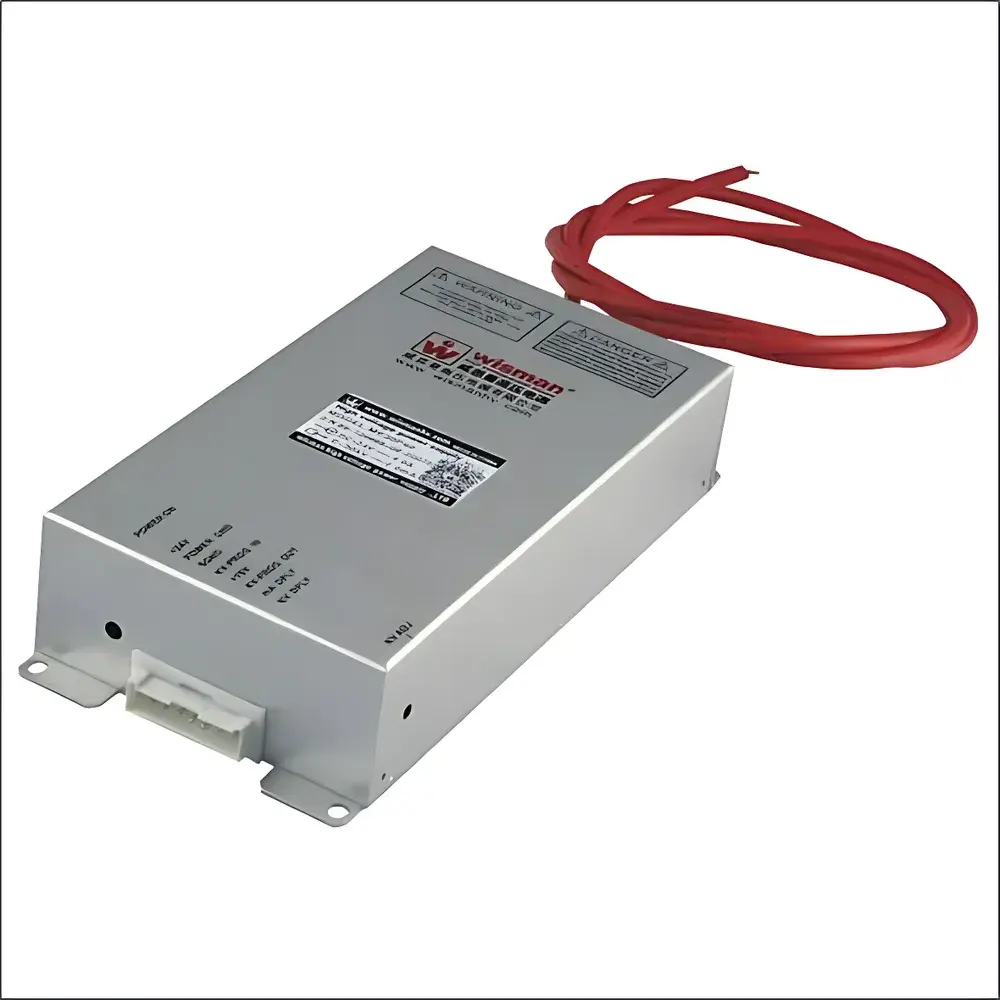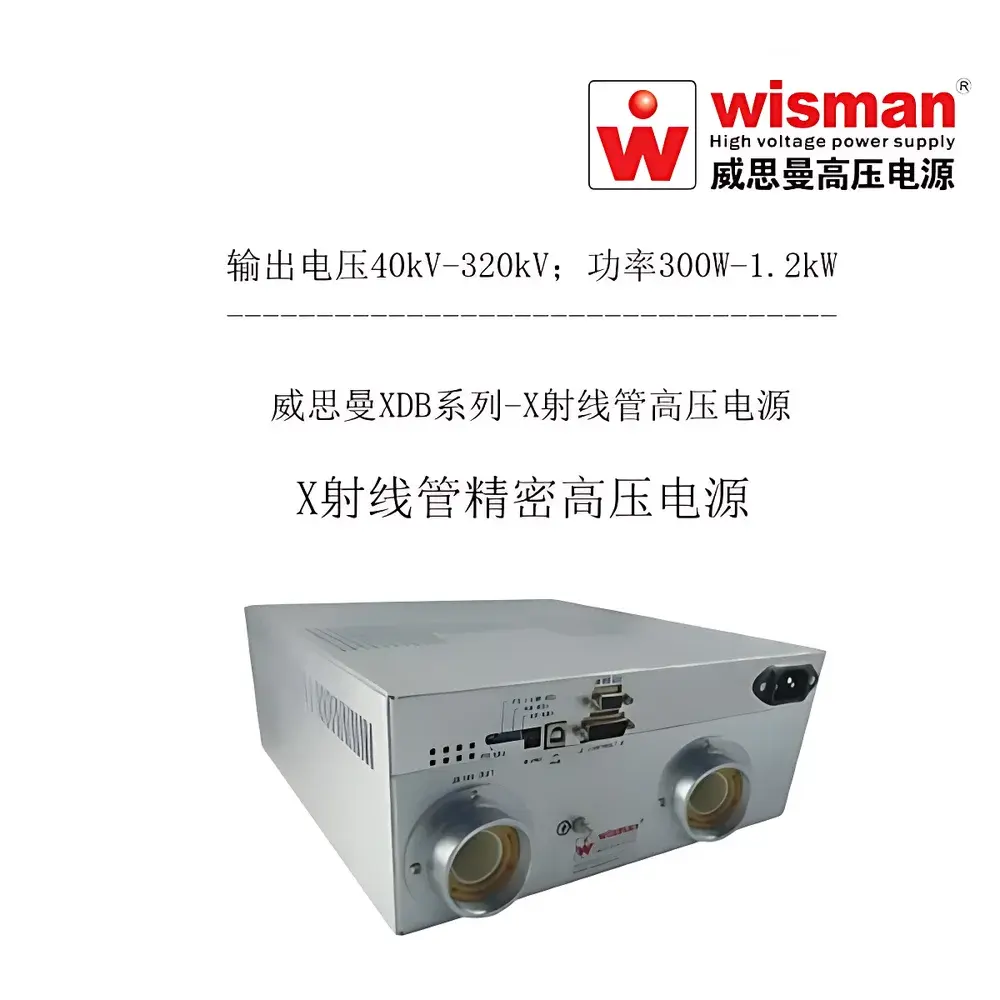

Wiseman XDB Series Bipolar High-Voltage Power Supply for X-Ray Tubes (320 kV / 1.2 kW)

| Brand | Wiseman |
|---|---|
| Origin | Shaanxi, China |
| Model | XDB |
| Output Voltage | ±320 kV (bipolar) |
| Output Power | 1.2 kW |
| Input Voltage Range | 180–264 VAC, 47–63 Hz |
| Voltage Stability | ≤25 ppm/hr (after 2-hr warm-up) |
| Ripple | ≤1% RMS (>20 kHz), 0.1% RMS (≤20 kHz) |
| Temperature Coefficient | 25 ppm/°C |
| Control Interface | Analog 0–10 V, RS-232, RS-485, optional Ethernet |
| Filament Output | 0–5 A / 0–10 V, closed-loop controlled |
| Operating Temperature | 0–50 °C |
| Dimensions (320 kV variant) | 546 × 482.5 × 266 mm |
| Weight (320 kV variant) | 65 kg |
Ask about pricing, availability and specifications.
Overview
The Wiseman XDB Series is a high-precision, bipolar high-voltage power supply engineered specifically for demanding X-ray tube applications in analytical instrumentation. Designed to meet the stringent stability and noise requirements of modern X-ray diffraction (XRD), X-ray fluorescence (XRF), and wavelength-dispersive spectrometry (WDS) systems, the XDB platform employs digital signal processor (DSP)-based regulation to deliver exceptional long-term voltage stability and ultra-low ripple performance. Unlike conventional analog HV supplies, the XDB series utilizes zero-current resonant switching topology and advanced high-voltage insulation design—enabling compact form factor without compromising dielectric integrity or thermal management. Its bipolar output capability (±320 kV) supports both grounded-cathode and floating-filament X-ray tube configurations, making it compatible with single-crystal diffractometers, portable XRF analyzers, industrial thickness gauges, and security screening systems requiring high-energy bremsstrahlung generation.
Key Features
- Bipolar high-voltage output up to ±320 kV with programmable polarity—optimized for suspended-filament X-ray tubes used in high-resolution XRD and WDS.
- 1.2 kW continuous output power at full rated voltage, with optional 300 W and 600 W variants for modular system integration.
- DSP-controlled regulation ensures voltage stability of ≤25 ppm/hr after thermal equilibrium (2-hour warm-up), critical for long-duration crystallographic scans and quantitative elemental analysis.
- Ultra-low output ripple: ≤0.1% RMS below 20 kHz and ≤1% RMS above 20 kHz—minimizing spectral noise in energy-dispersive and wavelength-dispersive detection.
- Integrated filament supply with closed-loop current control (0–5 A, 0–10 V), featuring automatic interlock that disables filament output when HV falls below 30% of setpoint—preventing cathode damage.
- Multi-mode control architecture: local adjustment via precision multi-turn potentiometers; remote analog (0–10 V) and digital interfaces including RS-232, RS-485, and optional Ethernet (ET) for OEM system synchronization and SCADA integration.
- Power factor corrected (PFC) AC input (180–264 VAC, 47–63 Hz) ensures consistent operation across global laboratory mains conditions and reduces harmonic distortion per IEC 61000-3-2 Class A compliance.
Sample Compatibility & Compliance
The XDB series is designed for seamless integration into ISO/IEC 17025-accredited analytical laboratories and regulated manufacturing environments. Its stable, low-noise output supports reproducible data acquisition required by ASTM E915 (residual stress measurement), ISO 21942 (XRD phase identification), and USP (XRF elemental impurity testing). The power supply meets EN 61000-6-3 (EMC emission limits) and EN 61000-6-2 (immunity standards), with integrated EMI filtering compliant with IEC 60601-1 for medical-grade auxiliary equipment. While not a standalone diagnostic device, its performance parameters align with GLP/GMP instrument qualification protocols—including IQ/OQ documentation support, traceable calibration procedures, and audit-ready parameter logging via digital interface.
Software & Data Management
Through RS-232 or RS-485 serial communication, the XDB supports ASCII command protocol for real-time monitoring and control of HV, filament current, temperature, and fault status. Optional Ethernet interface enables TCP/IP-based integration into LabVIEW, Python-based automation frameworks, or enterprise MES systems. All operational parameters—including voltage/current setpoints, actual readings, thermal sensor outputs, and error codes—are timestamped and accessible for export. Firmware supports configurable alarm thresholds and event-triggered data capture, facilitating compliance with FDA 21 CFR Part 11 requirements when deployed in validated analytical workflows. No proprietary software is required; standard terminal emulators or custom scripts suffice for full parameter interrogation and closed-loop feedback integration.
Applications
- Single-crystal and powder X-ray diffractometers requiring high-voltage stability for Bragg angle precision and peak intensity reproducibility.
- Wavelength-dispersive X-ray spectrometers (WDS) where low ripple minimizes background scatter and improves peak-to-background ratios.
- Industrial on-line thickness gauging and coating weight measurement systems operating in harsh factory environments.
- Portable and benchtop XRF analyzers for RoHS, ELV, and mining applications—leveraging bipolar output for optimized tube efficiency across multiple anode materials (Rh, Mo, Cr).
- Security screening systems (e.g., baggage EDS) demanding high-power, high-kV sources for dual-energy material discrimination.
- Research-grade electron microprobe and micro-XRD platforms requiring synchronized HV/filament ramping and sub-ppm drift control over multi-hour acquisitions.
FAQ
Is the XDB series certified for use in medical X-ray equipment?
The XDB is not classified as a medical device under FDA 21 CFR Part 820 or EU MDR Annex II, but its electrical safety and EMC performance comply with IEC 61010-1 and IEC 61000-6-3—making it suitable as a subsystem component in Class I or IIa medical analyzers when integrated under OEM responsibility.
Can the XDB be operated in constant current mode?
Yes—the unit supports both constant voltage (CV) and constant current (CC) regulation modes, with automatic crossover and programmable transition thresholds via digital interface.
What is the recommended warm-up time before achieving specified stability?
Voltage stability specification (≤25 ppm/hr) applies after a minimum 2-hour thermal stabilization period at nominal load and ambient temperature within 20–25 °C.
Does Wiseman provide calibration certificates traceable to NIST or CNAS standards?
Calibration reports with uncertainty budgets are available upon request, traceable to national metrology institutes via Wiseman’s ISO/IEC 17025-accredited internal calibration lab (CNAS L8229).
Are custom voltage ranges or mechanical form factors available?
Yes—Wiseman offers engineering support for tailored output specifications (e.g., 200 kV @ 2 kW, water-cooled variants, rack-mount chassis) under NDA, with typical lead times of 8–12 weeks for non-standard configurations.