
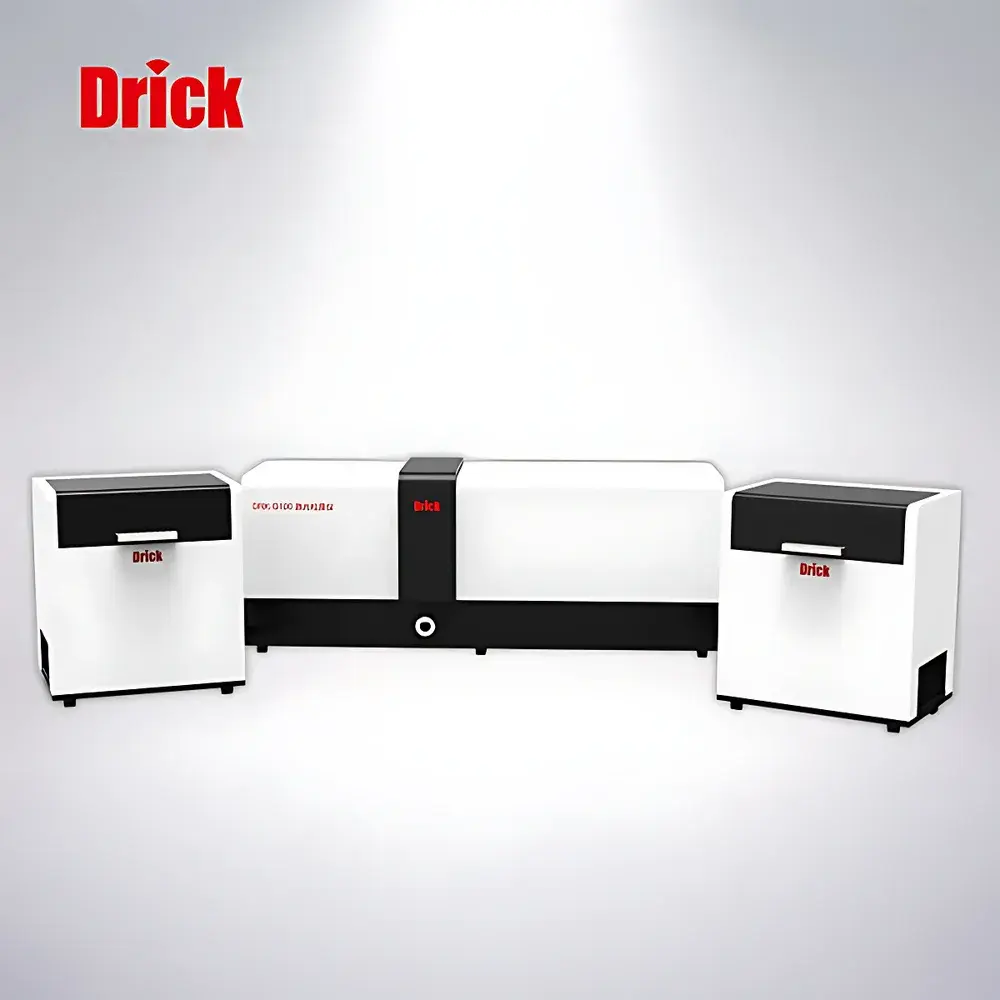
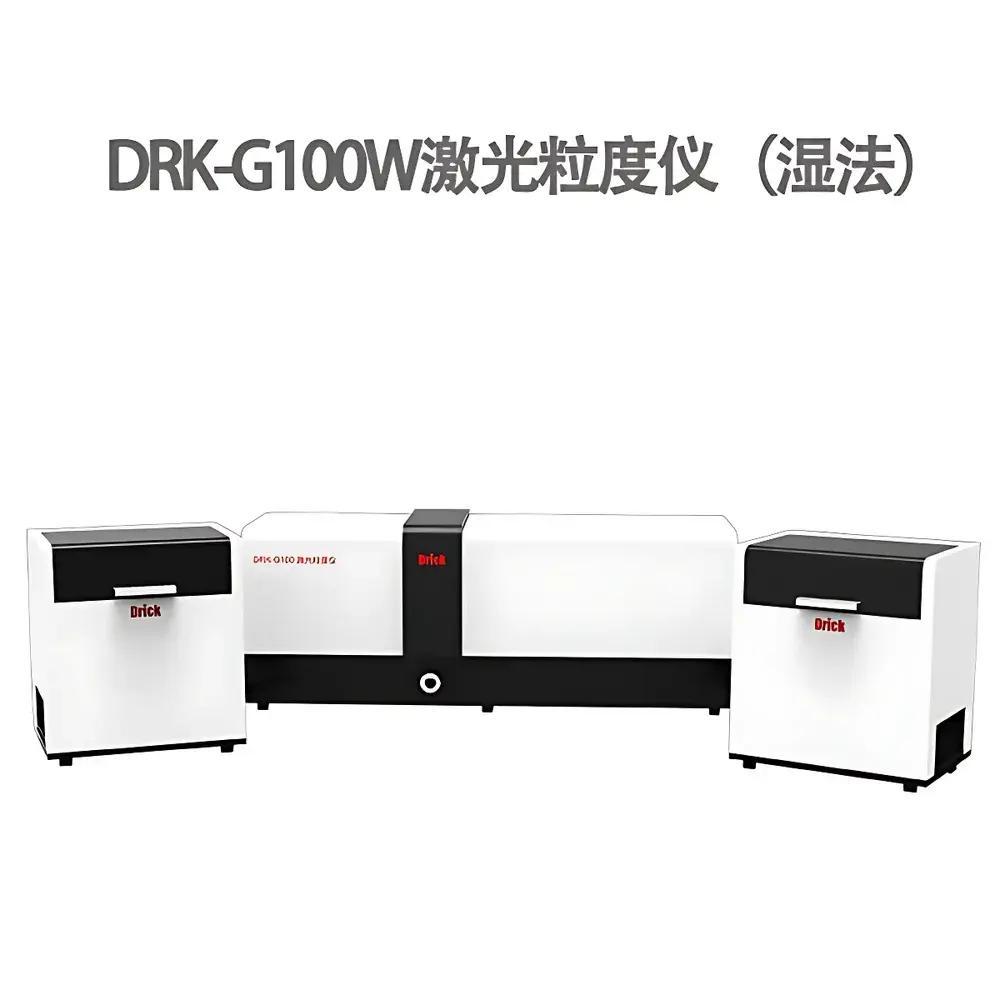
Drick DRK-G100W Wet-Dispersion Laser Particle Size Analyzer
| Brand | Drick |
|---|---|
| Origin | Shandong, China |
| Manufacturer Type | OEM Manufacturer |
| Product Category | Domestic |
| Model | DRK-G100W |
| Dispersion Method | Wet Dispersion |
| Instrument Type | Laboratory Laser Particle Size Analyzer |
| Measurement Range (Wet) | 0.1–1000 µm |
| Repeatability | <1% RSD (D50, certified NIST-traceable standard reference material) |
Overview
The Drick DRK-G100W is a laboratory-grade wet-dispersion laser particle size analyzer engineered for high-precision, reproducible granulometric characterization of suspensions in demanding industrial and research environments. It operates on the principle of Mie scattering theory, utilizing a dual-lens optical system with a high-stability He-Ne laser (632.8 nm) and multi-angle forward/backward scattering detection to resolve particle size distributions across a broad dynamic range. Designed specifically for routine quality control and formulation development in chemical, ceramic, pharmaceutical, and advanced materials laboratories, the DRK-G100W delivers ISO 13320-compliant results with robust signal-to-noise performance and minimal operator dependency. Its sealed optical path and anti-contamination fluidic design ensure long-term measurement stability under continuous use in high-throughput QC settings.
Key Features
- Wide dynamic measurement range: 0.1–1000 µm for wet dispersions—covering colloidal nanoparticles, fine powders, and coarse granules in a single run
- High-resolution detection via 32-channel photodiode array with real-time background subtraction and auto-alignment compensation
- Integrated ultrasonic dispersion unit (40 kHz, adjustable power up to 100 W) and programmable peristaltic circulation pump (flow rate: 0–4000 mL/min) for optimal de-agglomeration and sample homogeneity
- Stainless-steel wet module with quick-release fittings, corrosion-resistant flow cell, and automatic cleaning cycle to minimize cross-contamination between samples
- Compliance-ready architecture: supports audit trail logging, user access levels, electronic signature capability, and data export formats compatible with FDA 21 CFR Part 11 requirements when paired with optional validated software modules
- Modular design enables future upgrades—including dry dispersion accessory integration and GMP-aligned validation packages
Sample Compatibility & Compliance
The DRK-G100W is optimized for aqueous and organic suspensions commonly encountered in ceramic slip preparation, pigment dispersion, catalyst slurry analysis, and polymer emulsion characterization. Compatible with common dispersants (e.g., sodium hexametaphosphate, ammonium citrate) and solvents including water, ethanol, isopropanol, and xylene. All wet-path components meet ISO 8502-2 surface cleanliness standards and are certified non-reactive with pH 2–12 media. The instrument conforms to ISO 13320:2020 (Particle size analysis — Laser diffraction methods), ASTM D4291-22 (Standard Test Method for Particle-Size Distribution of Pigments by Centrifugal Sedimentation), and supports method validation per USP <429> and ICH Q5A(R2) guidelines for particulate assessment in biopharmaceutical manufacturing.
Software & Data Management
Equipped with Drick Particle Analysis Suite (v4.2), the DRK-G100W provides intuitive workflow-driven operation—from automated measurement sequence setup to ISO-standardized reporting. Software features include batch processing of up to 99 samples, customizable report templates (PDF/CSV/XLSX), statistical comparison tools (t-test, ANOVA), and D10/D50/D90 trend tracking with SPC charting. Raw scattering data is stored in HDF5 format for traceability, while metadata fields capture operator ID, timestamp, environmental conditions (temperature/humidity), and calibration history. Optional LIMS integration via OPC UA or RESTful API enables seamless data transfer to enterprise QA systems in regulated environments.
Applications
- Ceramic industry: Monitoring green body slurry stability, zirconia/alumina powder dispersion quality, and glaze particle distribution prior to spray drying
- Chemical manufacturing: Verifying catalyst support particle uniformity, pigment agglomerate breakdown efficiency, and filler dispersion in polymer masterbatches
- Pharmaceutical R&D: Characterizing nanosuspension formulations, excipient particle blends, and milled API batches per ICH Q5A and USP <729>
- Advanced materials: Quantifying graphene oxide flake size distribution, battery cathode slurry homogeneity, and metal-organic framework (MOF) particle integrity after sonication
- Environmental testing labs: Analyzing sediment suspension profiles, wastewater treatment coagulant floc size, and airborne particulate analogs in aqueous extraction protocols
FAQ
What standards does the DRK-G100W comply with for regulatory submissions?
It meets ISO 13320:2020 requirements for laser diffraction methodology and supports full documentation packages aligned with GLP and GMP practices, including instrument qualification (IQ/OQ/PQ) templates.
Can the system be validated for use in FDA-regulated environments?
Yes—when configured with the optional 21 CFR Part 11 Compliance Package, it provides electronic signatures, immutable audit trails, and role-based access control required for regulated QC labs.
Is third-party calibration verification available?
Drick provides NIST-traceable calibration verification using SRM 1963 (NIST silica dispersion) and SRM 2800 (NIST titanium dioxide), with certificates issued per ISO/IEC 17025 accredited procedures.
How is maintenance performed to ensure long-term optical alignment stability?
The optical bench uses passive thermal compensation and vibration-damped mounting; annual preventive maintenance includes laser power calibration, lens cleaning verification, and flow-path pressure profiling.
Does the software support multi-language interfaces and local language report generation?
The base software supports English and Chinese UI; localized report templates (including metric/imperial unit toggling and regional decimal formatting) are configurable per site deployment.



