
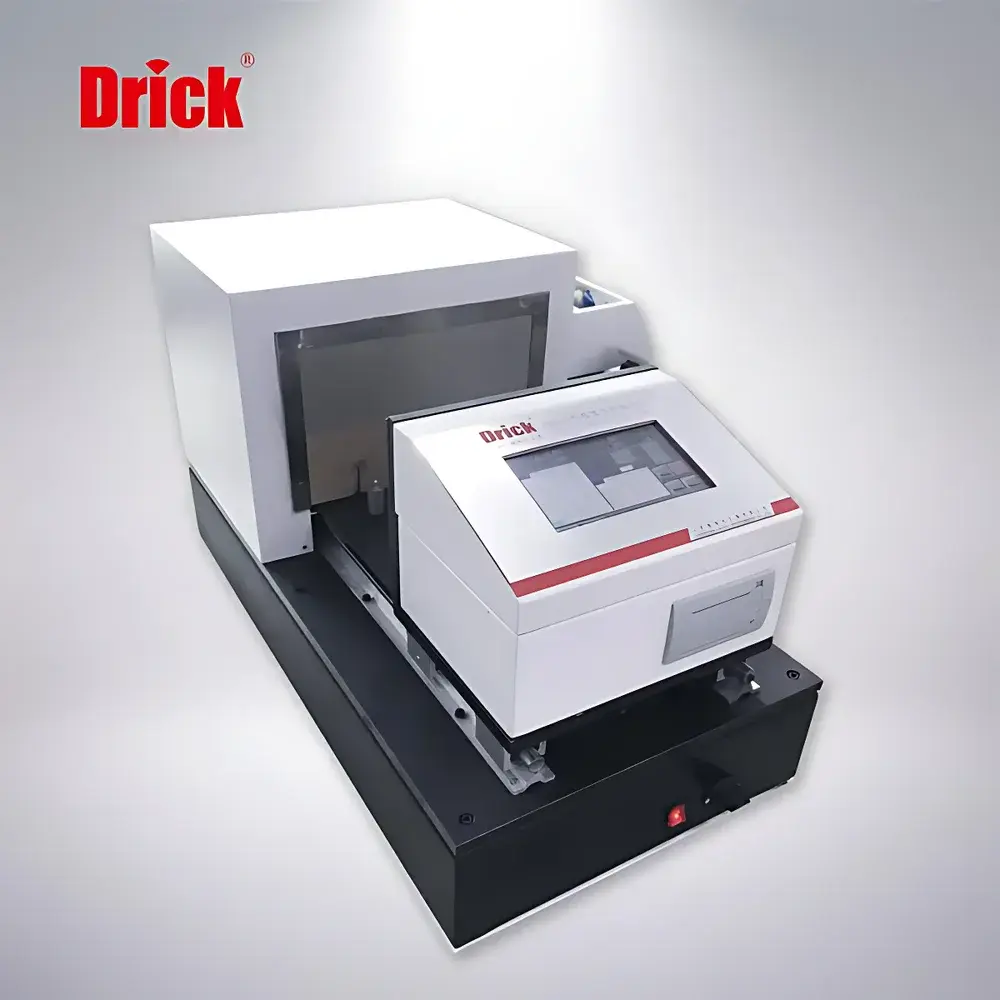
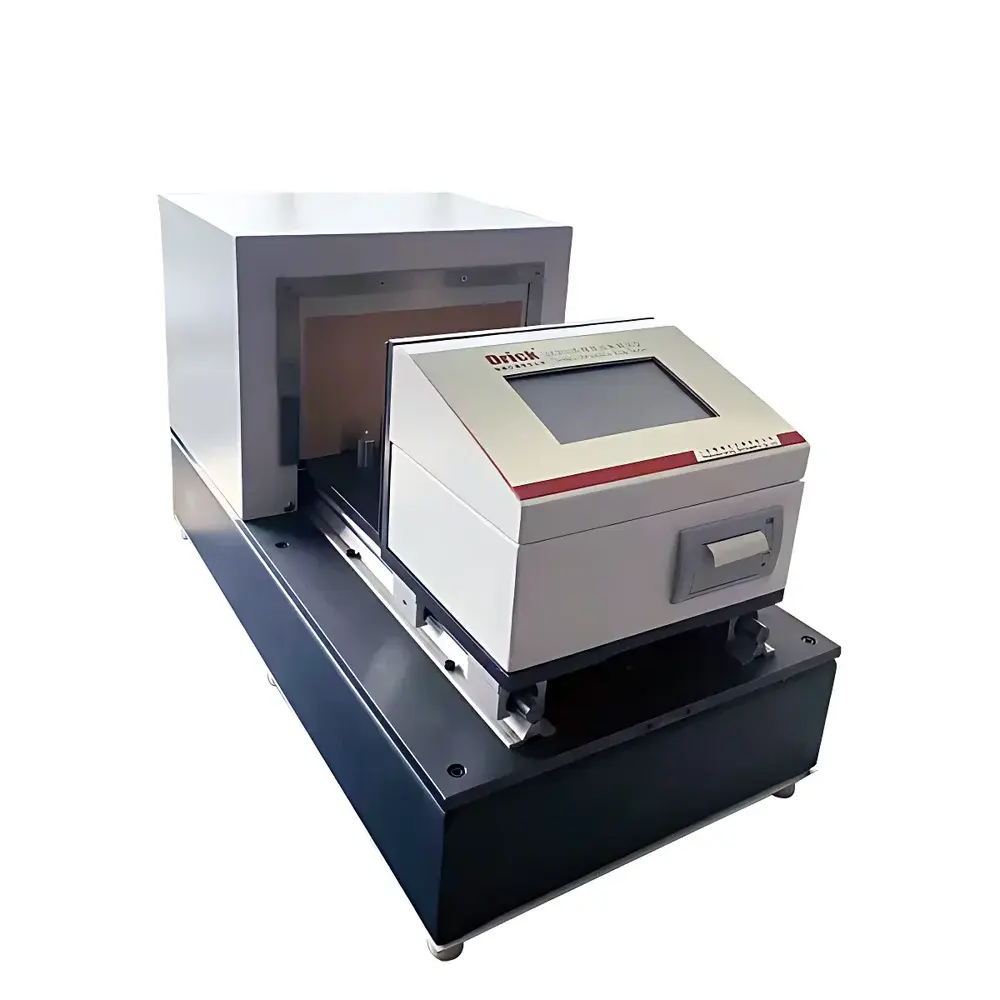
Drick DRK166 Air-Bath Film Thermal Shrinkage Tester
| Brand | Drick |
|---|---|
| Origin | Shandong, China |
| Manufacturer Type | Direct Manufacturer |
| Region of Origin | Domestic (China) |
| Model | DRK166 |
| Price | ¥50,000 CNY |
| Force Range | 0.2–30 N |
| Force Accuracy | ±0.2% FS |
| Displacement Range | 0.125–45 mm |
| Displacement Accuracy | ±0.125 mm |
| Temperature Range | Ambient to 210 °C |
| Temperature Control Accuracy | ±0.5 °C |
| Chamber Dimensions | 700 × 400 × 390 mm |
| Specimen Size | 150 mm × 15 mm |
| Test Stations | 1–3 simultaneous |
| Compliance | ISO 14616 |
Overview
The Drick DRK166 Air-Bath Film Thermal Shrinkage Tester is a precision-engineered instrument designed for quantitative evaluation of thermal shrinkage behavior in polymeric packaging films. It operates on the principle of controlled convective air heating, in strict accordance with ISO 14616:2015 — “Plastics — Heat-shrinkable film — Determination of shrinkage force and shrinkage rate”. Unlike liquid-bath or oven-based methods, the DRK166 employs a thermally insulated, forced-air circulation chamber to deliver uniform, reproducible heating profiles across multiple test specimens. This architecture ensures minimal thermal gradient deviation (<±0.5 °C), critical for distinguishing subtle differences in shrink onset temperature, peak shrink force, and post-cooling recovery behavior. The system measures both dynamic shrinkage force (tensile stress developed during heating) and cold shrink force (residual contractile stress measured after cooling to ambient), enabling full characterization of viscoelastic relaxation kinetics in heat-shrink materials such as PE, POF, PVC, and PETG films.
Key Features
- Triple-station independent testing capability: supports concurrent evaluation of up to three specimens under identical thermal conditions, improving throughput and inter-sample comparability.
- High-fidelity dual-sensor architecture: integrated load cell (0.2–30 N, ±0.2% full-scale accuracy) and linear displacement transducer (0.125–45 mm, ±0.125 mm resolution) capture synchronized force–displacement–time data streams.
- Precise air-bath thermal control: PID-regulated forced-air system maintains setpoint stability within ±0.5 °C from ambient to 210 °C, with programmable ramp rates (0.1–10 °C/min) and dwell time flexibility.
- Standardized specimen handling: accommodates ISO 14616-compliant specimens (150 mm × 15 mm), mounted via spring-loaded clamps with adjustable preload to minimize slippage artifacts.
- Real-time parametric visualization: software interface displays live curves of thermal shrink force, cold shrink force, and nine standardized shrink rate metrics (e.g., free shrink % at 100 °C, constrained shrink force at 120 °C, etc.) aligned to ASTM D2732 and ISO 11509 reference points.
Sample Compatibility & Compliance
The DRK166 is validated for use with mono- and multi-layer thermoplastic shrink films including low-density polyethylene (LDPE), polyolefin (POF), polyvinyl chloride (PVC), polyethylene terephthalate glycol (PETG), and ionomer-based blends. It supports directional shrink analysis—machine direction (MD) and transverse direction (TD)—as required by packaging specification standards for bundled product integrity and pallet wrap performance. All measurement protocols align with ISO 14616:2015, ISO 11509:2010 (shrink tension), and ASTM D2732-22 (free shrink). Data acquisition and storage comply with GLP documentation requirements, supporting audit-ready reporting for quality assurance departments operating under ISO 9001 or IATF 16949 frameworks.
Software & Data Management
The embedded Windows-based control software provides calibrated instrument operation, automated test sequencing, and export-ready data output in CSV, PDF, and XML formats. Each test record includes timestamped metadata (operator ID, calibration certificate ID, environmental conditions), raw sensor traces, and calculated parameters per ISO 14616 Annex B. Audit trail functionality logs all user actions—including method edits, calibration events, and result overrides—with immutable timestamps. Exported reports include statistical summaries (mean, SD, CV%) across replicates and pass/fail flags against user-defined specification limits. Data files are structured for seamless integration into LIMS platforms and satisfy traceability requirements under FDA 21 CFR Part 11 when deployed with electronic signature modules.
Applications
- Formulation development: comparative assessment of resin grades, additive packages (e.g., slip agents, UV stabilizers), and co-extrusion layer architectures on shrink kinetics.
- Process validation: correlation of shrink performance with extrusion line parameters (quench rate, draw ratio, annealing zone temperature).
- Quality control: routine verification of incoming shrink film lots against internal specifications or customer technical agreements (e.g., maximum shrink force ≤18 N at 135 °C).
- Packaging design support: prediction of label adherence, tray lidding integrity, and tamper-evident band performance under thermal distribution conditions.
- Regulatory documentation: generation of test evidence for CE marking dossiers, FDA food-contact notifications (21 CFR 177), and REACH SVHC screening reports.
FAQ
What standards does the DRK166 explicitly support?
ISO 14616:2015, ISO 11509:2010, ASTM D2732-22, and GB/T 13519–2016 (Chinese national standard equivalent).
Can the system measure shrink force in both MD and TD directions without reconfiguration?
Yes — directional testing is achieved by rotating the specimen mount 90°; the software auto-tags orientation and applies appropriate calculation algorithms.
Is temperature calibration traceable to national metrology institutes?
Calibration certificates are issued with NIST-traceable references for both thermal and mechanical subsystems, valid for 12 months under normal operating conditions.
Does the DRK166 support automated pass/fail decision logic based on specification limits?
Yes — users define upper/lower limits per parameter; the software generates immediate compliance status indicators and exports nonconformance logs.
What maintenance intervals are recommended for long-term measurement stability?
Load cell and displacement sensor verification every 6 months; air-flow path inspection and filter replacement every 3 months; full system calibration annually.





