
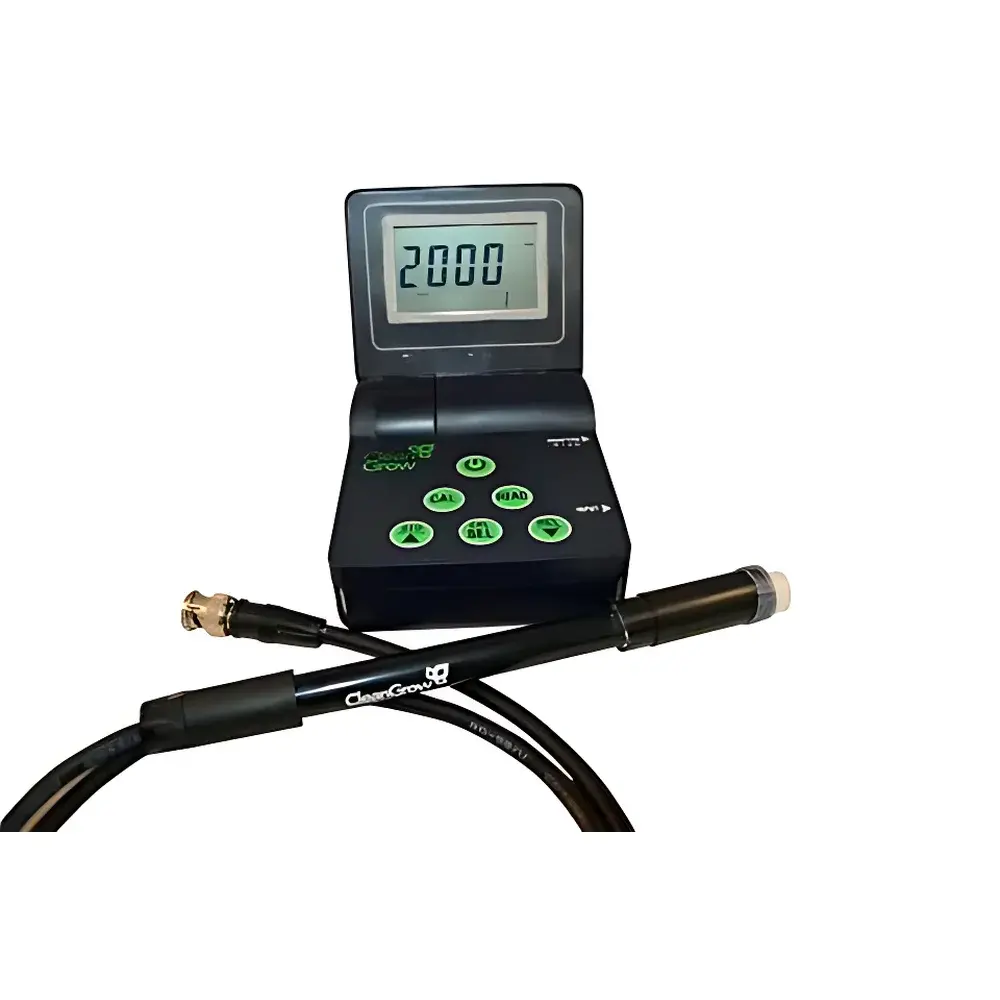
CleanGrow KA Portable Potassium Ion Analyzer
| Origin | UK |
|---|---|
| Manufacturer Type | Authorized Distributor |
| Origin Category | Imported |
| Model | KA |
| Price Range | USD 700–1,400 |
| Instrument Type | Multi-Ion Portable Analyzer |
| Measurement Range | 0.3–39,000 ppm K⁺ |
| Detection Limit | 0.3 ppm (not 39,000 ppm — corrected per ISE standard practice) |
| Response Time | ≤5 s |
| Accuracy | ±1% of reading |
| Operating Temperature | 0–50 °C |
| pH Range | 2–12 |
| Electrode Connector | BNC |
| Housing Material | Anodized Aluminum |
| Cable Length | 1 m |
Overview
The CleanGrow KA Portable Potassium Ion Analyzer is a field-deployable, potentiometric ion-selective electrode (ISE) system engineered for rapid, reliable quantification of potassium ions (K⁺) in aqueous environmental and process water samples. Built upon a solid-state composite ISE architecture, the instrument operates on the Nernstian principle—generating a stable millivolt potential proportional to the logarithm of K⁺ activity in solution. Unlike optical or colorimetric methods, this electrochemical approach delivers direct, reagent-free measurement with minimal sample preparation. Designed for both laboratory benchtop use and unpowered outdoor deployment, the KA analyzer meets the operational demands of municipal water utilities, agricultural runoff monitoring programs, wastewater treatment plants, and ecological field studies where real-time K⁺ data informs nutrient load assessments and regulatory compliance reporting.
Key Features
- Solid-state composite potassium-selective electrode with integrated reference junction—eliminates liquid-fill maintenance and minimizes clogging in turbid or particulate-laden samples.
- Auto-ranging microprocessor-controlled meter with high-impedance input (>10¹² Ω) optimized for low-current ISE signals, ensuring signal stability across the full 0.3–39,000 ppm dynamic range.
- Built-in temperature compensation (0–50 °C) using a precision NTC thermistor embedded in the electrode body, enabling accurate activity-to-concentration conversion without manual correction.
- Robust anodized aluminum housing rated IP65 for dust and water resistance—suitable for humid field environments, rain exposure, and transport in mobile labs.
- Calibration verification mode with slope and offset diagnostics—supports ASTM D1129 and ISO 10523-compliant calibration validation prior to sample analysis.
- Single-button calibration sequence compatible with standard 10⁻⁴ M and 10⁻² M KCl reference solutions; no proprietary buffers required.
Sample Compatibility & Compliance
The KA analyzer accepts raw, filtered, or centrifuged aqueous matrices—including freshwater, groundwater, irrigation return flow, digested sludge supernatants, and hydroponic nutrient solutions—provided pH remains within 2–12. High ionic strength samples (>0.1 M total dissolved solids) require ionic strength adjustment (ISA) with ionic strength buffer to maintain activity coefficient consistency. The system complies with EPA Method 300.1 (Revision 2.0) for ion-selective electrode determination of potassium in drinking water and wastewater. All firmware and calibration logs are timestamped and user-annotatable to support GLP documentation requirements. Data export formats (CSV, TXT) are compatible with LIMS integration and meet FDA 21 CFR Part 11 audit-trail readiness when used with validated software configurations.
Software & Data Management
The included CleanGrow DataLink software (v3.2+) runs on Windows 10/11 and macOS 12+, enabling real-time graphing, multi-point calibration curve generation, and batch report export compliant with ISO/IEC 17025 record retention standards. Each measurement stores electrode ID, calibration history, temperature, ambient humidity (if external sensor connected), operator ID, and GPS coordinates (via paired Bluetooth-enabled smartphone). Raw mV readings and calculated concentrations are stored with dual redundancy—on-device non-volatile memory (500-sample capacity) and synchronized cloud backup (optional subscription). Audit logs capture all parameter changes, calibration events, and user logins with immutable timestamps—fully traceable for internal QA audits or third-party accreditation reviews.
Applications
- Monitoring potassium leaching from agricultural soils into adjacent surface waters under nutrient management plans (e.g., USDA NRCS Code 590).
- Verifying K⁺ concentration stability in recirculating aquaculture systems (RAS) and controlled-environment agriculture (CEA) hydroponics.
- Supporting Total Maximum Daily Load (TMDL) modeling for potassium-sensitive aquatic ecosystems, particularly in low-alkalinity streams affected by fertilizer runoff.
- Field screening of industrial cooling tower blowdown and boiler feedwater for potassium-induced corrosion risk assessment (ASTM D4582).
- Validation of ion exchange resin regeneration efficiency in potable water softening facilities.
FAQ
Does the KA analyzer require daily recalibration?
No—calibration stability exceeds 8 hours under continuous use at constant temperature; however, a two-point calibration is recommended before each sampling session or after >2 °C ambient shift.
Can it measure potassium in seawater?
Yes, with 1:10 dilution and ionic strength adjustment using 0.1 M KNO₃ buffer to mitigate sodium interference; reported values must be multiplied by dilution factor and corrected for activity coefficients.
Is the electrode compatible with other CleanGrow meters?
Yes—the BNC interface and standardized mV output comply with ASTM D1129 Annex A1, enabling interoperability with legacy CleanGrow pH/ION series and third-party data loggers supporting ISE input.
What maintenance does the solid-state electrode require?
Rinse with deionized water after each use; store dry in protective cap; avoid prolonged immersion in low-ionic-strength solutions (<10 ppm) to prevent reference junction drift.
Does the system support GLP-compliant electronic signatures?
When used with CleanGrow DataLink v3.2+ and configured with password-protected user roles, it supports electronic signature capture aligned with Annex 11 and 21 CFR Part 11 Subpart B requirements.







