
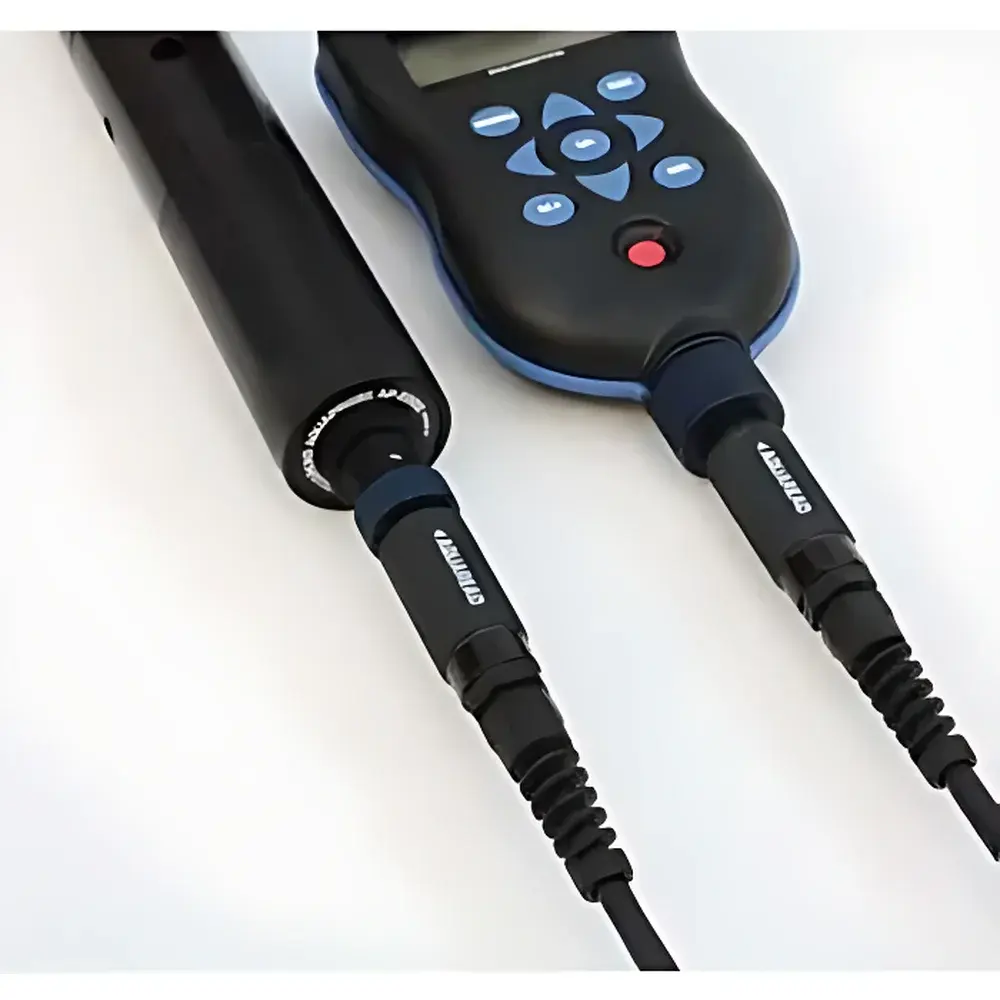
AP-5000 Portable Chlorophyll-a and Phycocyanin Fluorescence Analyzer with Integrated Multiparameter Water Quality Platform
| Origin | UK |
|---|---|
| Manufacturer Type | Authorized Distributor |
| Origin Category | Imported |
| Model | AP-5000 |
| Application | Field-deployable chlorophyll-a quantification and cyanobacterial biomass assessment |
Overview
The AP-5000 is a field-portable, integrated fluorescence-based water quality analyzer engineered for in-situ quantification of chlorophyll-a (Chl-a) and phycocyanin (PC)—a robust proxy for cyanobacterial abundance—in freshwater systems. It operates on the principle of excitation-emission fluorescence spectroscopy: Chl-a is excited at 470 nm and emits at 685 nm, while PC is excited at 590–620 nm and emits at 650 nm. Dual-channel optical detection enables simultaneous, temperature-compensated measurement of both pigments—critical for distinguishing green algae from cyanobacteria-dominated blooms. Unlike laboratory fluorometers requiring filtration and extraction, the AP-5000 delivers real-time, non-destructive measurements directly in water, supporting rapid response to algal bloom dynamics. Its modular architecture integrates optical sensors with electrochemical and physical parameter modules—including temperature, depth, pH, ORP, dissolved oxygen (optical), conductivity, TDS, salinity, and resistivity—each equipped with automatic temperature compensation per ISO 7888 and ASTM D1293 standards.
Key Features
- Simultaneous dual-wavelength fluorescence detection for chlorophyll-a and phycocyanin with built-in thermal drift correction
- Integrated multiparameter platform compliant with EPA Method 445.0 (in vivo Chl-a) and ASTM D6508 (cyanobacteria estimation)
- Ruggedized handheld display (AM-200): IP67-rated enclosure, -20 °C to +70 °C operating range, 12-channel GPS (±10 m accuracy), and 1900-point onboard memory
- Optional Aqualogger data logger: Submersible cylindrical form factor (Ø44 mm × 250 mm), 6-month battery life on two C-cell alkalines, 32,000-point storage, programmable sampling intervals or event-triggered acquisition
- Expandable sensor interface supporting up to one ISE module (NH₄⁺, NO₃⁻, F⁻, Cl⁻, Ca²⁺) and one optical probe (turbidity, hydrocarbon fluorescence, or additional pigment channels)
- RS-485/RS-232 communication protocol with LoggerLink software for configuration, calibration validation, and traceable data export (CSV, XML)
Sample Compatibility & Compliance
The AP-5000 is validated for use in lakes, reservoirs, rivers, drinking water intakes, and wastewater effluents with turbidity ≤ 100 NTU and suspended solids < 200 mg/L. Optical path design minimizes fouling through self-cleaning flow-through geometry and optional wiper integration. All electrochemical sensors meet ISO 10523 (pH), ISO 5814 (DO), and ISO 7888 (conductivity) performance criteria. Fluorescence modules adhere to the European Standard EN 15205:2006 for in vivo chlorophyll-a determination and support GLP-compliant audit trails when paired with LoggerLink’s timestamped metadata (GPS coordinates, atmospheric pressure, operator ID). The system satisfies data integrity requirements under FDA 21 CFR Part 11 when configured with user-access controls and electronic signature capability.
Software & Data Management
LoggerLink v3.2 provides full lifecycle management: sensor calibration (multi-point standardization with NIST-traceable reference solutions), QA/QC flagging (e.g., signal saturation, low signal-to-noise ratio), and automated report generation aligned with USGS NWIS and EU WISE reporting templates. Data files include embedded metadata—geotagged location, ambient pressure (150–1150 mbar, ±1 mbar), instrument serial number, and calibration certificate expiry. Export formats support direct ingestion into LIMS platforms and statistical analysis tools (R, Python pandas). Audit logs record all configuration changes, calibration events, and data exports—enabling full traceability required for regulatory submissions under ISO/IEC 17025-accredited laboratories.
Applications
- Early warning monitoring of cyanobacterial harmful algal blooms (cyanoHABs) in source water protection zones
- Seasonal phytoplankton community structure assessment in eutrophication studies
- Performance verification of UV disinfection and coagulation-flocculation processes targeting algal cells
- Regulatory compliance monitoring under the U.S. EPA Cyanobacteria and Toxins Microcystin Method (Method 544) and EU Bathing Water Directive 2006/7/EC Annex II
- Long-term ecological research requiring high-temporal-resolution pigment time-series (e.g., diel vertical migration studies)
- Field validation of satellite-derived chlorophyll-a products (e.g., Sentinel-3 OLCI, Landsat 9 OLI-2)
FAQ
Does the AP-5000 require sample filtration or extraction prior to measurement?
No. It performs in vivo fluorescence measurements directly in unfiltered water, eliminating preprocessing bias and enabling true real-time assessment.
Can the fluorescence sensors be recalibrated in the field?
Yes—using portable solid-state calibration standards traceable to NIST SRM 1931c (chlorophyll-a) and custom PC reference suspensions; calibration coefficients are stored in sensor EEPROM.
Is the system compatible with third-party telemetry networks?
Yes—via RS-485 Modbus RTU output, it interfaces with SCADA systems, LoRaWAN gateways, and cellular data loggers using standard protocol mapping.
What is the detection limit for chlorophyll-a in natural waters?
Typical limit of quantification is 0.1 µg/L in clear waters; performance degrades above 50 NTU due to inner-filter effects—turbidity correction algorithms are available in LoggerLink.
How is temperature compensation implemented across all parameters?
Each sensor incorporates a platinum RTD (Pt1000) thermistor; compensation follows manufacturer-specific polynomial equations per ISO/IEC 17025 validation reports.
Related Products







