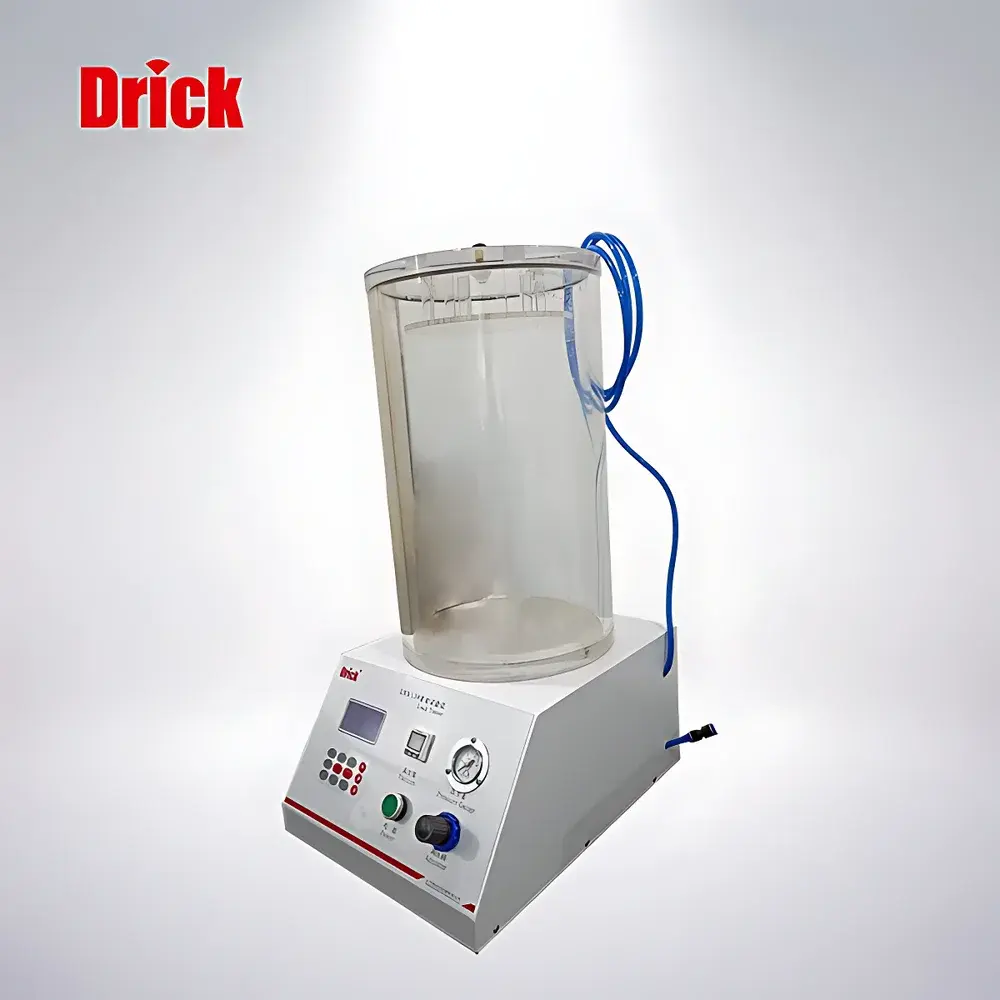
Drick DRK134 Intelligent High-Precision Seal Integrity Tester (Standard Configuration)
| Brand | Drick |
|---|---|
| Origin | Shandong, China |
| Manufacturer Type | Manufacturer |
| Country of Origin | China |
| Model | DRK 134 |
| Vacuum Range | 0 to –90 kPa |
| Vacuum Chamber Dimensions (Std.) | Φ270 mm × 210 mm (H) |
| Accuracy Class | Class 1 |
| Power Supply | AC 220 V ±5%, 50 Hz |
| Net Weight | ~12 kg |
| Air Source Requirement | 0.7 MPa, Φ8 mm polyurethane tubing interface |
| Overall Dimensions | 300 mm (L) × 380 mm (B) × 450 mm (H) |
Overview
The Drick DRK134 Intelligent High-Precision Seal Integrity Tester is an automated vacuum-decay-based instrument engineered for quantitative assessment of package seal integrity across regulated and non-regulated manufacturing environments. It operates on the principle of controlled vacuum application within a sealed test chamber, followed by real-time monitoring of pressure decay kinetics—enabling detection of leaks ranging from gross failures to sub-micron-level defects in flexible, semi-rigid, and rigid packaging systems. Designed in strict conformance with GB/T 15171 and ASTM D3078 methodologies, the DRK134 delivers repeatable, traceable, and auditable results suitable for quality control laboratories in food, pharmaceutical, and personal care industries. Its microprocessor-controlled architecture ensures stable vacuum generation, automatic pressure compensation, and precise dwell-time management—eliminating operator-dependent variability inherent in manual leak-checking methods.
Key Features
- Microcomputer-controlled vacuum generation with digital presetting of target vacuum level (0 to –90 kPa) and hold duration
- High-contrast LCD display with intuitive PVC membrane keypad interface for real-time parameter monitoring and adjustment
- Imported pneumatic components ensuring long-term reliability and consistent actuation performance
- Auto-compensation mode maintains constant vacuum pressure during test duration via closed-loop feedback control
- Automated test termination and reverse-air purge cycle for rapid sample unloading and chamber reset
- Class 1 accuracy per national metrological standards, verified through internal calibration routines and external traceable verification protocols
- Modular vacuum chamber design: standard Φ270 mm × 210 mm (H); optional larger configurations available (Φ360 × 585 mm; Φ460 × 330 mm) for oversized or multi-unit testing
Sample Compatibility & Compliance
The DRK134 accommodates diverse packaging geometries and materials without requiring fixture customization. It validates seal integrity of pouches, lidded trays, blister cards, vials, ampoules, pre-filled syringes, BFS/FFS containers, and rigid bottles—including those containing CO₂-saturated contents such as carbonated beverages or modified-atmosphere-packaged (MAP) foods. In pharmaceutical applications, it supports testing under Good Manufacturing Practice (GMP) and ALCOA+ data integrity principles when integrated with compliant documentation workflows. While not inherently 21 CFR Part 11–compliant, its deterministic test logic, timestamped event logging, and non-editable result output support GLP/GMP audit readiness when deployed with appropriate procedural controls and system validation documentation.
Software & Data Management
The DRK134 operates as a standalone hardware platform with embedded firmware—no external PC or proprietary software required for basic operation. All test parameters, vacuum profiles, and pass/fail outcomes are stored internally with time/date stamps. Data export is supported via USB interface (optional accessory) for CSV-formatted reports compatible with LIMS or QMS platforms. For regulated users, the device can be incorporated into validated computerized systems where electronic records are generated under defined SOPs, including user access control, audit trail review, and periodic backup procedures. Firmware updates are performed via secure USB loading and include version-locking and checksum verification to ensure configuration integrity.
Applications
- Seal strength verification of heat-sealed, adhesive-bonded, and ultrasonically welded packaging
- Leak detection in low-headspace and high-barrier pharmaceutical unit-dose packaging (e.g., strip packs, Alu-Alu blisters)
- Integrity screening of sterile barrier systems per ISO 11607-2 requirements
- Quality release testing of food-grade pouches, stand-up bags, retort pouches, and laminated sachets
- Validation of closure integrity for PET, HDPE, and glass containers used in nutraceutical and OTC product lines
- Process capability studies during packaging line qualification (IQ/OQ/PQ) and routine preventive maintenance checks
FAQ
What vacuum source is required for operation?
A clean, oil-free compressed air supply at 0.7 MPa (100 psi) is mandatory. Users must provide their own air compressor with appropriate filtration (coalescing + desiccant) and pressure regulation. The instrument accepts Φ8 mm polyurethane tubing via standardized push-to-connect fittings.
Can the DRK134 detect leaks smaller than 50 µm?
Detection sensitivity depends on package volume, material permeability, test duration, and vacuum stability. Under optimized conditions (e.g., small-volume rigid containers, 60-second dwell time), the system reliably identifies leaks ≥30 µm. For sub-30 µm detection, complementary methods such as helium mass spectrometry or tracer-gas vacuum decay are recommended.
Is calibration traceable to national standards?
Yes—the built-in pressure transducer is factory-calibrated against NIM (National Institute of Metrology, China)-traceable reference standards. Users receive a calibration certificate with each unit. Annual recalibration is advised and can be performed in-house using certified deadweight testers or via accredited third-party labs.
Does the DRK134 meet FDA or EU Annex 11 requirements?
The instrument itself is a Class I electrical device and does not embed electronic records or user authentication. Compliance with FDA 21 CFR Part 11 or EU Annex 11 is achieved at the system level—through documented SOPs, procedural controls, and integration into validated laboratory information management systems (LIMS).