
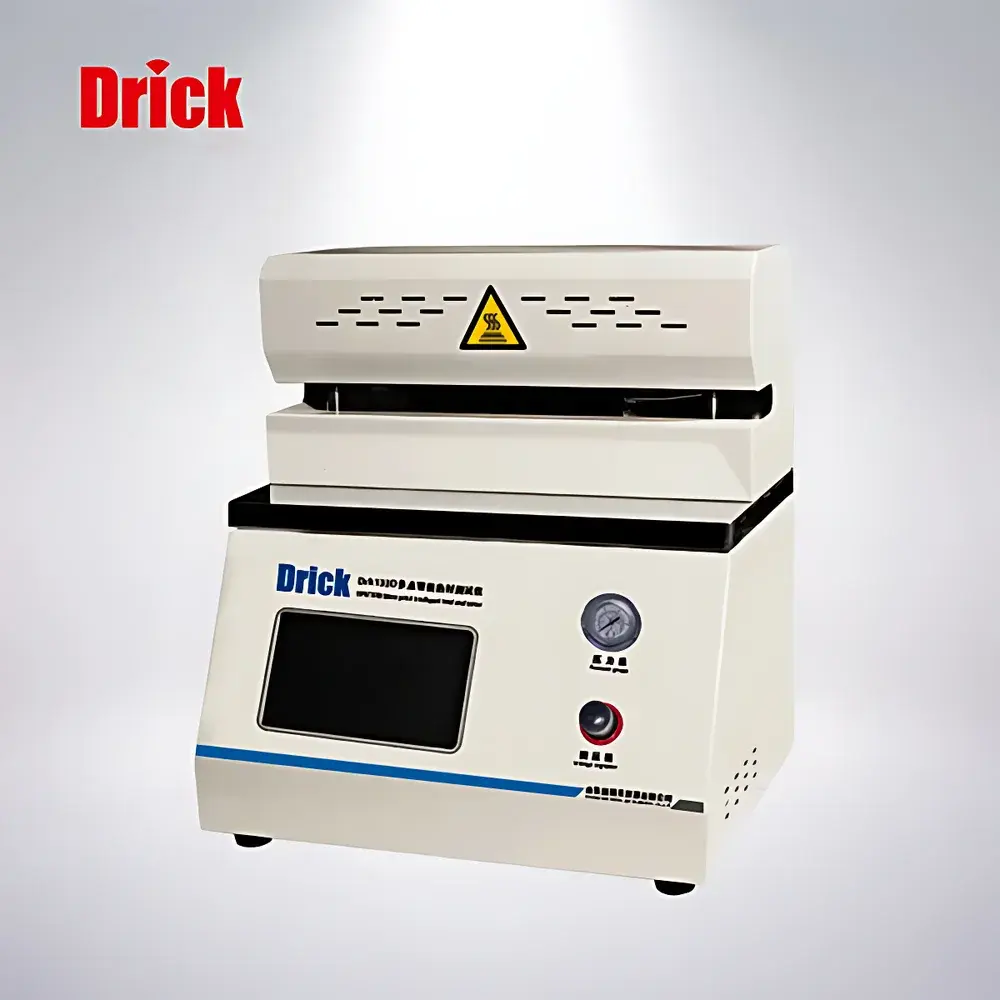
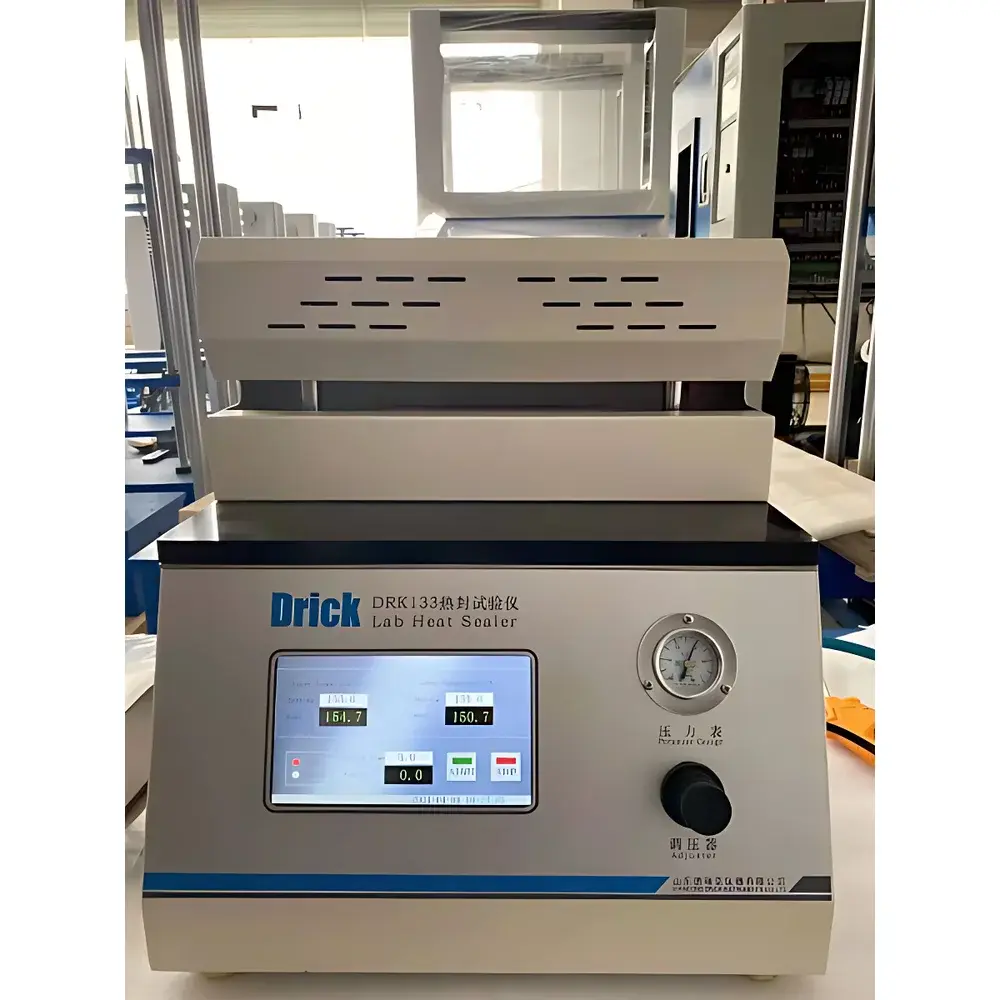
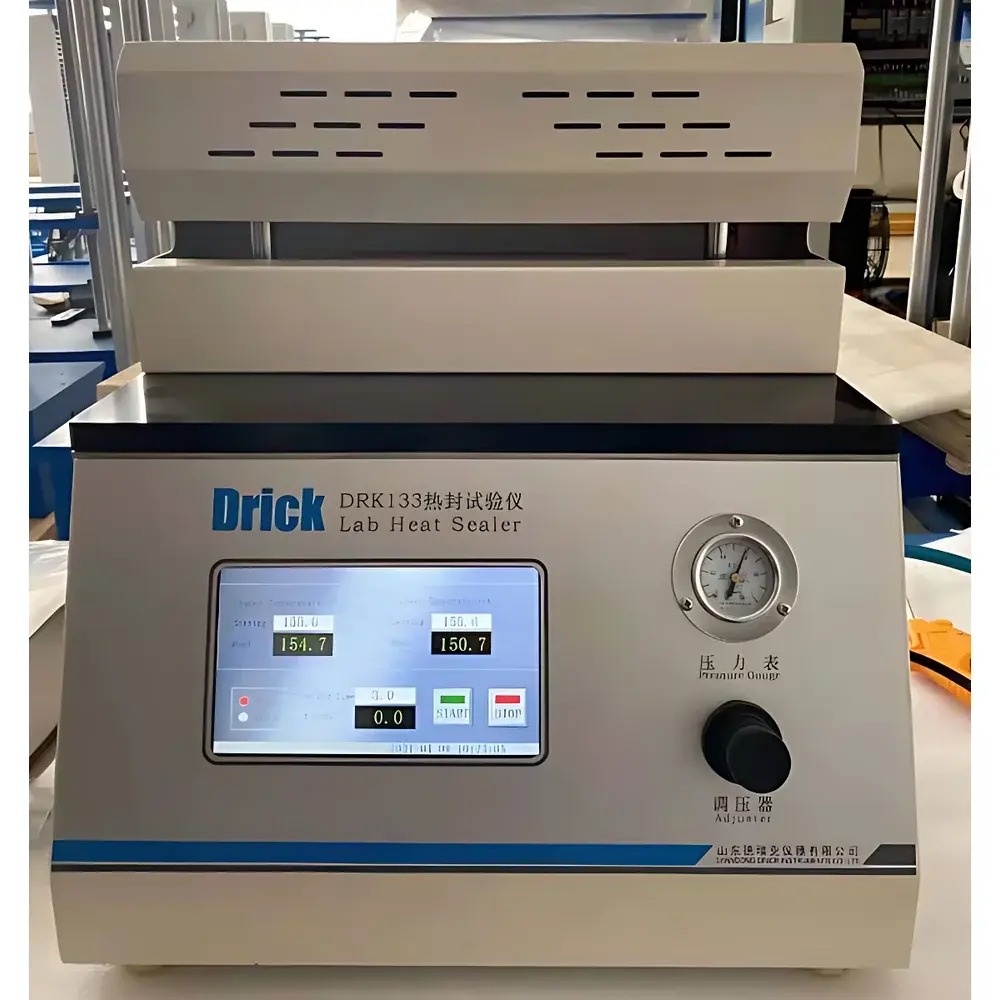
Drick DRK133 QB/T 2358 Heat Seal Tester for Flexible Packaging Laminates
| Brand | Drick |
|---|---|
| Origin | Shandong, China |
| Manufacturer Type | Direct Manufacturer |
| Country of Origin | China |
| Model | DRK133 |
| Heat Seal Temperature Range | Ambient to 300 °C |
| Temperature Control Accuracy | ±1 °C |
| Seal Time Range | 0.1–999.9 s |
| Seal Pressure Range | 0.05–0.7 MPa |
| Seal Jaw Dimensions | 180 mm × 10 mm (customizable) |
| Pneumatic Actuation (Air Supply Required | 0.5–0.7 MPa, Ø8 mm PU Tube) |
| Power Supply | AC 220 V ±5%, 50 Hz |
| Dimensions | 400 × 280 × 380 mm (L×W×H) |
| Weight | ~40 kg |
Overview
The Drick DRK133 QB/T 2358 Heat Seal Tester is an engineered laboratory instrument designed for precise, repeatable thermal sealing evaluation of flexible packaging materials. It operates on the principle of controlled heat-and-pressure sealing—applying calibrated thermal energy and pneumatic force across parallel sealing jaws to replicate industrial heat seal processes under standardized conditions. This method enables quantitative assessment of seal integrity, onset temperature, and optimal sealing parameters for multilayer laminates used in food, pharmaceutical, medical device, and consumer goods packaging. The system complies with key international and national standards including QB/T 2358 (China), ASTM F2029 (Standard Test Method for Measuring Heat Seal Strength of Thermoplastic Films), and YBB 00122003 (Chinese Pharmacopoeia packaging standard for sterile barrier systems), supporting regulatory documentation and process validation in GLP- and GMP-aligned environments.
Key Features
- Microprocessor-based control with intuitive 7-inch capacitive touchscreen interface and hierarchical menu navigation—designed for rapid method setup and operator consistency.
- Dual independent PID temperature control circuits for upper and lower sealing jaws, ensuring uniform thermal distribution and minimizing inter-jaw temperature drift during extended testing cycles.
- Integrated dual-cylinder pneumatic actuation with synchronized downstroke motion—provides stable, linear pressure application across the full jaw width, eliminating edge bias or uneven compression.
- Modular sealing jaw design: Standard 180 mm × 10 mm smooth-face configuration; optional custom geometries (e.g., patterned, stepped, or narrow-width jaws) available for specialized applications such as tube sealing or narrow-track pouches.
- Aluminum-encapsulated heating elements with fast-disconnect electrical terminals—enabling rapid maintenance, calibration verification, and field-replacement without tooling or disassembly.
- Dual activation modes: Manual start via touchscreen confirmation and foot-pedal initiation—supporting hands-free operation during high-throughput lab workflows while maintaining operator safety compliance.
- Thermal insulation and recessed jaw housing with auto-locking guard interlock—meeting IEC 61000-6-2/6-4 EMC and ISO 13857 safety clearance requirements to prevent accidental contact during active heating phases.
Sample Compatibility & Compliance
The DRK133 accommodates a broad spectrum of thermoplastic and composite film substrates, including but not limited to: cast and blown polyethylene (PE), polypropylene (PP), polyester (PET), nylon (PA), metallized films (e.g., VMPET, VMCPP), aluminum foil laminates, paper-plastic composites, and coextruded structures. Its flat, parallel-jaw architecture ensures consistent contact pressure across heterogeneous surfaces—critical for evaluating seal performance in asymmetrical or multi-layer architectures common in retortable, barrier, and child-resistant packaging. All operational parameters (temperature ramp rate, dwell time, pressure profile) are logged with timestamp and user ID per test cycle, enabling full traceability in accordance with FDA 21 CFR Part 11 electronic record requirements when paired with validated data management protocols.
Software & Data Management
The embedded firmware supports configurable test methods with up to 20 saved profiles—each storing target temperature, pressure setpoint, dwell duration, cooling delay, and pass/fail thresholds. Real-time thermal and pressure feedback is displayed graphically during each seal event, allowing immediate visual verification of process stability. Raw data export is supported via USB 2.0 to CSV format, compatible with LIMS integration and statistical process control (SPC) platforms. Audit trail functionality records all parameter changes, user logins, and calibration events—meeting GLP audit readiness criteria for quality assurance laboratories conducting packaging validation per ISO 11607-2 and ISTA 3A.
Applications
- Determination of hot tack strength and seal initiation temperature (SIT) for film development and supplier qualification.
- Optimization of packaging line settings—including dwell time, temperature gradient, and pressure mapping—for vertical form-fill-seal (VFFS) and horizontal form-fill-seal (HFFS) machinery.
- Accelerated aging studies correlating seal integrity loss with thermal degradation under accelerated storage conditions.
- Comparative analysis of seal performance between alternative resins, adhesive systems, or surface treatments (e.g., corona vs. plasma treatment).
- Validation of sterile barrier integrity for medical device pouches per ISO 11607-1 Annex B and AAMI ST77.
FAQ
What standards does the DRK133 explicitly support?
It is configured and verified for QB/T 2358, ASTM F2029, and YBB 00122003. Custom calibration certificates and protocol templates for additional standards (e.g., ISO 9001 clause 7.5.2, ASTM F88) can be provided upon request.
Is compressed air supply included with the instrument?
No—users must provide a clean, dry, oil-free compressed air source delivering 0.5–0.7 MPa through an Ø8 mm polyurethane tube. A desiccant filter and pressure regulator are recommended upstream.
Can the sealing jaw width be modified after purchase?
Yes—Drick offers retrofit kits for alternate jaw widths (e.g., 5 mm, 30 mm, 80 mm) and surface finishes (e.g., embossed, Teflon-coated). Mechanical adaptation requires factory service or certified technician installation.
How is temperature uniformity across the jaw verified?
Each unit undergoes thermal mapping per ASTM E2251 using NIST-traceable infrared thermography and contact thermocouple arrays. A full mapping report is supplied with calibration documentation.
Does the system support automated pass/fail decision logic?
Yes—user-defined upper/lower limits for seal strength (when integrated with optional tensile tester), visual inspection criteria, or thermal deviation thresholds can trigger automatic result classification and report generation.




