
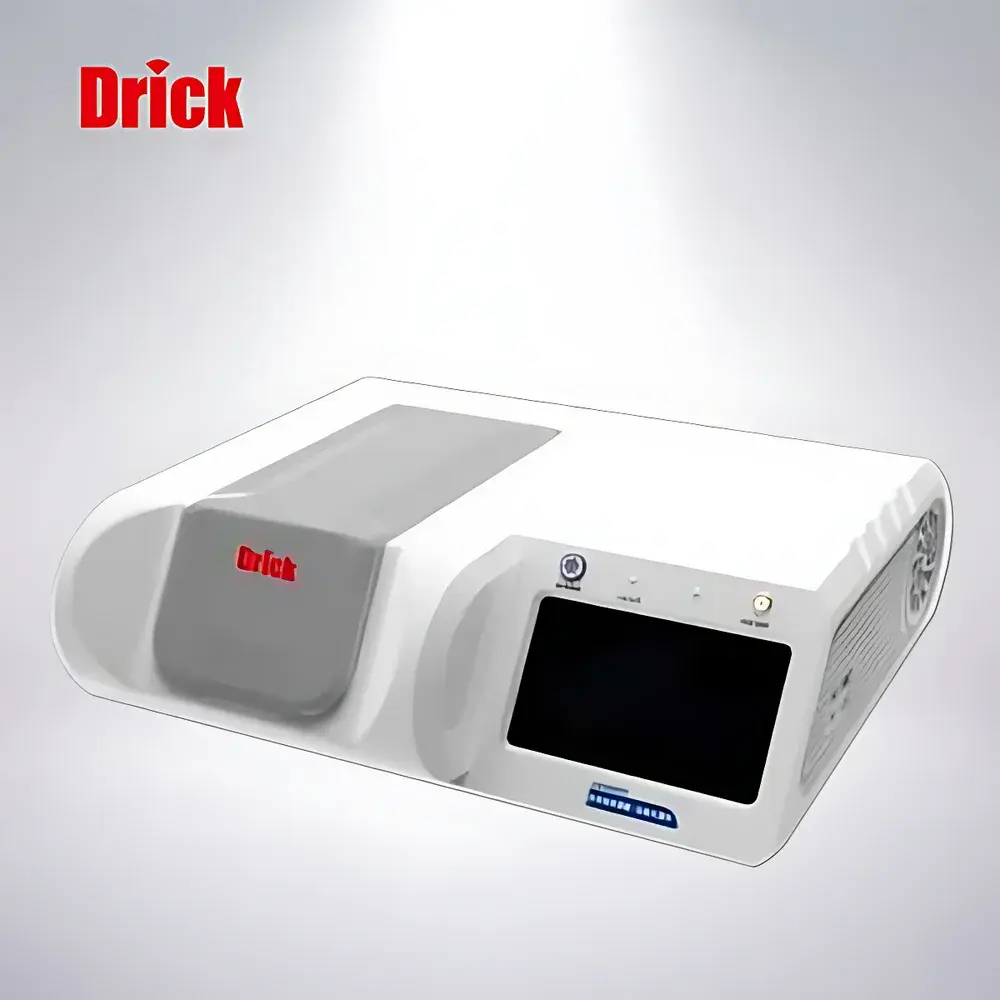
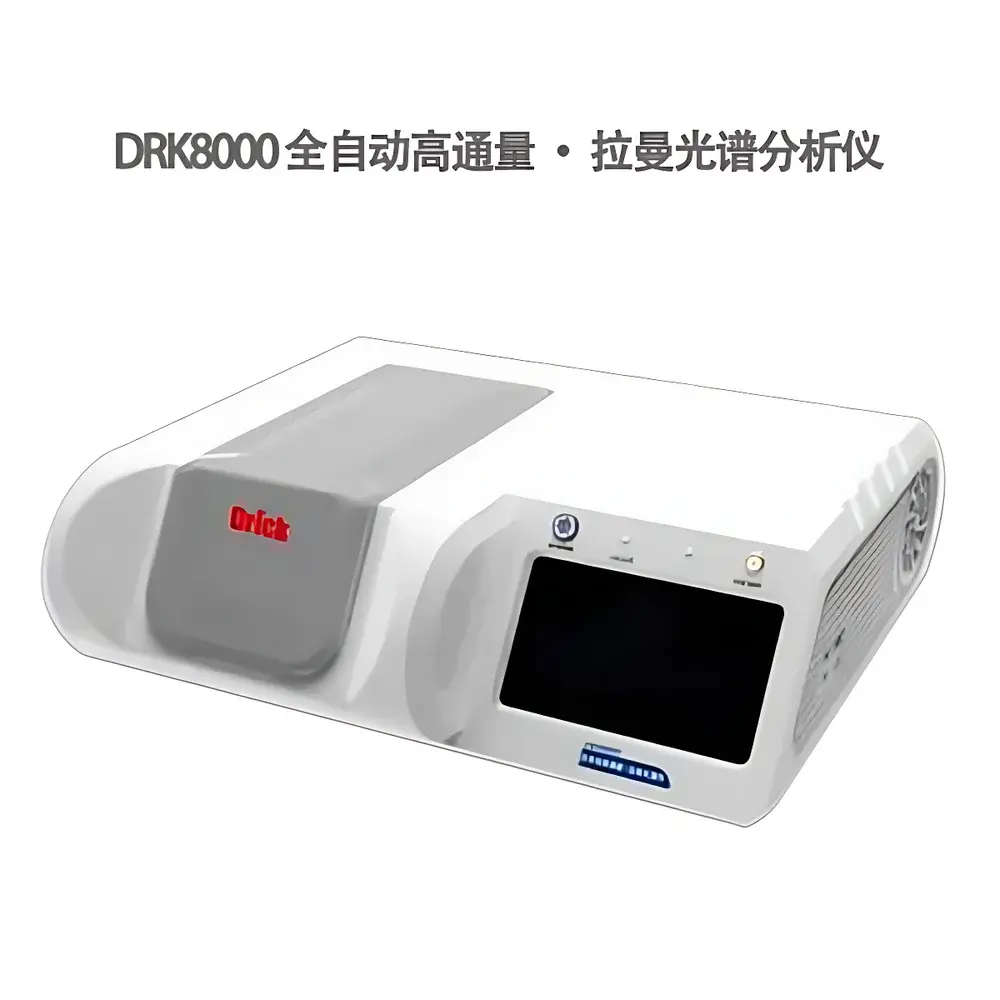
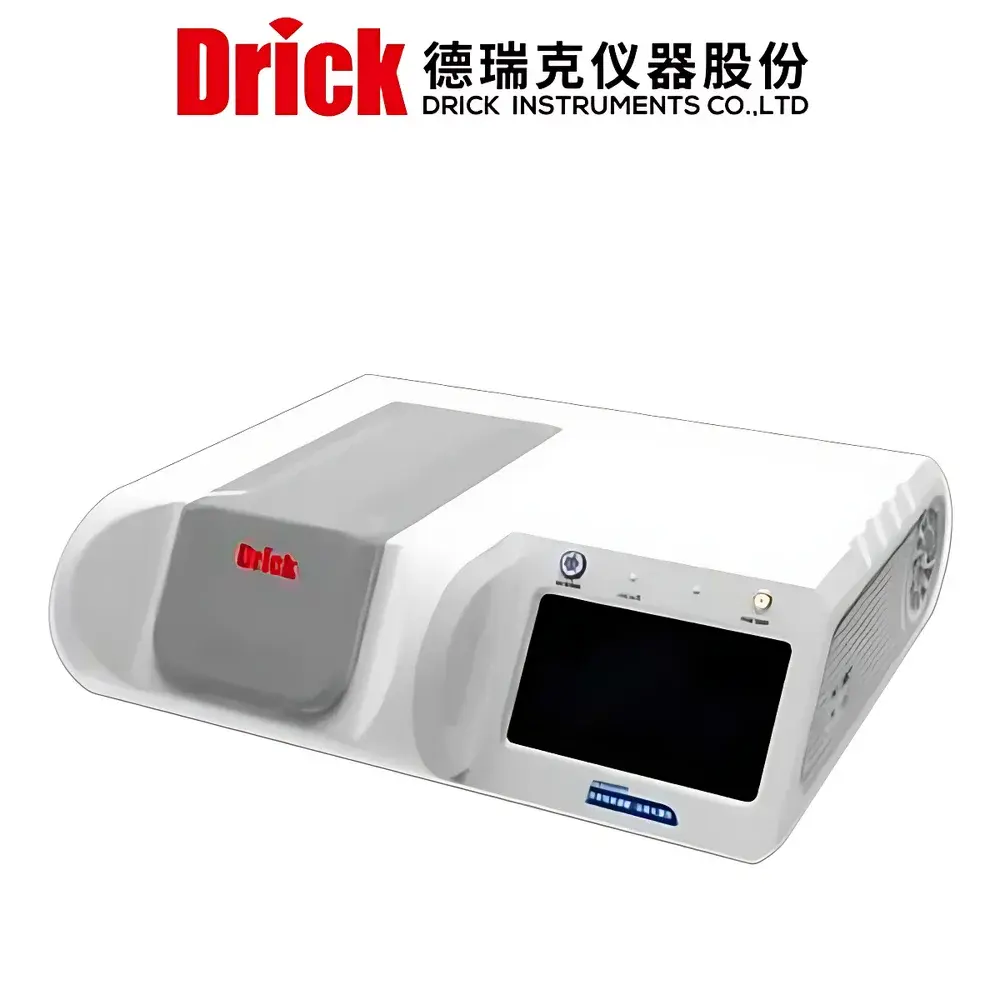
Drick DRK8000 Fully Automated High-Throughput Raman Spectrometer
| Brand | Drick |
|---|---|
| Origin | Shandong, China |
| Manufacturer Type | OEM Manufacturer |
| Model | DRK8000 |
| Excitation Wavelengths | 532 nm / 633 nm / 785 nm / 830 nm / 1064 nm (single or dual) |
| Laser Power | Up to 500 mW |
| Spectral Range | 200–4200 cm⁻¹ (configurable per module) |
| Spectral Resolution | 3–12 cm⁻¹ (dependent on excitation & grating) |
| Detector | Back-illuminated CCD (532/633/785/830 nm) or thermoelectrically cooled InGaAs array (1064 nm) |
| Cooling | –10 °C (CCD), –20 °C (InGaAs) |
| Integration Time | 1 ms – 120 s |
| Sample Capacity | 100-position motorized tray |
| Positioning Accuracy | 0.625 µm |
| S/N Ratio | >1500:1 (532 nm), >3000:1 (633/785/830/1064 nm) |
| Spectral Stability | σ/μ < 0.5% over 8 h (COT) |
| Wavenumber Shift Stability | ≤1 cm⁻¹ across 10–40 °C |
| Intensity Variation | <±5% over 5–40 °C |
| Operating System | Custom Android-based embedded OS with audit-trail-ready UI |
| Connectivity | USB 2.0, Wi-Fi, optional 4G LTE |
| Dimensions | 800 × 500 × 300 mm |
| Weight | 25–27 kg |
Overview
The Drick DRK8000 Fully Automated High-Throughput Raman Spectrometer is an engineered solution for laboratories requiring unattended, reproducible molecular fingerprinting across large sample cohorts. Based on elastic inelastic light scattering (Raman effect), the system delivers vibrational spectral signatures with high specificity for chemical identification, polymorph characterization, stress/strain analysis, and reaction monitoring. Unlike conventional benchtop Raman systems requiring manual stage positioning and iterative acquisition, the DRK8000 integrates precision motion control, intelligent sample presence detection, and multi-wavelength laser excitation into a single compact platform—enabling walk-away operation for up to 100 samples per run. Its architecture supports both top-down (e.g., SERS substrate interrogation) and bottom-up (e.g., vial-based liquid/solid analysis) probe geometries, accommodating diverse sample formats without optical realignment.
Key Features
- Fully automated 100-position sample handling with motorized XY stage and sub-micron positioning accuracy (0.625 µm)
- Configurable single- or dual-laser excitation: 532 nm, 633 nm, 785 nm, 830 nm, and/or 1064 nm—optimized for fluorescence suppression, penetration depth, and detector quantum efficiency
- High-sensitivity detection architecture: back-illuminated, deep-cooled CCD (–10 °C) for visible/NIR wavelengths; thermoelectrically cooled InGaAs array (–20 °C) for 1064 nm with extended NIR response (900–1700 nm)
- Real-time auto-detection of sample presence—skips empty wells to prevent unnecessary exposure and conserve instrument lifetime
- Embedded Android-based operating system with touchscreen interface, barcode/QR code reader, thermal printer, and network stack (Wi-Fi standard; 4G LTE optional)
- Robust thermal and spectral stability: wavenumber drift ≤1 cm⁻¹ over 10–40 °C ambient; intensity variation <±5%; spectral reproducibility σ/μ < 0.5% over 8-hour continuous operation (COT)
- Flexible integration time (1 ms–120 s) and dynamic range (up to 80,000:1) supporting low-concentration analytes and highly scattering matrices
Sample Compatibility & Compliance
The DRK8000 accommodates standard 96-well microplates, custom trays, vials (1.5–20 mL), SERS chips, solid pellets, and thin-film substrates. Its dual-probe orientation design enables direct measurement of surface-enhanced Raman scattering (SERS) substrates without reconfiguration, while bottom-illumination mode ensures compatibility with opaque or colored containers. All hardware and firmware comply with IEC 61000-6-3 (EMC emissions) and IEC 61010-1 (safety for laboratory equipment). The embedded OS supports user-level access control, electronic signature capture, and configurable audit trails—facilitating alignment with GLP, GMP, and FDA 21 CFR Part 11 requirements when deployed in regulated environments. Data export adheres to ASTM E1382-22 (standard guide for Raman spectral data exchange) and supports .csv, .spa, and .jdx formats.
Software & Data Management
The DRK8000 runs a purpose-built Android application with intuitive workflow navigation—designed for minimal training requirements across multidisciplinary teams. Predefined method templates include quantitative calibration (internal/external standard), spectral subtraction, baseline correction (asymmetric least squares), peak fitting (Voigt/Gaussian), and multivariate analysis (PCA, PLS-DA). Raw spectra are timestamped, geotagged (if enabled), and linked to sample IDs via barcode scan. All acquisitions are stored locally with optional cloud synchronization (via HTTPS API) or direct transmission to LIMS via configurable REST endpoints. Audit logs record operator ID, method parameters, instrument state (laser power, integration time, grating position), and environmental metadata (ambient temperature/humidity)—retained for ≥180 days unless purged per institutional policy.
Applications
- Academic & Government Research: High-throughput screening of catalyst libraries, MOFs, perovskites, and 2D materials under controlled atmospheres
- Pharmaceutical Development: Polymorph mapping, counterfeit drug detection, API-excipient interaction studies, and lyophilized product stability assessment
- Biomedical & Diagnostics: Label-free identification of pathogenic bacteria, exosome characterization, tissue margin analysis during surgery, and immunoassay validation
- Forensic Science: Non-destructive analysis of trace evidence (paint chips, fibers, explosives residues, illicit substances) with minimal sample prep
- Food & Agriculture: Adulterant detection (melamine, Sudan dyes), pesticide residue screening, authenticity verification (olive oil, honey, wine), and grain quality grading
- Materials Science: Strain distribution mapping in semiconductors, carbon nanotube chirality assignment, graphene layer counting, and battery electrode degradation monitoring
FAQ
Does the DRK8000 support Good Laboratory Practice (GLP) documentation requirements?
Yes—the system records full acquisition metadata, operator actions, and configuration changes in tamper-resistant audit logs. Exported reports include digital signatures and can be configured to meet ALCOA+ principles (Attributable, Legible, Contemporaneous, Original, Accurate, Complete, Consistent, Enduring, Available).
Can the DRK8000 perform simultaneous dual-wavelength acquisition?
No—dual-wavelength configurations operate sequentially, not concurrently. Each laser is activated independently with dedicated grating and detector optimization to ensure maximal sensitivity and resolution per channel.
What is the minimum detectable concentration for common analytes using SERS mode?
Detection limits depend on substrate enhancement factor and analyte Raman cross-section. Under optimized conditions with commercial Au/Ag nanostructures, sub-nanomolar concentrations of rhodamine 6G, melamine, or thiophene have been routinely achieved.
Is remote monitoring and control supported?
Yes—via integrated Wi-Fi or optional 4G LTE, users may initiate runs, monitor progress, receive completion alerts, and download spectra through a secure web dashboard accessible from any modern browser.
How is calibration verified and maintained?
The system includes onboard NIST-traceable silicon (520.7 cm⁻¹) and cyclohexane (2847 cm⁻¹, 2925 cm⁻¹) reference standards. Automated wavelength calibration is triggered before each batch or at user-defined intervals; results are logged and exportable for QA review.
Related Products





