
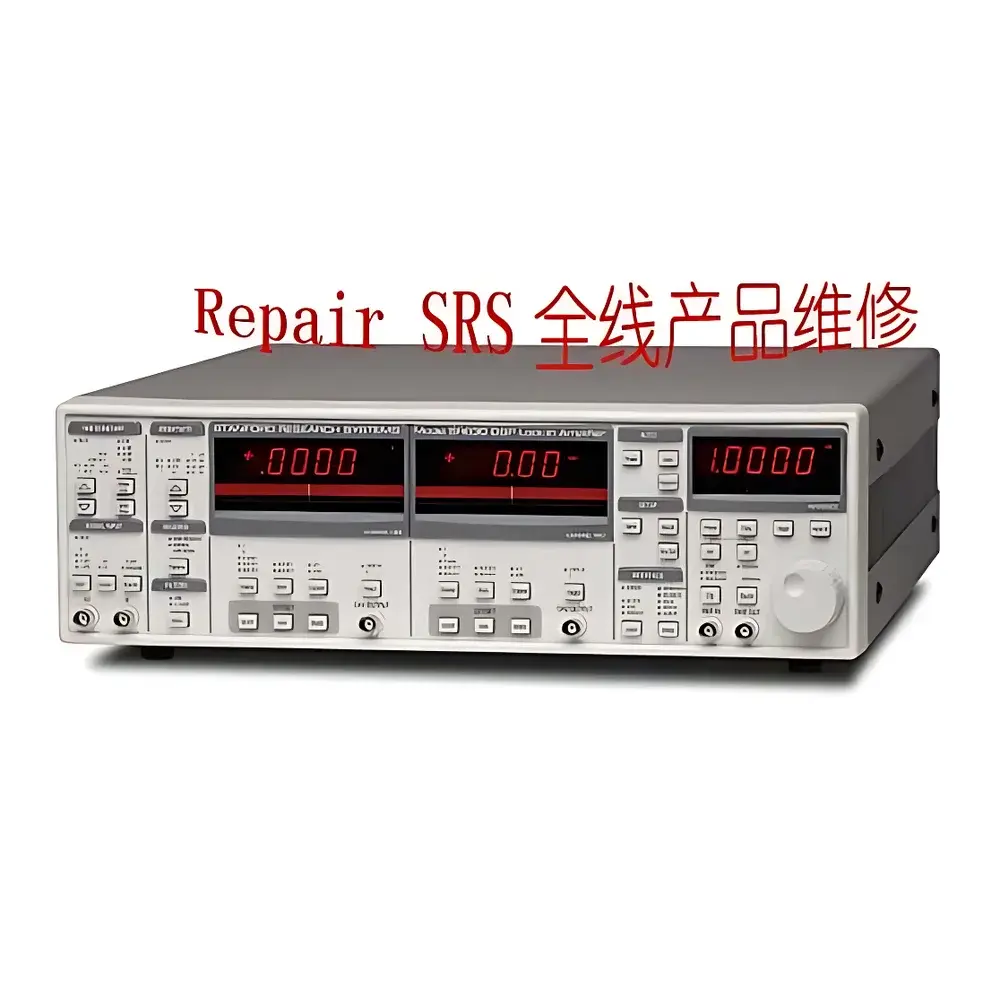
Stanford Research Systems SR560 Low-Noise Voltage Preamplifier
| Brand | SRS/Stanford Research Systems |
|---|---|
| Origin | USA |
| Manufacturer Type | Authorized Service Partner |
| Product Origin | Imported |
| Model | SR560 |
| Price Range | USD 0 – 7,200 |
Overview
The Stanford Research Systems SR560 Low-Noise Voltage Preamplifier is a high-performance, DC-coupled instrumentation amplifier engineered for precision signal conditioning in demanding low-level measurement applications. Designed using discrete JFET input stages and optimized feedback topologies, the SR560 delivers exceptional voltage gain stability, ultra-low input noise (≤ 5 nV/√Hz at 1 kHz), and wide dynamic range across its full 1 mV/V to 500 V/V gain range. Its architecture adheres to classical transimpedance and differential amplification principles, making it ideal for use with photodiodes, piezoelectric sensors, thermocouples, and other low-output transducers where signal integrity, common-mode rejection (> 100 dB at 60 Hz), and minimal drift are critical. The unit operates within a temperature-stabilized enclosure to ensure long-term baseline stability and is calibrated traceable to NIST standards.
Key Features
- Gain range of 1–500,000 (0–114 dB) in 12 calibrated steps with <±0.1% gain accuracy
- Input-referred voltage noise density as low as 5 nV/√Hz (typical at 1 kHz), with <1 µV p-p 0.1–10 Hz noise
- DC-coupled operation with bandwidth from DC to 1 MHz (–3 dB), switchable low-pass filtering (1 Hz–1 MHz)
- High CMRR (>100 dB at 60 Hz) and input impedance >1012 Ω || 2 pF
- Front-panel and rear-panel BNC inputs/outputs; fully isolated output stage with ground-lift capability
- Internal 12 V and ±15 V regulated supplies for optional external sensor biasing
- Compliant with IEC 61000-4 electromagnetic immunity standards; CE-marked for industrial environments
Sample Compatibility & Compliance
The SR560 interfaces seamlessly with a broad spectrum of passive and active optical and physical sensors—including photovoltaic and photoconductive detectors, strain gauge bridges, capacitive displacement transducers, and electrochemical cells—without requiring external signal conditioning. Its low-noise performance enables reliable detection of sub-microvolt signals in photon counting setups, interferometric metrology, and scanning probe microscopy preamplification stages. All units undergo functional verification per SRS Factory Test Procedure F-560-REV4 and conform to ISO/IEC 17025 requirements when serviced by accredited calibration laboratories. Repair and recalibration services comply with GLP documentation practices and support FDA 21 CFR Part 11 audit trails upon request.
Software & Data Management
While the SR560 is an analog front-end device without embedded firmware or digital control, its operational parameters are fully compatible with industry-standard data acquisition systems (e.g., National Instruments DAQmx, Keysight PathWave, MATLAB Data Acquisition Toolbox). Configuration and monitoring can be performed via GPIB (IEEE-488.2) or RS-232 interfaces using SCPI command sets defined in the SRS SR560 Programming Manual Rev. G. Service records—including component-level diagnostics, thermal stress test logs, and post-calibration verification reports—are archived in secure cloud-based service management platforms compliant with ISO 27001 information security controls.
Applications
- Low-light optical detection in Raman spectroscopy and fluorescence lifetime measurements
- Signal amplification in cryogenic sensor arrays and superconducting quantum interference device (SQUID) readout chains
- Dynamic strain analysis in aerospace structural health monitoring systems
- Electrophysiological signal acquisition in patch-clamp electrophysiology rigs
- Reference-grade amplification in metrology labs performing primary standard comparisons
- Integration into automated test equipment (ATE) platforms for semiconductor parametric testing
FAQ
Does the SR560 require periodic recalibration?
Yes. For metrological traceability and optimal performance, annual recalibration is recommended—especially when used in ISO/IEC 17025-accredited laboratories or regulated environments governed by FDA or EU MDR requirements.
Can the SR560 be repaired under warranty if purchased through a third-party distributor?
Warranty coverage depends on the original sales channel and proof of purchase. SRS-authorized service partners honor valid warranties and provide extended service agreements with documented failure analysis and component-level reporting.
Is remote diagnostics supported during repair evaluation?
Yes. Diagnostic sessions via secure remote desktop (with customer consent) allow real-time oscilloscope capture, gain/noise profiling, and power supply rail validation prior to physical shipment.
What documentation is provided after service completion?
Each serviced unit ships with a Certificate of Calibration (traceable to NIST), full test report (including pre- and post-service noise spectra, gain linearity plots, and CMRR verification), and updated firmware revision log if applicable.
Are obsolete SR560 units still supported for component-level repair?
Yes. SRS maintains legacy parts inventory for all models manufactured since 1992, and our engineering team performs schematic-level reverse engineering for discontinued subassemblies to ensure long-term maintainability.





