
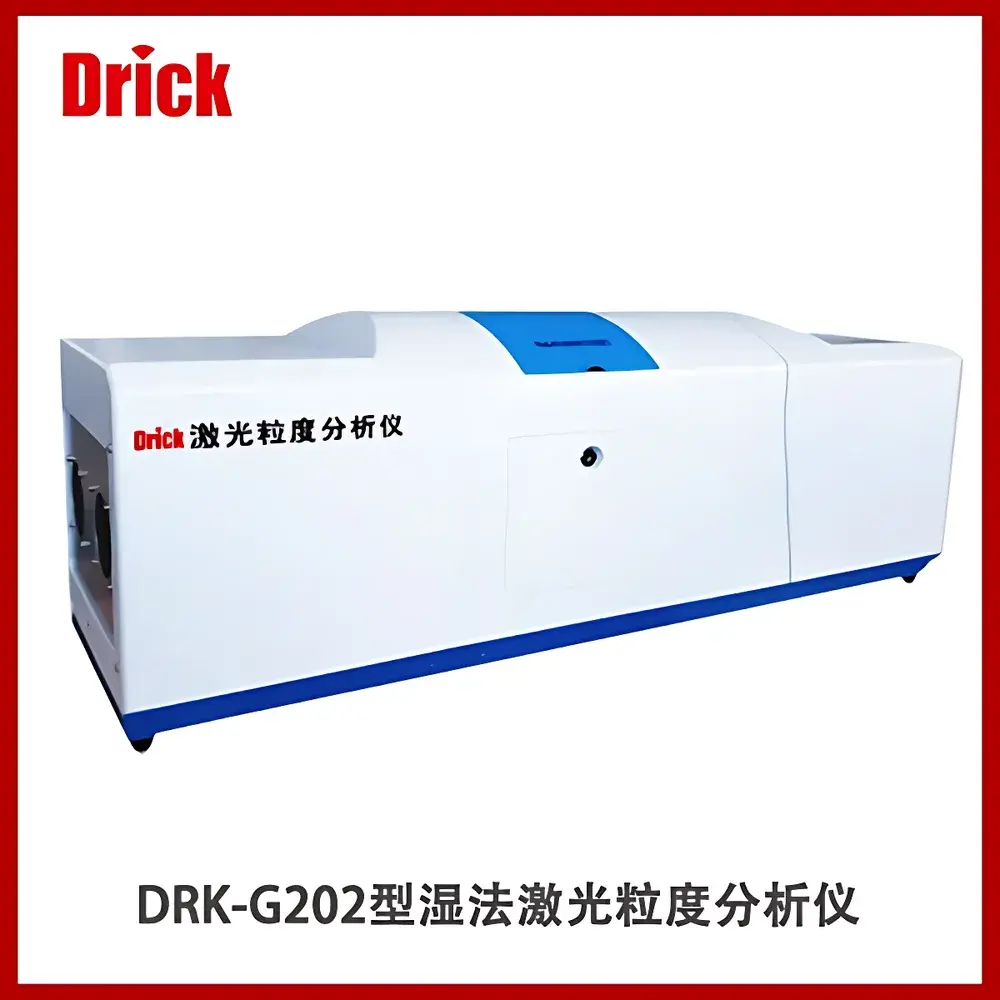
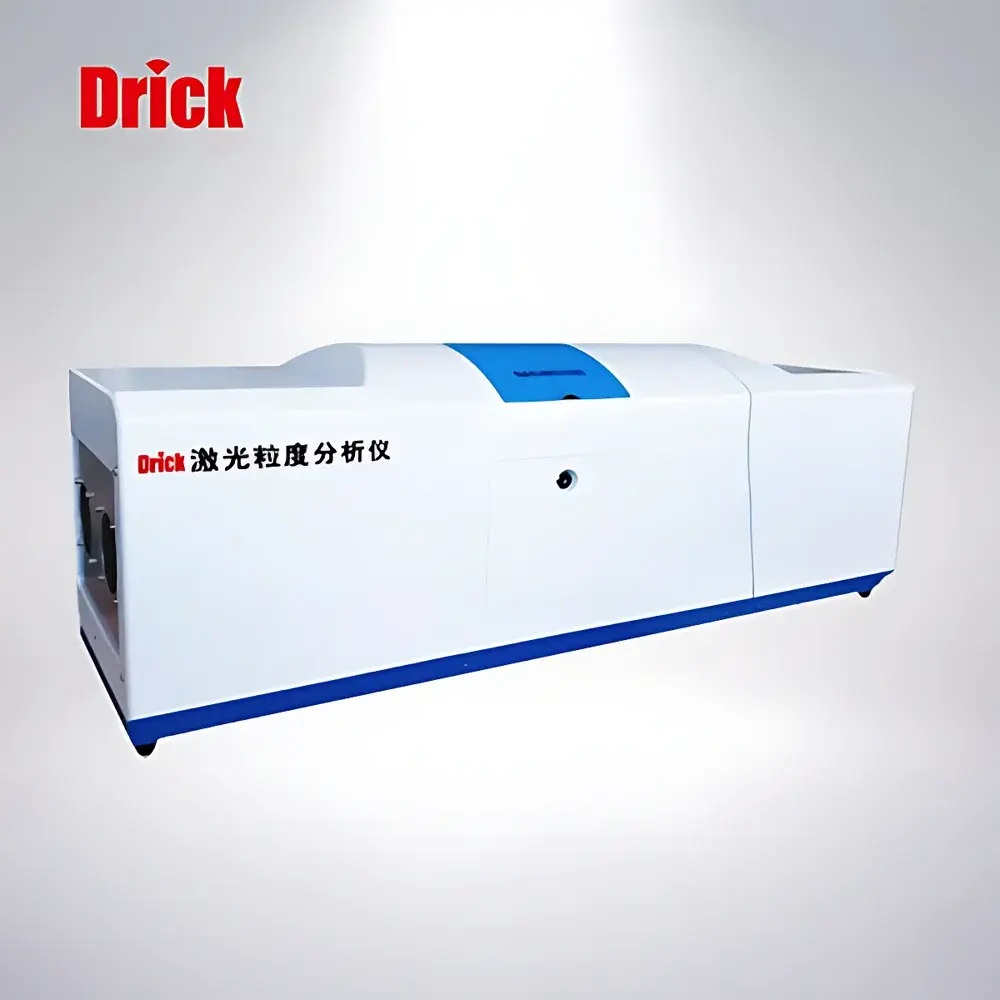
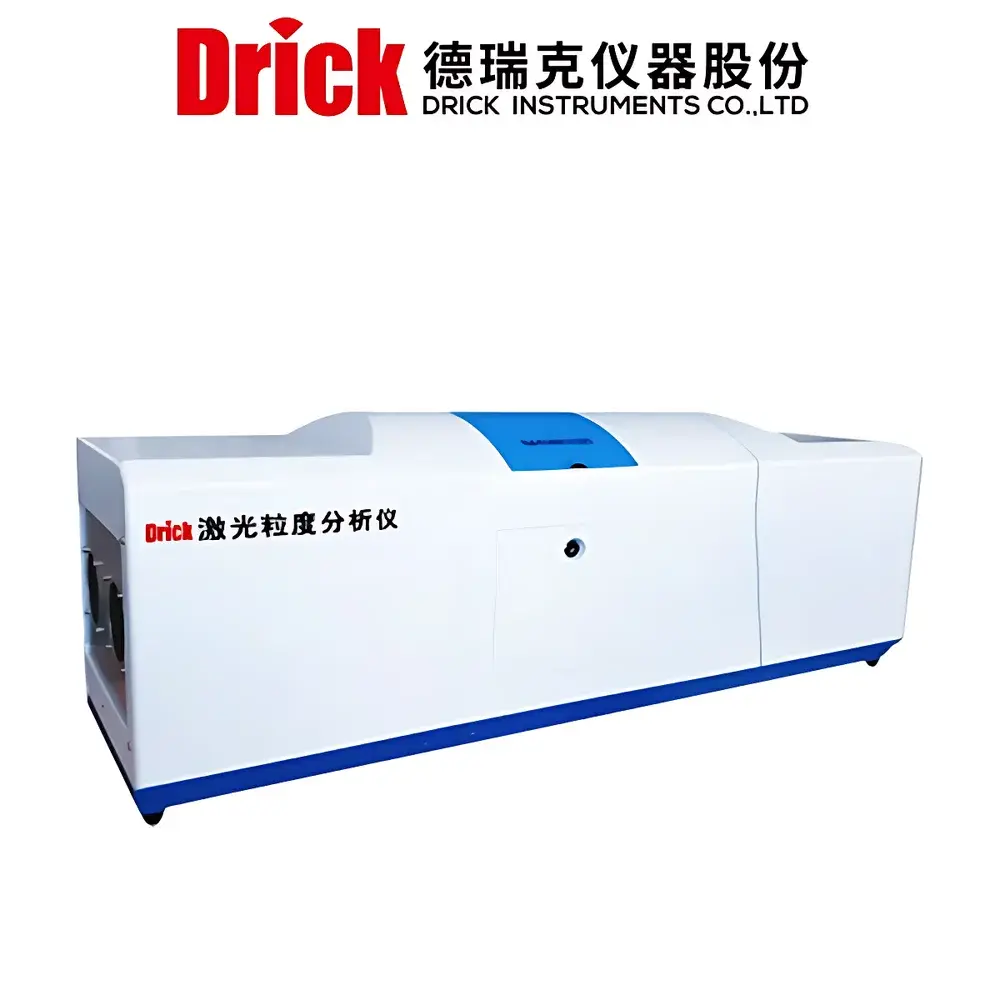
Drick DRK-G202 Fully Automated Wet-Dispersion Laser Particle Size Analyzer
| Brand | Drick |
|---|---|
| Origin | Shandong, China |
| Manufacturer Type | Direct Manufacturer |
| Product Origin | Domestic (China) |
| Model | DRK-G202 |
| Dispersion Method | Wet Dispersion |
| Instrument Type | Laboratory Laser Particle Size Analyzer |
| Measurement Range | 0.1–800 µm (Full-range, No Sub-ranges) |
| Repeatability | ≤1% RSD (D50, certified NIST-traceable standard reference material) |
Overview
The Drick DRK-G202 Fully Automated Wet-Dispersion Laser Particle Size Analyzer is an ISO 13320-compliant instrument engineered for high-precision particle size distribution (PSD) analysis of suspensions across diverse industrial and research laboratories. It operates on the principle of Mie scattering theory, utilizing a dual-lens optical system with a high-stability He-Ne laser (632.8 nm) and multi-angle forward/side/backward detection array to resolve particle sizes from 0.1 µm to 800 µm in a single, continuous measurement sweep—eliminating range-switching artifacts and ensuring traceable, reproducible data. Designed for routine QC/QA and method development workflows, the DRK-G202 integrates automated sample introduction, ultrasonic dispersion control, and real-time refractive index compensation, enabling robust quantification of polydisperse systems without manual intervention or operator-dependent alignment.
Key Features
- Fully automated wet dispersion module with programmable sonication power (0–100 W), adjustable duration (0–300 s), and variable stirring speed (0–4000 rpm) to ensure deagglomeration consistency across challenging samples including pigments, APIs, and nanocomposites.
- Optical bench with temperature-stabilized laser source and sealed detector array to minimize thermal drift and ambient light interference—critical for long-term measurement stability under GLP-compliant environments.
- Integrated peristaltic circulation system with flow-rate control (50–500 mL/min) and automatic cleaning cycle (solvent + air purge) between measurements to prevent cross-contamination and reduce downtime.
- Self-calibrating optical path via built-in reference standard (NIST-traceable polystyrene latex spheres) with automated alignment verification prior to each analysis sequence.
- Modular design compliant with IEC 61000-6-3 (EMC) and IEC 61010-1 (safety), supporting optional integration into LIMS via RS-232, USB, or Ethernet interfaces.
Sample Compatibility & Compliance
The DRK-G202 accommodates aqueous and organic suspensions—including water, ethanol, isopropanol, xylene, and chloroform-based dispersions—within standard cuvette or flow-cell configurations. It meets ASTM D4291 (standard test method for particle size distribution of pigment dispersions), ISO 13320:2020 (laser diffraction methods), and USP (light scattering for pharmaceutical particulates). Its software supports audit trail generation, electronic signatures, and 21 CFR Part 11–compliant user access levels (Administrator, Analyst, Reviewer), making it suitable for regulated environments in pharmaceutical, food, and medical device manufacturing where data integrity and process validation are mandatory.
Software & Data Management
Equipped with Drick ParticleLab v4.2 software, the DRK-G202 provides comprehensive data processing capabilities including volume-, number-, and surface-area-weighted distributions; customizable reporting templates (PDF, CSV, XML); batch analysis mode for statistical process control (SPC); and automated outlier detection using IQR-based filtering. Raw intensity data is stored in HDF5 format for long-term archival and third-party reprocessing. All user actions—including parameter changes, calibration events, and report exports—are time-stamped and logged with operator ID, fulfilling ALCOA+ (Attributable, Legible, Contemporaneous, Original, Accurate, Complete, Consistent, Enduring, Available) data governance requirements.
Applications
- Pharmaceuticals: Quantifying micronized API particle size for dissolution rate prediction and bioavailability assessment per ICH Q5A guidelines.
- Coatings & Inks: Monitoring pigment dispersion quality and batch-to-batch consistency in gravure and flexographic formulations.
- Food Science: Characterizing starch granule swelling behavior, dairy powder agglomeration, and emulsion droplet stability during thermal processing.
- Environmental Testing: Analyzing sediment suspension dynamics and microplastic particle size profiles in wastewater effluents.
- Advanced Materials: Validating nanoparticle synthesis yield and post-milling homogeneity in battery cathode slurries and ceramic precursors.
FAQ
Does the DRK-G202 support dry powder measurement?
No—the DRK-G202 is specifically configured for wet-dispersion analysis. Dry dispersion requires separate pneumatic dispersion modules not included in this model.
What refractive index ranges does the software support for Mie calculation?
The software allows manual input of real and imaginary components (1.00–3.00 and 0.00–0.10, respectively) for both dispersant and particle phases, covering common materials such as silica (n = 1.46), titanium dioxide (n = 2.55), and polymers (n = 1.49–1.59).
Is the instrument compatible with Good Manufacturing Practice (GMP) documentation requirements?
Yes—when operated with enabled audit trail, electronic signature, and role-based access controls, the DRK-G202 satisfies GMP Annex 11 and FDA expectations for analytical instrument qualification (AIQ) and computerized system validation (CSV).
Can raw scattering pattern data be exported for independent analysis?
Yes—intensity vs. scattering angle matrix files (.h5) are automatically generated and exportable for advanced modeling using external tools such as MATLAB or Python-based Mie solvers.
What maintenance intervals are recommended for optimal optical performance?
Laser output power and detector sensitivity should be verified quarterly using the supplied calibration standard; optical windows require cleaning every 200 runs or when turbidity exceeds 0.5 NTU in blank measurement; full optical alignment verification is recommended annually by authorized service personnel.



