
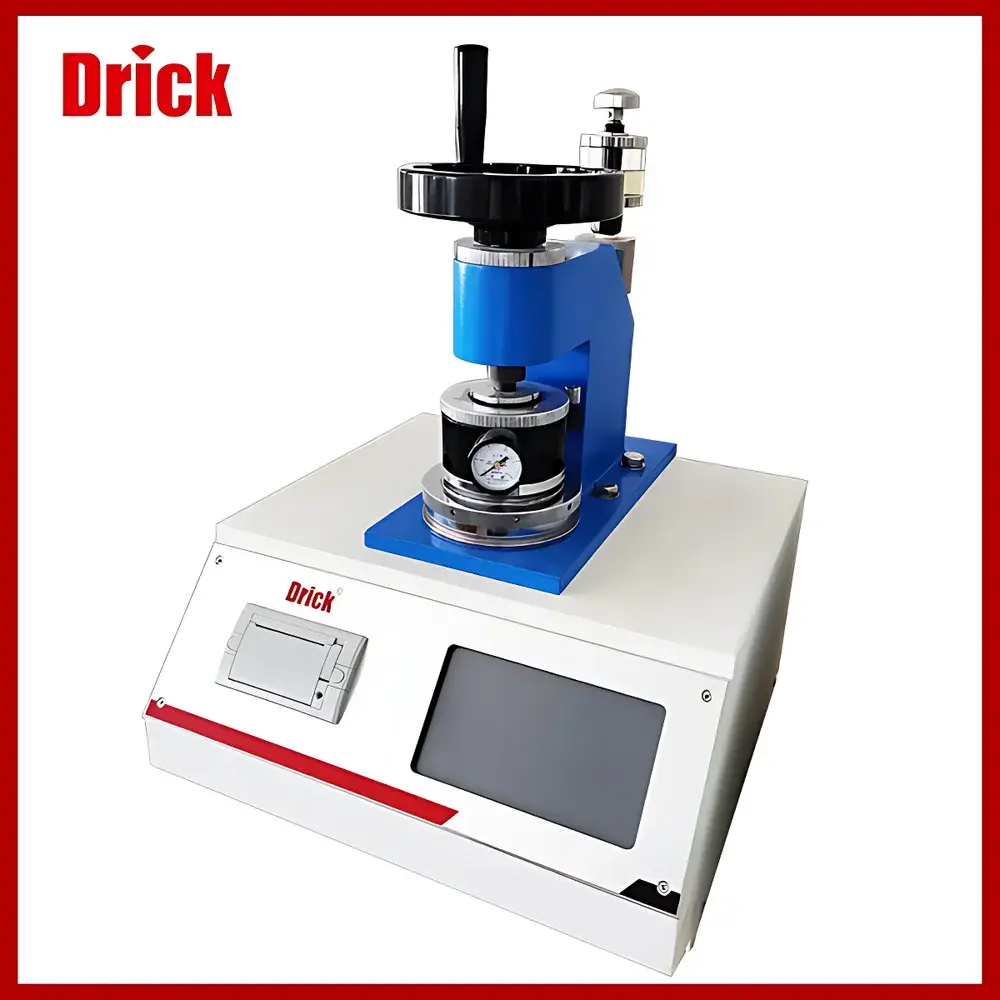
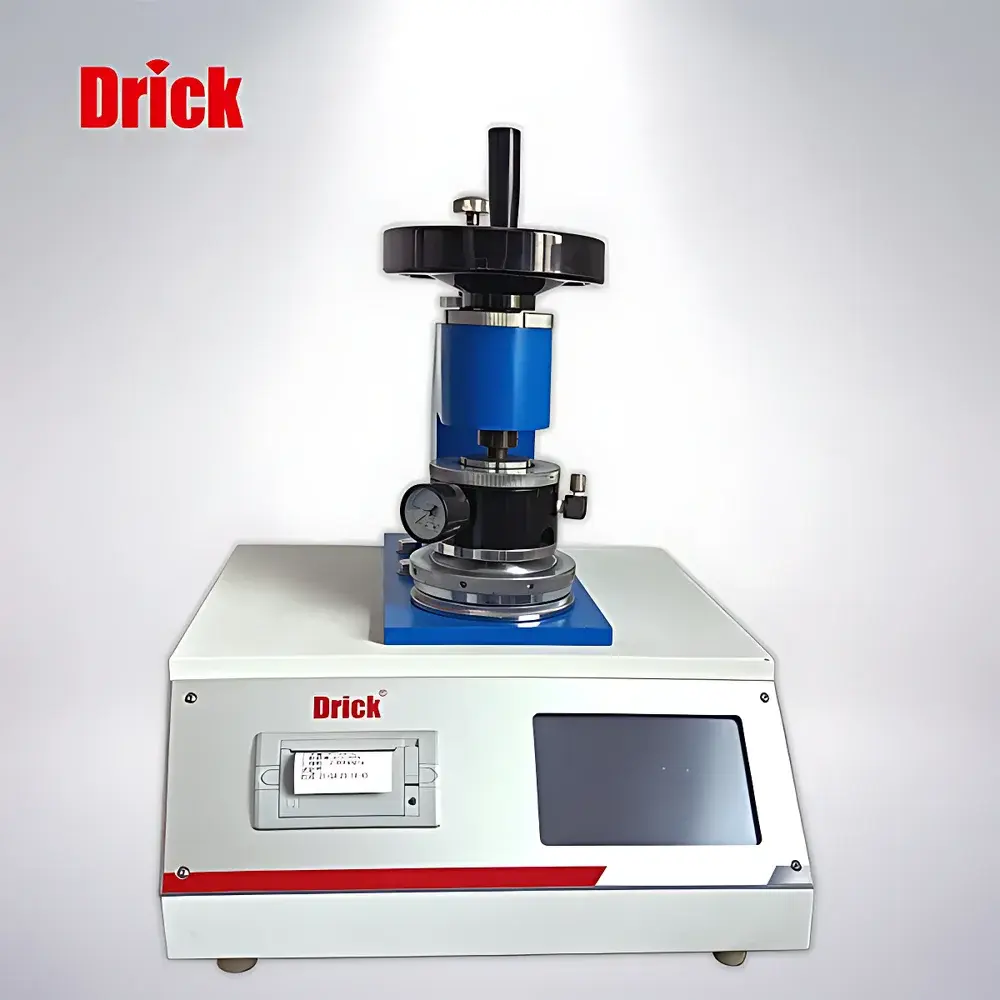
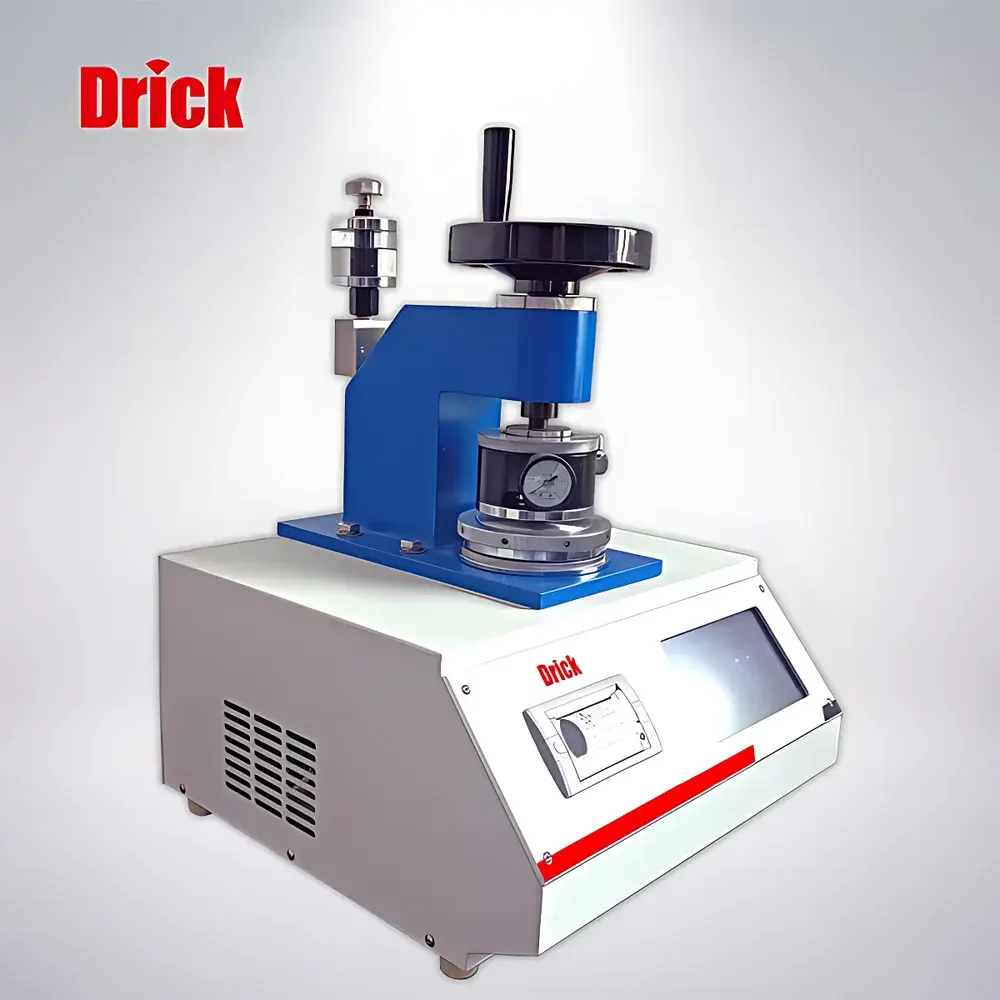
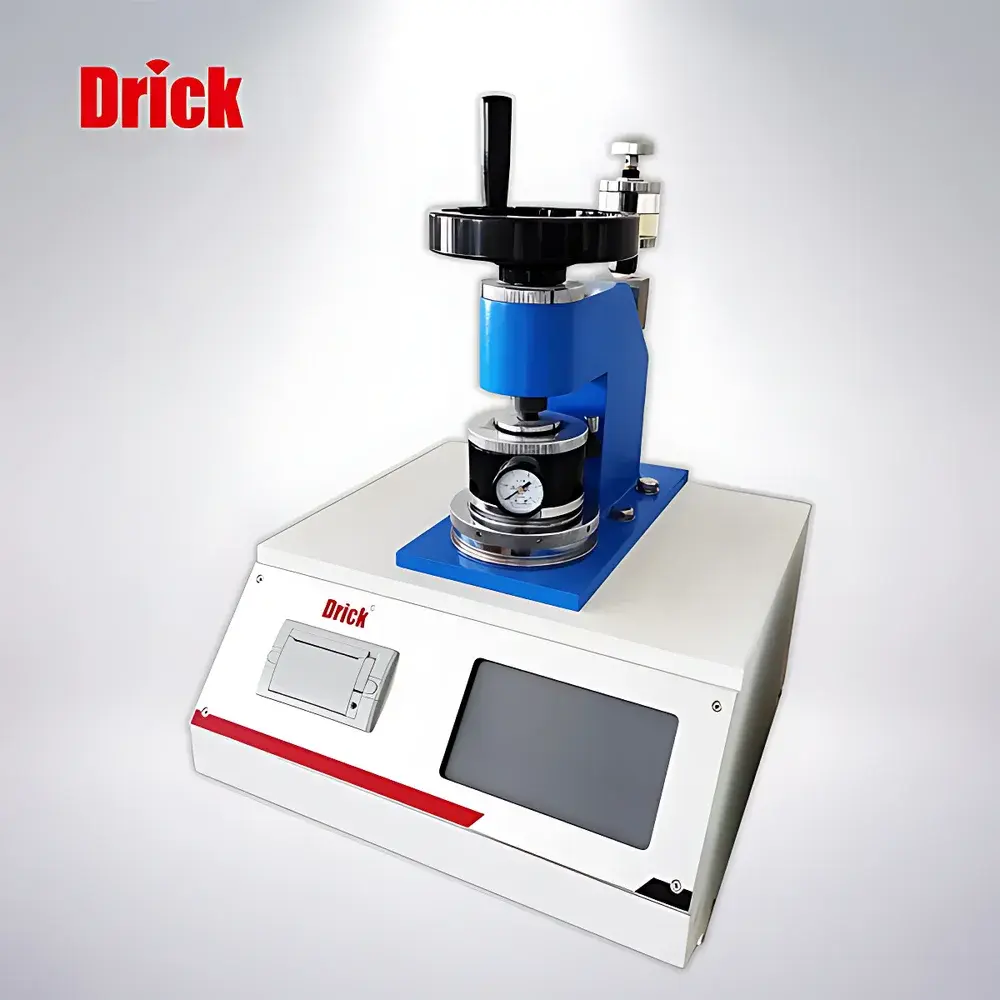
Drick DRK109 Manual Touchscreen Bursting Strength Tester
| Brand | Drick |
|---|---|
| Origin | Shandong, China |
| Manufacturer Type | Direct Manufacturer |
| Regional Classification | Domestic (China) |
| Model | DRK109 Manual Touchscreen |
| Price | USD 7,000 (FOB Qingdao) |
Overview
The Drick DRK109 Manual Touchscreen Bursting Strength Tester is a precision-engineered instrument designed for the quantitative determination of bursting strength and rupture resistance of corrugated board, solid fiberboard, paperboard, and other flexible packaging substrates. It operates on the fundamental principle of hydraulic pressure application via a rubber diaphragm, conforming to standardized test methodologies including ISO 2758, ISO 2759, TAPPI T403, GB/T 454, and ASTM D774. The device features an open-frame mechanical architecture—optimized for operator visibility, sample accessibility, and routine maintenance—while integrating a responsive 7-inch capacitive touch interface for intuitive parameter entry, real-time pressure monitoring, and result display. Unlike fully automated systems, the DRK109 employs manual hydraulic actuation, offering controlled, stepwise pressure ramping suitable for laboratories requiring traceable, operator-verified test sequences in GLP-compliant environments.
Key Features
- Open structural design with unobstructed sample chamber access—facilitates rapid specimen placement, visual alignment, and residue removal between tests.
- Capacitive touchscreen HMI (7-inch, 800 × 480 resolution) supporting multilingual UI (English, Spanish, Portuguese, Chinese), unit switching (kPa / psi / kgf/cm²), and direct calibration coefficient input.
- Hydraulic loading system with precision-machined piston cylinder and calibrated pressure transducer (accuracy ±0.5% FS), delivering stable force application without servo-driven complexity.
- Integrated burst peak-hold circuitry ensures accurate capture and retention of maximum bursting pressure prior to membrane rupture—critical for reproducible pass/fail evaluation per ISO 2759 Annex A.
- Robust aluminum alloy frame with powder-coated steel base—engineered for long-term dimensional stability under repeated load cycles and ambient laboratory conditions (10–35°C, ≤80% RH).
- Manual operation mode supports full operator control over pressurization rate and dwell timing—enabling method-specific validation protocols required by internal QA or third-party accreditation bodies.
Sample Compatibility & Compliance
The DRK109 accommodates standard test specimens measuring 100 mm × 100 mm (per ISO 2758) or 140 mm × 140 mm (per TAPPI T403), with clamping force independently adjustable up to 1,200 kPa to prevent edge slippage during high-strength board testing. It is validated for use with single- and multi-wall corrugated fiberboard, chipboard, linerboard, kraft paper, and laminated composites exhibiting bursting strengths from 150 kPa to 2,500 kPa. All mechanical and electronic components comply with CE marking requirements (EMC Directive 2014/30/EU, Low Voltage Directive 2014/35/EU). Test reports generated via the built-in interface include timestamp, operator ID, sample ID, and environmental condition fields—supporting audit readiness for ISO/IEC 17025-accredited labs and FDA-regulated packaging validation workflows.
Software & Data Management
While the DRK109 operates as a standalone instrument, its embedded firmware supports USB export of CSV-formatted test logs—including date/time stamp, peak pressure (kPa), burst energy (J/m² calculated), and pass/fail status—to external PCs or network drives. No proprietary software installation is required; exported files are compatible with Microsoft Excel, LabArchives, and LIMS platforms compliant with 21 CFR Part 11 when paired with institutional digital signature infrastructure. Audit trail functionality records all parameter changes, calibration events, and user logins—retained for ≥180 days in non-volatile memory. Firmware updates are delivered via secure HTTPS download through Drick’s authorized service portal, with version history and change logs available for regulatory review.
Applications
- Corrugated box manufacturing: Incoming raw material verification of linerboard and medium fluting bursting resistance.
- Printing & converting facilities: In-process quality control of pre-laminated boards prior to die-cutting and folding.
- Regulatory compliance testing: Preparation of technical dossiers for ISTA 3A/3E transport simulation validation.
- Academic research: Mechanical property benchmarking of bio-based packaging substrates (e.g., molded fiber, mycelium composites) against conventional fiberboard baselines.
- Government metrology institutes: Secondary standard verification using NIST-traceable pressure reference cells (calibration interval: 12 months recommended).
FAQ
Does the DRK109 meet ISO/IEC 17025 calibration traceability requirements?
Yes—the pressure transducer is supplied with a factory calibration certificate traceable to CNAS-accredited national standards; users may perform in-house verification using certified deadweight testers.
Can the instrument be integrated into a central lab data network?
It does not support Ethernet or Wi-Fi natively, but USB-exported CSV files can be ingested into enterprise LIMS via scheduled batch scripts or manual upload.
What maintenance intervals are recommended for sustained accuracy?
Daily: Visual inspection of diaphragm integrity and clamp surface cleanliness. Quarterly: Hydraulic oil level check and replacement if discolored. Annually: Full transducer recalibration and mechanical play assessment.
Is operator training included with purchase?
Yes—Drick provides complimentary on-site startup training (1 day) covering safe operation, calibration procedures, troubleshooting, and report generation, delivered by certified field application engineers.
How is compliance with ASTM D774 ensured during testing?
The DRK109’s fixed clamping area (100 cm²), diaphragm expansion rate (<0.5 mm/s), and pressure sampling frequency (≥100 Hz) satisfy all apparatus-related clauses in ASTM D774–22 Section 6.





