
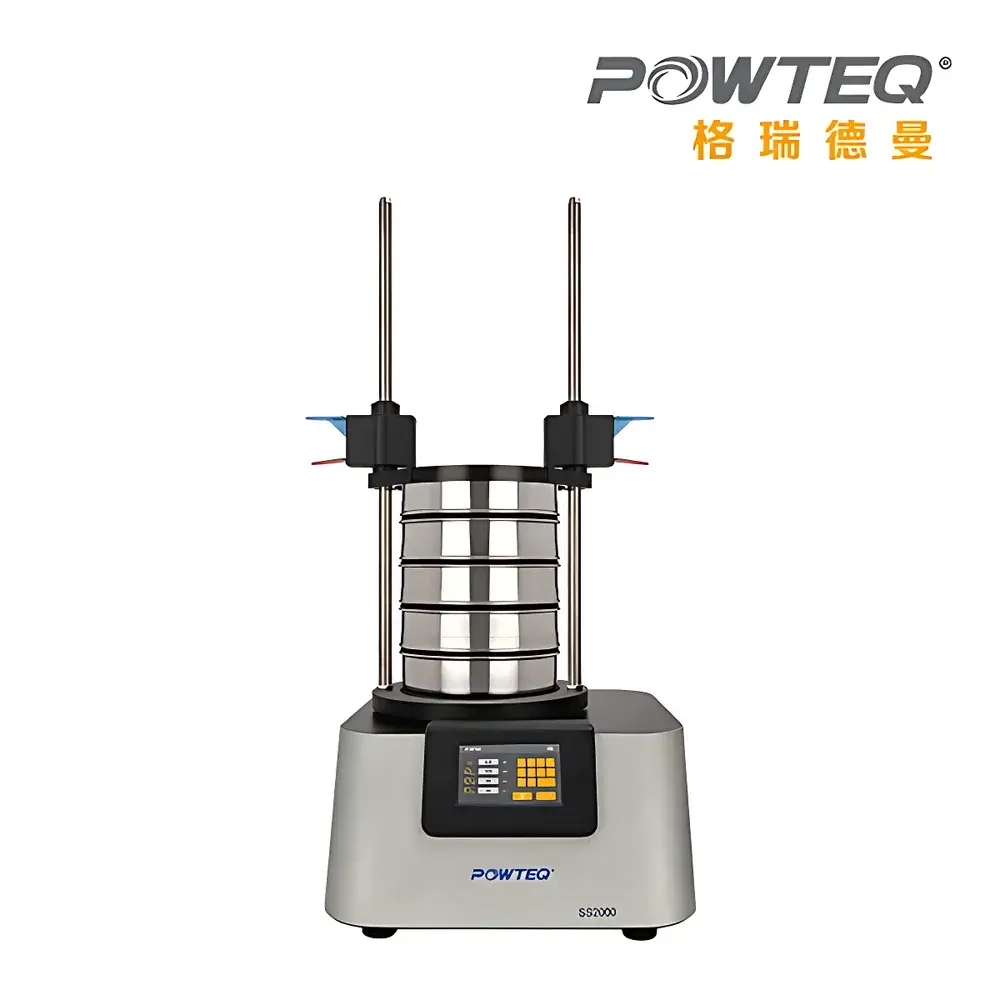
Grinderman SS2000 Electromagnetic Vibratory Sieve Analyzer
| Brand | Grinderman |
|---|---|
| Origin | Beijing, China |
| Manufacturer Type | Direct Manufacturer |
| Model | SS2000 |
| Principle | Electromagnetic vibratory sieving |
| Drive Mode | Electromagnetic drive |
| Sieving Motion | Three-dimensional throw motion |
| Sieve Stages | 9 |
| Amplitude Range | 0.3–3.0 mm |
| Time Setting | 1–99 min |
| Sieve Diameter Options | 100 mm / 150 mm / 200 mm / 203 mm (8") |
| Max Sample Load | 3 kg |
| Parameter Memory Slots | 9 |
| Particle Size Range | 20 µm – 25 mm |
| Compliance | Designed to support ISO 2591-1, ASTM E11, USP <786>, and GLP-aligned laboratory workflows |
Overview
The Grinderman SS2000 Electromagnetic Vibratory Sieve Analyzer is an engineered solution for precise, reproducible particle size distribution analysis via mechanical sieving. It operates on the principle of controlled electromagnetic excitation, generating a three-dimensional throw motion that ensures uniform sample dispersion across the full active sieve surface. Unlike rotary or tapping sievers, this motion minimizes particle agglomeration and segregation effects—critical for accurate classification of cohesive, brittle, or irregularly shaped materials. The instrument is designed for routine quality control, R&D screening, and regulatory-compliant particle characterization in pharmaceutical, mineralogical, agricultural, construction, and academic laboratories. Its architecture supports both dry and wet sieving protocols, accommodating a broad operational envelope—from fine micronized powders (down to 20 µm) to coarse granular aggregates (up to 25 mm).
Key Features
- Electromagnetic drive system delivering stable, low-noise oscillation with adjustable amplitude (0.3–3.0 mm) and programmable duration (1–99 minutes)
- Three-dimensional throw motion optimized for high-efficiency stratification and minimal blinding of mesh apertures
- Digital parameter interface enabling pre-set storage of up to nine distinct sieving methods—including amplitude, time, and motion profile configurations
- Ergonomic front-access design with tool-free sieve stack assembly and quick-lock clamping mechanism for rapid method changeover
- Modular sieve compatibility supporting standardized diameters: 100 mm, 150 mm, 200 mm, and 203 mm (8-inch), compliant with ISO 3310-1 and ASTM E11 specifications
- Integrated dry/wet sieving capability with optional liquid containment accessories and corrosion-resistant stainless-steel housing components
- Low-maintenance operation: no belts, gears, or lubricated mechanisms; electromagnetic actuator rated for >50,000 operational cycles
Sample Compatibility & Compliance
The SS2000 accommodates diverse material classes including friable ceramics, crushed ores, polymer granules, milled APIs, ground spices, soil fractions, and seed lots. Its robust motion profile handles both free-flowing and slightly cohesive particulates without requiring dispersants or sonication pretreatment. The system aligns with international standards governing sieve analysis methodology: ISO 2591-1 (determination of particle size distribution by sieving), ASTM E11 (specification for wire cloth and sieves), and USP (particle-size distribution—microscopic and sieving methods). When used within documented SOPs—including calibrated sieve certification, environmental monitoring, and operator training—the SS2000 supports GLP and GMP environments where audit trails and method traceability are required.
Software & Data Management
While the SS2000 operates as a standalone benchtop instrument with embedded digital controls, its parameter memory architecture enables seamless integration into laboratory data management systems. All stored methods include timestamped metadata (date, operator ID placeholder, amplitude/time settings), facilitating manual logbook correlation or export via USB-connected printers. For regulated environments, users may implement external electronic lab notebooks (ELNs) or LIMS interfaces to record raw mass-on-sieve values, calculate cumulative undersize/oversize distributions, and generate PDF reports compliant with FDA 21 CFR Part 11 requirements—provided appropriate user access controls and electronic signature validation are deployed at the enterprise level.
Applications
- Pharmaceutical: Excipient grading, granule sizing prior to tablet compression, and final blend uniformity verification
- Minerals & Aggregates: Classification of crushed limestone, silica sand, and recycled concrete fines per EN 933-1
- Agriculture: Seed sizing consistency checks, fertilizer granule homogeneity assessment, and feed pellet integrity screening
- Construction Materials: Cement fineness testing (Blaine equivalent correlation), asphalt aggregate gradation (AASHTO T 27), and fly ash particle distribution
- Academic Research: Teaching core principles of particle mechanics, sieving efficiency modeling, and statistical analysis of PSD datasets
FAQ
What sieve standards does the SS2000 support?
It accepts all ISO 3310-1 and ASTM E11-compliant test sieves with nominal diameters of 100 mm, 150 mm, 200 mm, or 203 mm.
Can the SS2000 perform wet sieving without modification?
Yes—wet sieving is supported using optional splash guards and drain trays; no internal modifications are required.
Is calibration documentation provided with the instrument?
Grinderman supplies factory calibration certificates for amplitude linearity and timer accuracy; periodic verification against traceable reference masses and stopwatch standards is recommended per ISO/IEC 17025.
How many sieve layers can be stacked simultaneously?
The mechanical design accommodates up to nine nested sieve decks, enabling multi-stage fractionation in a single run.
Does the SS2000 meet noise emission limits for ISO 14001-certified facilities?
Operational sound pressure level is ≤62 dB(A) at 1 m distance—within typical laboratory ambient thresholds and compatible with ISO 14001 environmental management frameworks.



