
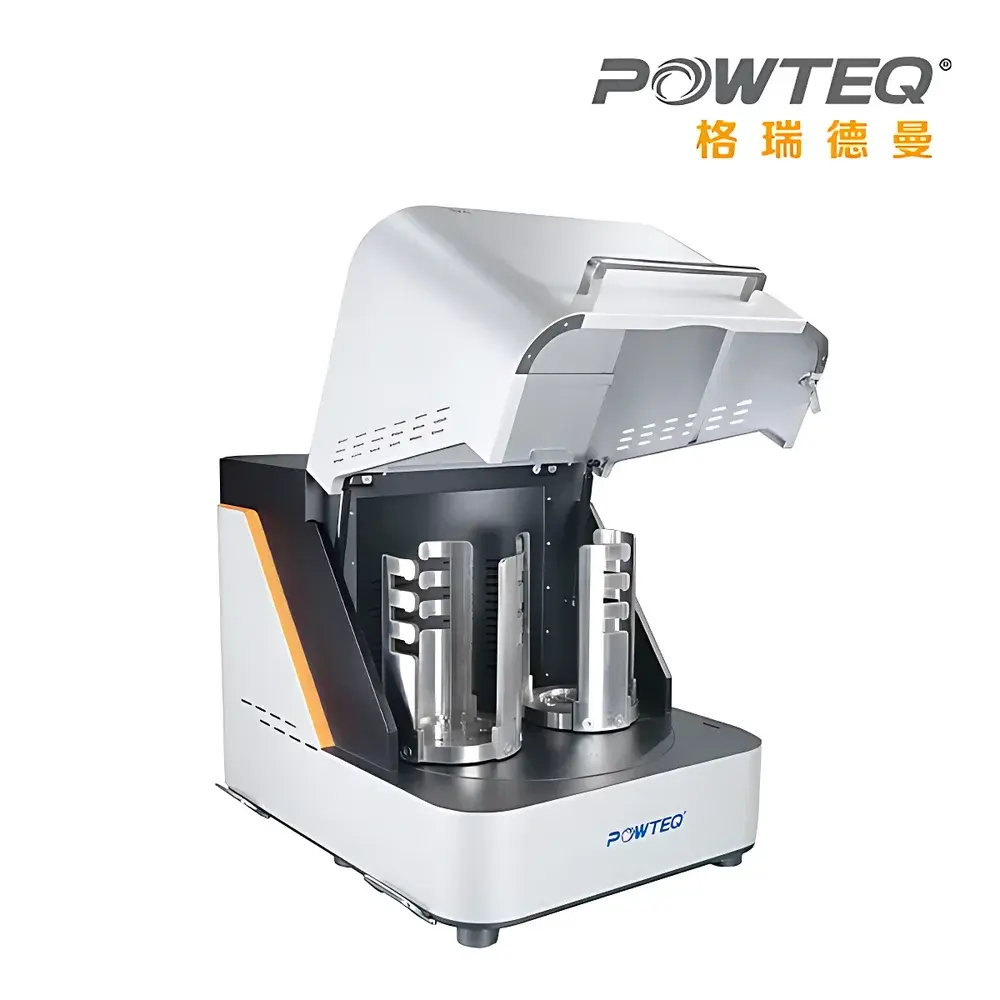
Grinder BM20Plus Planetary Ball Mill
| Brand | Grinder |
|---|---|
| Origin | Beijing, China |
| Manufacturer Type | Direct Manufacturer |
| Product Category | Domestic |
| Model | BM20Plus |
| Instrument Type | Planetary Ball Mill |
| Sample Suitability | Soft Materials |
| Feed Size | < 20 mm |
| Final Particle Size | < 0.1 µm |
| Operating Speed Range | 30–300 rpm |
| Speed Ratio (Sun Wheel | Jar Rotation): 1 : −1.9 (customizable from 1:1 to 1:−3.5) |
| Grinding Time Range | 0–999 min (with 1–99 cycles) |
| Effective Sun Wheel Diameter | 384 mm |
| Jar Volumes Available | 1 L, 2 L, 4 L |
| Display | 7-inch LED Touchscreen |
| Cooling | Integrated Automatic Ventilation System for Jars |
| Direction Control | Programmable Reverse Rotation |
| Jar Material Options | 6 types (e.g., stainless steel, tungsten carbide, agate, zirconia, polyurethane, PTFE-lined) |
Overview
The Grinder BM20Plus Planetary Ball Mill is a high-performance, dual-jar planetary grinding system engineered for precision size reduction and homogenization of diverse solid materials. It operates on the principle of high-energy planetary motion: a central sun wheel rotates while simultaneously driving two eccentrically mounted grinding jars in opposite directions—both revolving around the sun wheel axis and rotating about their own axes. This dual rotational motion generates intense centrifugal and Coriolis forces, accelerating grinding media (balls) to kinetic energies sufficient to fracture, abrade, and cold-weld particles at submicron and nanoscale levels. Designed for reproducible, scalable laboratory processing, the BM20Plus supports both dry and wet grinding protocols and meets fundamental mechanical alloying requirements per ASTM E290–22 and ISO 13320:2020 (laser diffraction particle size analysis preparation). Its robust architecture enables consistent energy input control, making it suitable for GLP-compliant method development in R&D and QC environments.
Key Features
- Programmable bidirectional rotation for optimized impact distribution and reduced jar wear
- Submicron final particle size (< 0.1 µm) achievable with extended milling; colloidal grinding down to < 100 nm under optimized wet-milling conditions
- Dual-jar configuration (1 L / 2 L / 4 L options) with six interchangeable jar materials—stainless steel, tungsten carbide, agate, zirconia, polyurethane, and PTFE-lined—to prevent contamination and accommodate reactive or abrasive samples
- Integrated automatic ventilation system actively cools jars during prolonged operation, minimizing thermal degradation of heat-sensitive organics, polymers, and pharmaceutical actives
- 7-inch LED touchscreen interface with intuitive parameter programming: speed (30–300 rpm), time (0–999 min), cycle count (1–99), and directional sequence
- Adjustable speed ratio (standard 1:−1.9; customizable 1:1 to 1:−3.5) for fine-tuned energy transfer matching sample hardness and desired amorphization degree
- Compliance-ready design: audit trail support via optional data logging module; compatible with 21 CFR Part 11–compliant software extensions for regulated pharmaceutical and medical device labs
Sample Compatibility & Compliance
The BM20Plus accommodates a broad spectrum of sample types—including soft (plant tissues, polymers, clays), brittle (ceramics, minerals, glass), hard (alloys, oxides, carbides), and fibrous (cellulose, hair, carbon fibers)—without pre-crushing required for feed sizes under 20 mm. Its versatility supports applications across ISO/IEC 17025-accredited testing laboratories, particularly in cementitious materials (ASTM C114), metallurgical powders (ISO 4490), catalyst characterization (ASTM D7263), and environmental solid waste analysis (EPA Method 6010D). All jar materials conform to USP for extractables profiling, and stainless-steel variants meet EN 10204 3.1 certification standards. The instrument’s mechanical design complies with IEC 61000-6-2 (EMC immunity) and IEC 61000-6-4 (EMC emission) requirements.
Software & Data Management
While the BM20Plus operates autonomously via its embedded controller, optional USB- or Ethernet-enabled data acquisition modules enable real-time export of operational logs—including speed, duration, direction events, and temperature trends—to CSV or XML formats. These records support traceability in GMP-regulated workflows and integrate with LIMS platforms via standardized API protocols. Firmware updates maintain alignment with evolving ISO/IEC 17025 documentation requirements, including calibration certificate management and uncertainty budgeting for grinding energy output. For advanced process analytics, third-party software (e.g., MATLAB® or Python-based scripts) can parse exported datasets to correlate milling parameters with downstream XRD amorphization indices or BET surface area measurements.
Applications
- Mechanical alloying of Fe–Al, Cu–Ti, and Ni–Cr systems for metastable phase synthesis
- Preparation of nanostructured catalysts (e.g., Pt/CeO₂, Co₃O₄) with controlled crystallite size and defect density
- Homogenization of heterogeneous geological samples (limestone, bentonite, iron ore) prior to XRF or ICP-MS digestion
- Cell disruption and DNA/RNA extraction from plant biomass and microbial pellets
- Production of ultrafine pigments and ceramic slurries with narrow PSD (D90 < 200 nm)
- Recycling process development for electronic waste (PCBs, Li-ion battery cathodes) and composite demolition debris
- Pharmaceutical solid dispersion formulation—amorphization of APIs (e.g., ibuprofen, griseofulvin) to enhance dissolution kinetics
FAQ
What is the maximum recommended continuous operating time per cycle?
The BM20Plus supports uninterrupted operation up to 999 minutes per cycle. For thermal-sensitive samples, intervals between cycles are advised when total active milling exceeds 4 hours.
Can the BM20Plus achieve true nanoscale particle size distribution?
Yes—under optimized wet-grinding conditions (e.g., ethanol suspension, zirconia media, 0.5 mm beads), D50 values below 80 nm have been verified by TEM and dynamic light scattering (DLS) per ISO 22412:2017.
Is jar material selection critical for analytical accuracy?
Absolutely. Stainless steel jars may introduce Fe/Ni contamination in trace-metal analysis; agate or zirconia is preferred for geochemical or semiconductor-grade powder prep per ASTM D5686.
Does the instrument support regulatory audit trails?
With the optional DataLogger Pro module, all parameter changes, start/stop timestamps, and emergency stops are timestamped and digitally signed—fully compliant with FDA 21 CFR Part 11 Annex 11 requirements.
How is energy input quantified and controlled?
Energy intensity is indirectly regulated via speed ratio and rotational speed; empirical calibration curves (rpm × time × mass factor) correlate with specific impact energy (J/g), validated against calorimetric reference methods per ISO 14855-2.



