
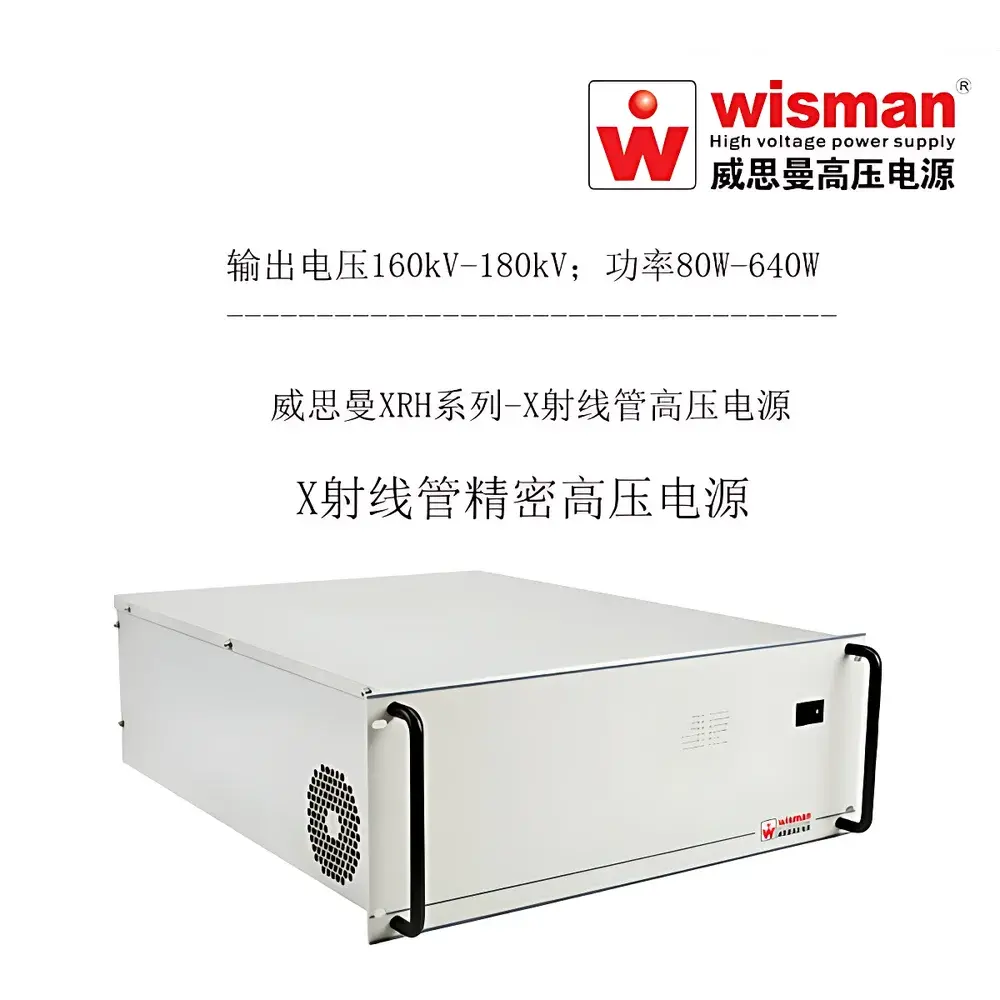
Wiseman XRH Microfocus X-ray High-Voltage Power Supply 180 kV / 640 W
| Brand | Wiseman |
|---|---|
| Origin | Shaanxi, China |
| Model | XRH |
| Output Voltage | Up to 180 kV (DC, negative polarity) |
| Output Power Options | 80 W / 320 W / 640 W |
| Output Current | Up to 4 mA @ 160 kV |
| Filament Supply | 0–7 V / 5 A DC, adjustable |
| Grid Bias Supply | 0–−1200 V / 100 mA DC, adjustable |
| Stability | ≤0.1% of set value after 30-min warm-up |
| Ripple | ≤0.1% p-p (≤320 W), ≤0.7% p-p (640 W) |
| Temperature Drift | 25 ppm/°C |
| Input | AC 220 V ±10%, 50 Hz |
| Cooling | Forced air (front-side intake, rear exhaust) |
| Dimensions | 176 mm H × 483 mm W × 558.8 mm D (4U rack-mount) |
| Weight | 30 kg |
| Compliance | Designed for integration into ISO/IEC 17025-compliant X-ray imaging systems |
Overview
The Wiseman XRH Microfocus X-ray High-Voltage Power Supply is an engineered solution for precision-driven X-ray imaging applications requiring stable, low-noise, and tightly regulated high-voltage operation. Designed specifically for microfocus and nanofocus X-ray tubes, the XRH series delivers up to 180 kV DC (negative polarity) at power levels of 80 W, 320 W, or 640 W—enabling high-resolution radiography, computed tomography (CT), and real-time non-destructive testing (NDT). Its core architecture integrates solid-state encapsulation, active power factor correction (PFC), and proprietary high-voltage floating technology to isolate filament and grid bias supplies from ground-referenced noise sources. This design ensures sub-0.1% output stability after thermal equilibrium, ultra-low ripple (<0.1% p-p at ≤320 W), and exceptional immunity to line-induced EMI—critical parameters for maintaining consistent X-ray photon flux and spatial resolution in metrology-grade imaging systems.
Key Features
- Triple-output architecture: independently regulated high-voltage (−160 kV to −180 kV), grid bias (0 to −1200 V), and filament supply (0–7 V / 5 A)
- Proprietary high-voltage floating topology enabling precise emission current control and <0.1% RMS noise on filament and grid outputs
- Active input power factor correction (PFC) minimizing harmonic distortion and reducing RMS input current demand
- 0.1% full-scale voltage stability after 30-minute warm-up; temperature coefficient of 25 ppm/°C across 0–50 °C operating range
- Standard RS-232 and Ethernet interfaces; optional RS-422 digital communication for deterministic command-response timing in automated test environments
- Rack-mount 4U form factor (176 × 483 × 558.8 mm); forced-air cooling with front-to-rear airflow path optimized for continuous-duty laboratory or industrial deployment
- Comprehensive safety monitoring: filament open-circuit detection, overvoltage/overcurrent interlocks, and thermal shutdown with latching fault reporting
Sample Compatibility & Compliance
The XRH series is purpose-built for integration with sealed microfocus X-ray tubes used in benchtop CT scanners, PCB inspection systems, battery electrode analysis platforms, and materials science synchrotron beamline pre-focusing stages. It meets electromagnetic compatibility requirements per CISPR 11 Class B and supports system-level compliance with IEC 61000-6-3 (emission) and IEC 61000-6-2 (immunity). While the XRH itself carries no standalone medical certification, its output stability, traceable calibration paths, and deterministic digital control interface enable qualification under ISO 13485 and FDA 21 CFR Part 11 when embedded within validated OEM imaging instruments. All units undergo 100% burn-in testing and high-potential (hi-pot) verification at 2× rated output voltage prior to shipment.
Software & Data Management
Remote operation is supported via ASCII-based SCPI-like command sets over RS-232 or TCP/IP. The power supply provides real-time analog monitoring outputs (0–10 V scaling linearly to HV, filament current, and grid voltage), enabling closed-loop feedback integration with third-party DAQ systems or PLCs. Optional Wiseman Control Suite (Windows/Linux) offers GUI-based parameter configuration, waveform capture of transient response, and CSV-exportable log files timestamped to system clock—facilitating GLP/GMP-aligned record retention. Audit trails, user role management, and electronic signature support are implemented at the host application layer; the XRH firmware includes write-protected calibration constants and EEPROM-based fault history storage compliant with IEC 62304 Class B software safety requirements.
Applications
- High-magnification X-ray microscopy of composite materials, additively manufactured components, and semiconductor packages
- Real-time inline quality assurance in automotive casting inspection and aerospace turbine blade porosity analysis
- Preclinical small-animal CT systems requiring repeatable tube loading and dose control
- Electron microscope column biasing where ultra-stable negative potentials are required for beam deceleration
- Custom radiation source development for homeland security backscatter imaging and cargo scanning prototypes
- Academic research in X-ray phase-contrast imaging, where microamp-level current regulation directly impacts fringe visibility
FAQ
What is the maximum continuous output voltage rating?
The XRH series is rated for continuous operation up to −180 kV DC with appropriate derating for ambient temperature and duty cycle. Standard configurations ship calibrated to −160 kV; −180 kV capability requires factory validation and may affect long-term stability specifications.
Can the XRH be operated in constant-power mode?
No. The XRH operates in constant-voltage mode with independent current limiting. Power delivery is determined by load impedance; it does not implement closed-loop power regulation.
Is the filament supply galvanically isolated from the high-voltage return?
Yes. The filament and grid bias supplies are fully floating relative to chassis ground and the HV cathode, enabling direct connection to grounded filament heaters in common-cathode X-ray tube configurations.
Does the unit include built-in high-voltage cable and connectors?
No. HV cabling, feedthroughs, and tube-specific connectors must be selected and qualified separately based on dielectric stress, creepage distance, and vacuum compatibility requirements.
What documentation is provided for regulatory submissions?
Wiseman supplies comprehensive technical files including schematic diagrams, bill-of-materials, traceable calibration reports, EMC test summaries, and RoHS/REACH declarations—sufficient for inclusion in IEC 62366-1 usability engineering files and ISO 14971 risk management dossiers.



