
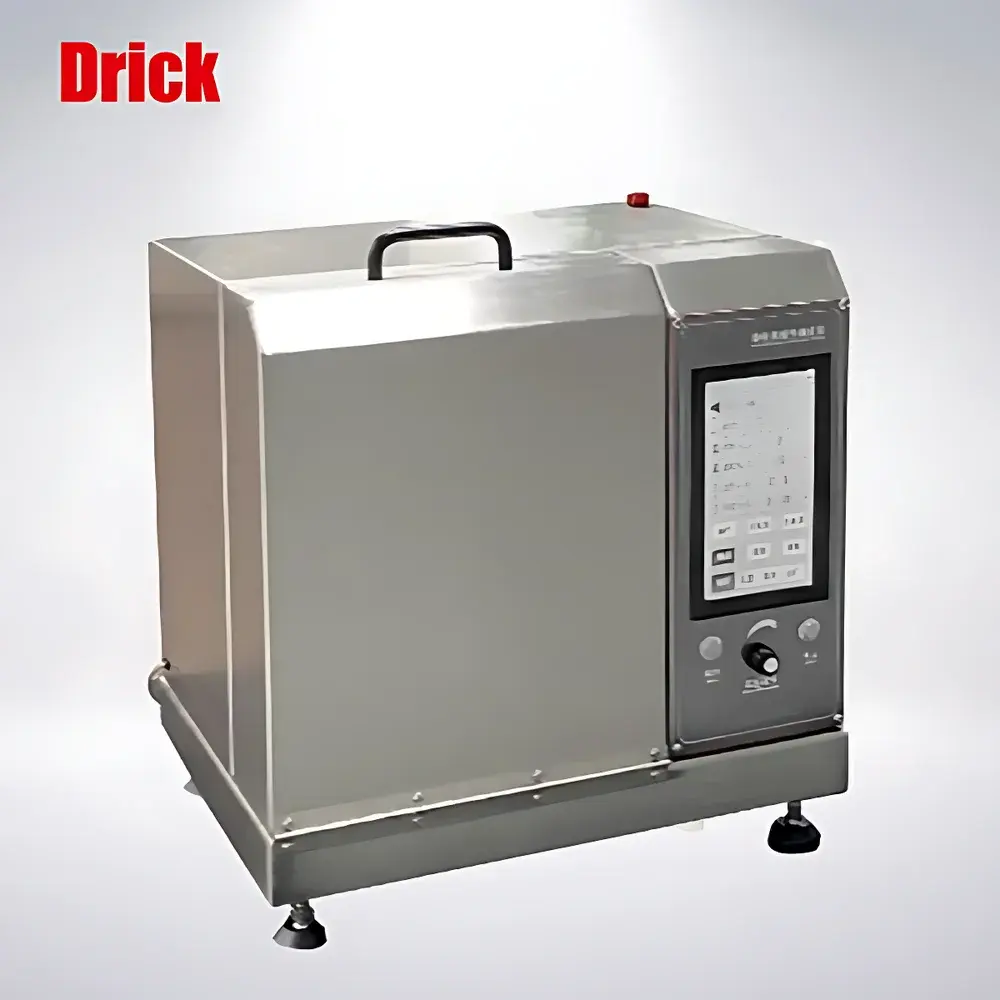


Drick DRK342A Electrostatic Decay Tester
| Brand | Drick |
|---|---|
| Model | DRK342A |
| Voltage Output Range | ±0–5 kV |
| Electrostatic Voltage Measurement Range | ±0–10 kV (Resolution: 5 V) |
| Decay Time Range | 0–9999.99 s (Accuracy: ±0.01 s) |
| Discharge Time Range | 0–999999 s |
| Probe-to-Specimen Distance | (25 ± 1) mm |
| Power Supply | AC 220 V, 50 Hz, 200 W |
| Dimensions (L×W×H) | 440 × 340 × 440 mm |
| Weight | ~20 kg |
| Compliance | GB 19082–2009 Section 5.10 |
Overview
The Drick DRK342A Electrostatic Decay Tester is a precision-engineered instrument designed for quantitative evaluation of electrostatic charge dissipation performance in nonwoven fabrics, medical protective materials, and other insulating textile substrates. It operates on the principle of controlled high-voltage charging followed by grounded decay monitoring—specifically measuring the time required for surface voltage to decay from its peak value (±5 kV) to 10% of that initial level (i.e., the 90% decay time, commonly referenced as “electrostatic decay time” or “half-life” in regulatory contexts). This measurement directly reflects the material’s ability to dissipate induced static charge under standardized grounding conditions, a critical parameter for ensuring operator safety, minimizing particle attraction in cleanroom environments, and meeting functional requirements for medical PPE. The instrument implements a four-module architecture: high-voltage generation and control, controlled discharge initiation, real-time electrostatic voltage sampling, and automated decay timing calculation—each module synchronized via a STMicroelectronics 32-bit embedded controller for deterministic timing and data integrity.
Key Features
- Full-color capacitive touchscreen interface with dual-language support (English and Chinese), enabling intuitive menu-driven operation without external PC dependency.
- Modular hardware design ensures traceable signal path separation: ±5 kV high-voltage source module, fast-switching discharge relay module, high-impedance electrostatic probe acquisition module, and microsecond-resolution timing module.
- High-fidelity voltage measurement system with ±10 kV range and 5 V resolution, calibrated against NIST-traceable reference standards; maintains linearity across full scale per IEC 61340-2-1 verification protocols.
- Precise probe positioning mechanism fixes the electrostatic sensor at (25 ± 1) mm above specimen surface—complying with GB 19082–2009 and aligned with ASTM F1819 test geometry for reproducible field coupling.
- Onboard data logging stores complete decay curves (voltage vs. time) and calculated decay metrics (e.g., t10%, t50%) with timestamp and operator ID; supports export via USB to CSV or direct thermal printing.
- Rugged industrial enclosure (440 × 340 × 440 mm, ~20 kg) with EMI-shielded chassis and redundant safety interlocks—including automatic HV cutoff upon door opening and ground fault detection.
Sample Compatibility & Compliance
The DRK342A accommodates flat, non-conductive specimens up to 200 mm × 200 mm, including spunbond/meltblown nonwovens, coated surgical gowns, face mask filter layers, and laminated barrier fabrics. Specimen mounting uses a grounded metal plate with adjustable clamping to ensure uniform contact and eliminate edge leakage paths. The test method conforms explicitly to Clause 5.10 of GB 19082–2009 “Technical Requirements for Disposable Medical Protective Clothing”, and is technically aligned with ISO 18080-2:2015 (Textiles — Electrostatic properties — Part 2: Test method for measurement of electrostatic decay) and IEC 61340-2-1:2018 (Electrostatics — Part 2-1: Methods of test for determining the resistance and resistivity of solid materials used to avoid electrostatic charge accumulation). While not FDA-cleared as a medical device, its output data meets evidentiary requirements for GLP-compliant quality control documentation in Class I/II medical textile manufacturing.
Software & Data Management
All operational logic resides in firmware—no external software installation required. The embedded OS provides audit-ready data handling: each test record includes date/time stamp, operator ID (manually entered), specimen ID, environmental temperature/humidity (optional external sensor input), raw voltage-time array (100 Hz sampling), and derived decay parameters. Data export supports CSV format compatible with LIMS integration; printed reports include instrument serial number, calibration due date, and pass/fail status relative to user-defined thresholds (e.g., ≤0.5 s for t10%). Firmware supports secure firmware updates via signed USB image, and maintains an immutable audit trail of all configuration changes per ISO/IEC 17025 clause 7.7.2 requirements.
Applications
- Quality assurance of meltblown electret filter media used in N95 respirators and surgical masks.
- Validation of antistatic finishing efficacy on polypropylene spunbond gowns and drapes.
- Comparative screening of conductive fiber blends (e.g., carbon-loaded PP, stainless steel hybrid yarns) for decay kinetics optimization.
- Regulatory submission testing for CE-marked medical textiles under MDR Annex I General Safety and Performance Requirements (GSPR 10.2).
- In-process monitoring during roll-to-roll nonwoven production lines where static buildup impacts web handling and particulate contamination.
- Research into humidity-dependent decay behavior per ISO 18080-1:2015 environmental conditioning protocols.
FAQ
What voltage polarity and magnitude does the DRK342A apply during charging?
It applies either +5 kV or –5 kV DC, selectable via touchscreen; polarity switching is software-controlled and verified by onboard HV monitor.
Is the 25 mm probe distance adjustable?
No—the distance is fixed mechanically to ensure compliance with GB 19082–2009; deviation would invalidate conformance claims.
Does the instrument meet FDA 21 CFR Part 11 requirements?
It does not implement electronic signatures or role-based access control; however, exported CSV files and printed reports are suitable for Part 11–compliant archival when managed within a validated QMS.
Can it measure decay time below 10 ms?
No—the minimum resolvable decay interval is 10 ms (0.01 s), sufficient for most medical textile applications per GB 19082–2009 acceptance criteria.
How often must the electrostatic probe be recalibrated?
Annual calibration is recommended; Drick provides NIST-traceable calibration certificates and supports third-party accredited labs per ISO/IEC 17025.






