
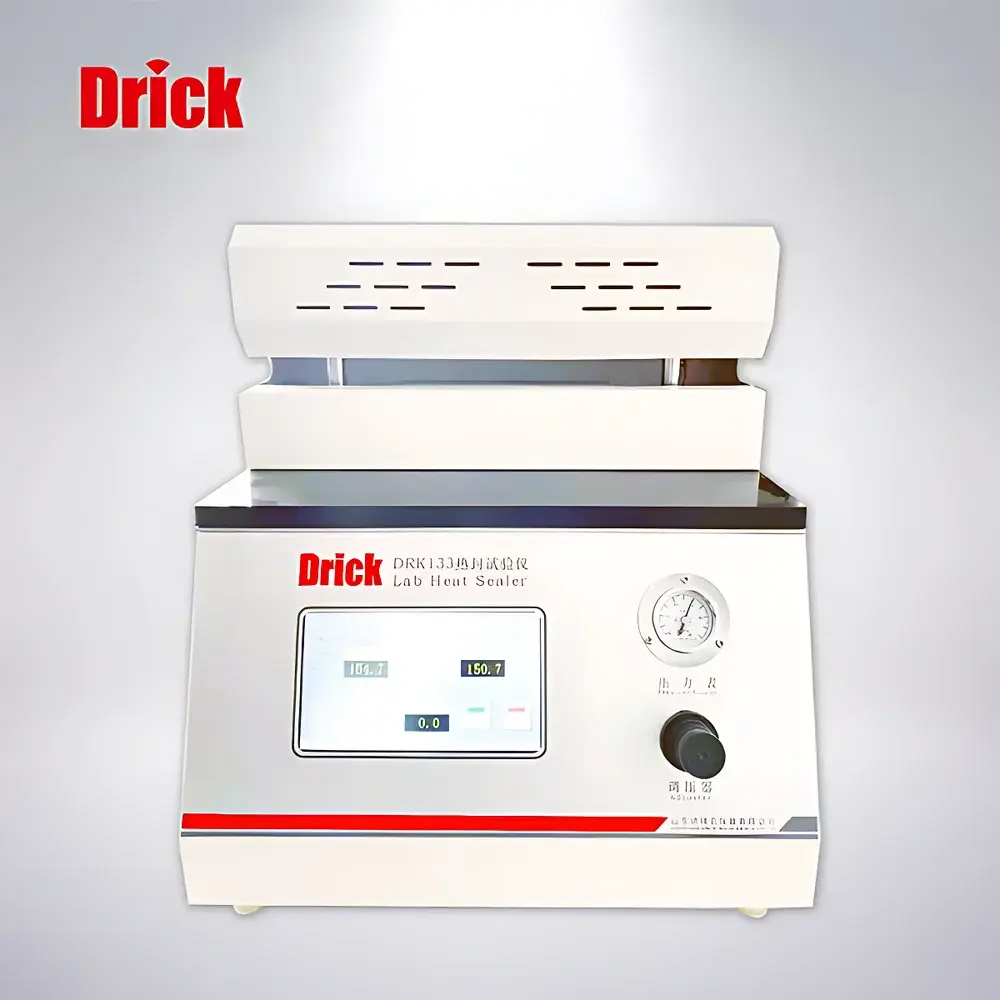
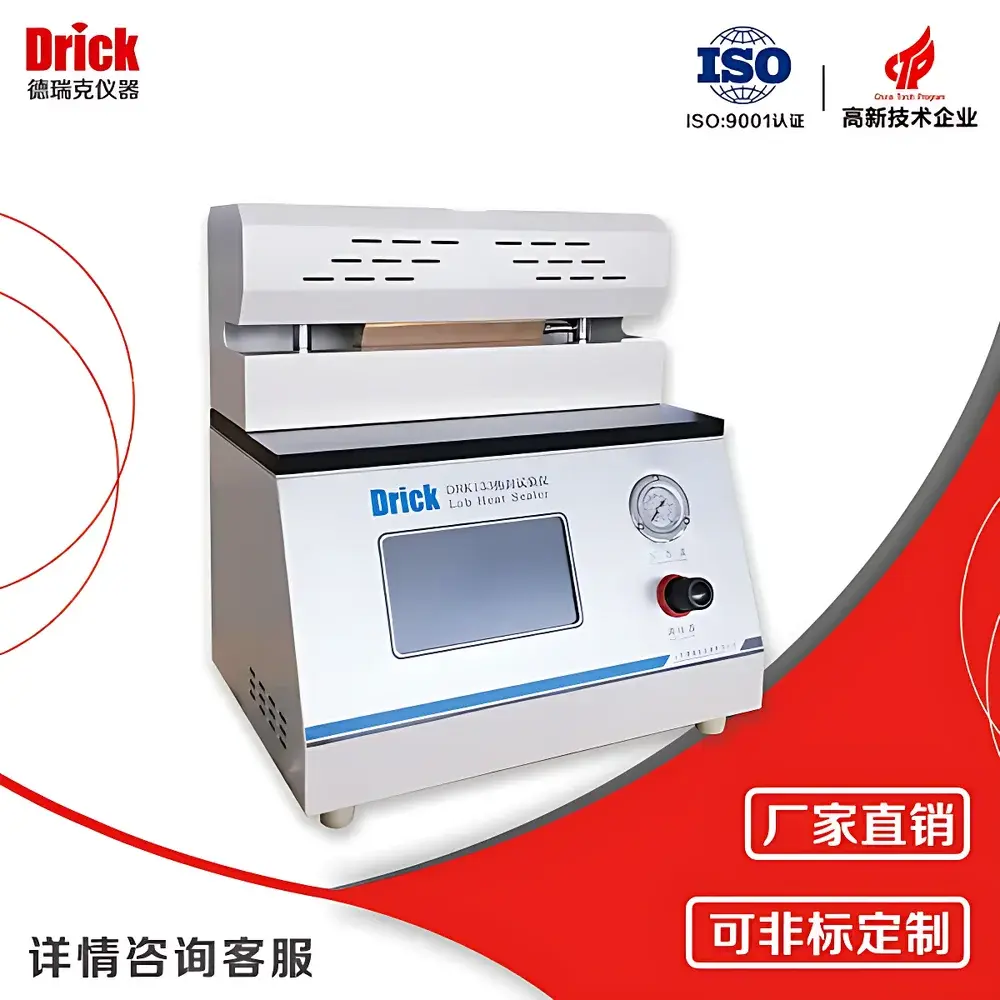
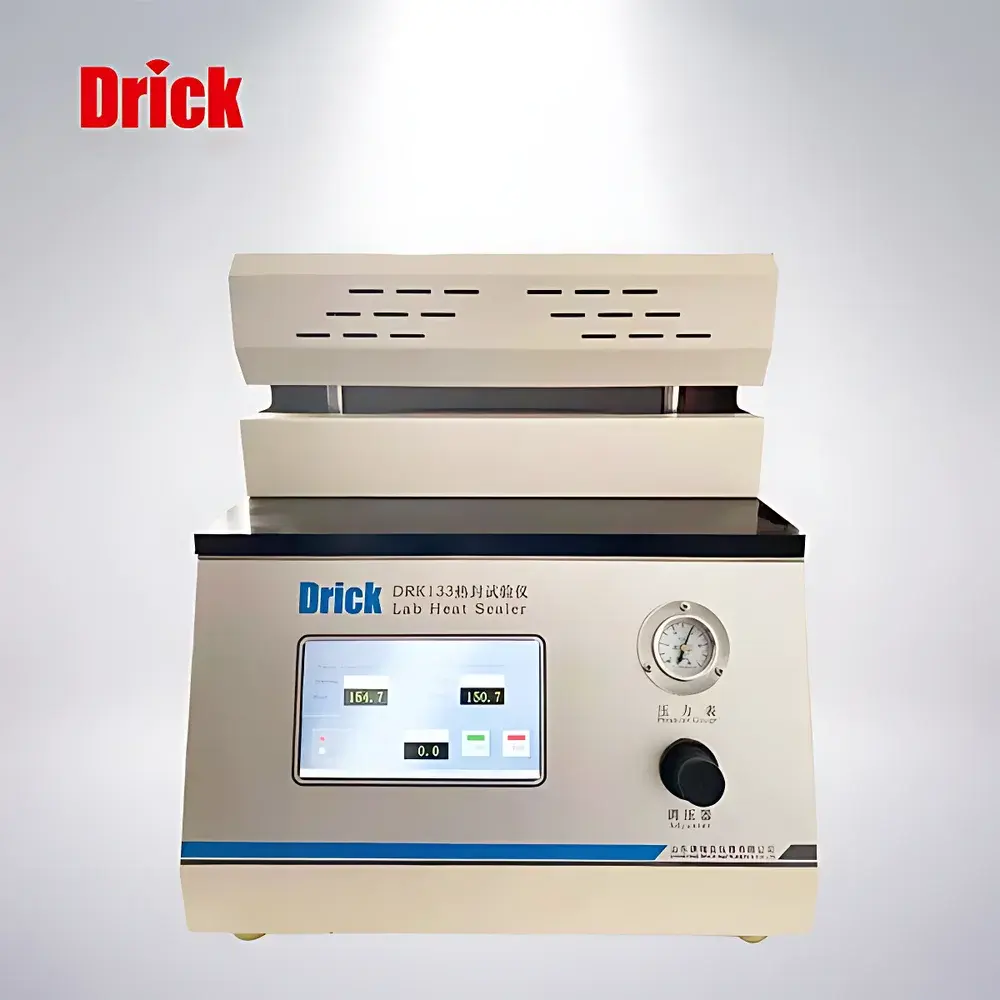
Drick DRK133 Hot Bar Sealing Tester for Flexible Packaging Laminates
| Brand | Drick |
|---|---|
| Origin | Shandong, China |
| Manufacturer Type | Direct Manufacturer |
| Country of Origin | China |
| Model | DRK133 |
| Temperature Range | Ambient to 300 °C |
| Temperature Control Accuracy | ±1 °C |
| Sealing Time | 0.1–999.9 s |
| Sealing Pressure | 0.05–0.7 MPa |
| Sealing Surface Dimensions | 180 mm × 10 mm (customizable) |
| Heating Method | Dual-zone resistive heating with aluminum-encapsulated heating elements |
| Pneumatic Supply Requirement | 0.5–0.7 MPa via Ø8 mm polyurethane tubing |
| Power Supply | AC 220 V ±5%, 50 Hz |
| Dimensions (L×W×H) | 400 mm × 280 mm × 380 mm |
| Weight | Approx. 40 kg |
Overview
The Drick DRK133 Hot Bar Sealing Tester is an engineered laboratory instrument designed for precise, repeatable evaluation of heat seal integrity in flexible packaging materials. It operates on the principle of controlled thermal compression—applying calibrated temperature, pressure, and dwell time across a defined sealing surface to replicate industrial hot-bar sealing conditions. This method enables quantitative assessment of seal initiation temperature, optimal sealing window, and failure mode onset (e.g., channeling, delamination, or adhesive degradation) under standardized test protocols. The DRK133 supports R&D, quality assurance, and process validation workflows in packaging development labs, contract testing facilities, and manufacturing QC departments where regulatory compliance and batch-to-batch consistency are critical.
Key Features
- Microprocessor-based control system with intuitive 7-inch capacitive touchscreen interface and hierarchical menu navigation for rapid parameter setup and execution.
- Dual independent PID temperature controllers—one for upper and one for lower sealing bars—enabling asymmetric thermal profiling and cross-material compatibility testing.
- Synchronized dual-piston pneumatic actuation system with bottom-mounted cylinders ensuring uniform pressure distribution and minimal mechanical hysteresis over repeated cycles.
- Modular sealing head design: standard 180 mm × 10 mm smooth flat surface; optional configurations include stepped, patterned, or narrow-width (e.g., 3 mm or 5 mm) sealing bars for specialized applications such as medical pouch seals or narrow-lid closures.
- Aluminum-encapsulated heating elements with fast-disconnect electrical interfaces for field-replaceable maintenance and minimized thermal lag.
- Integrated safety architecture including automatic thermal cutoff, guarded access zone, insulated external housing, and dual-mode activation (manual button + footswitch) to prevent accidental operation during setup.
Sample Compatibility & Compliance
The DRK133 accommodates a broad spectrum of thermoplastic and laminated substrates—including BOPP, PET, PE, CPP, metallized films, aluminum foil composites, paper-plastic laminates, and coextruded structures—without requiring substrate-specific fixtures. Its adjustable pressure range (0.05–0.7 MPa) and fine-resolution time control (0.1 s increments) allow empirical mapping of seal strength versus process variables per material formulation. The instrument conforms to key international and national standards governing seal performance evaluation: QB/T 2358–1998 (Chinese light industry standard for plastic film heat seal strength), ASTM F2029–22 (Standard Test Method for Measuring Heat Seal Strength of Thermoplastic Polymer-Based Flexible Barrier Materials), and YBB 00122003–2015 (Chinese pharmaceutical packaging standard for heat-sealable composite films). Data generated meets GLP documentation requirements when paired with validated software logging.
Software & Data Management
While the DRK133 operates as a standalone benchtop unit, its embedded firmware supports RS-232 serial output for integration with third-party data acquisition systems or custom LIMS environments. All test parameters—including setpoint temperature, actual measured bar temperature (via integrated PT100 sensors), applied pressure, dwell duration, and cycle count—are timestamped and storable in non-volatile memory. Optional PC-based companion software (sold separately) provides CSV export, trend charting, pass/fail threshold configuration, and audit-trail-enabled report generation compliant with FDA 21 CFR Part 11 principles when deployed with electronic signature modules and user access controls.
Applications
- Optimization of heat seal parameters during new packaging line commissioning or material changeovers.
- Comparative analysis of seal integrity across supplier batches of laminates or adhesives.
- Accelerated aging studies correlating seal strength retention with storage conditions (e.g., high humidity, elevated temperature).
- Root cause investigation of package failures—such as leak paths in sterile barrier systems or burst seams in retort pouches.
- Validation of seal performance for medical device packaging per ISO 11607–1 and ISO 11607–2 requirements.
- Supporting technical dossiers for regulatory submissions (e.g., FDA 510(k), EU MDR Annex I conformity assessments).
FAQ
Does the DRK133 support variable sealing width configurations?
Yes. While the standard sealing surface is 180 mm × 10 mm, custom widths (e.g., 3 mm, 5 mm, 25 mm) and lengths up to 300 mm are available upon request. Custom tooling requires lead-time verification and may incur additional engineering fees.
Is compressed air supply included with the instrument?
No. A clean, dry, oil-free compressed air source delivering 0.5–0.7 MPa through an Ø8 mm polyurethane tube is required. Users must provide and maintain this utility per ISO 8573–1 Class 3 specifications.
Can the DRK133 be used for peel strength testing?
No. The DRK133 is strictly a heat seal process simulator—not a tensile tester. Seal strength evaluation requires subsequent measurement using a dedicated force gauge or universal testing machine (e.g., ASTM F88-compliant instruments).
What calibration documentation is provided?
Each unit ships with a factory calibration certificate traceable to NIM (National Institute of Metrology, China) for temperature and pressure transducers. Annual recalibration is recommended; Drick offers certified service contracts with on-site or depot-level verification.
Is the instrument compatible with IQ/OQ/PQ validation protocols?
Yes. The DRK133’s deterministic control architecture, parameter logging capability, and mechanical reproducibility support full qualification per GAMP5 guidelines. Validation templates and URS alignment assistance are available from Drick Technical Services upon project engagement.






