
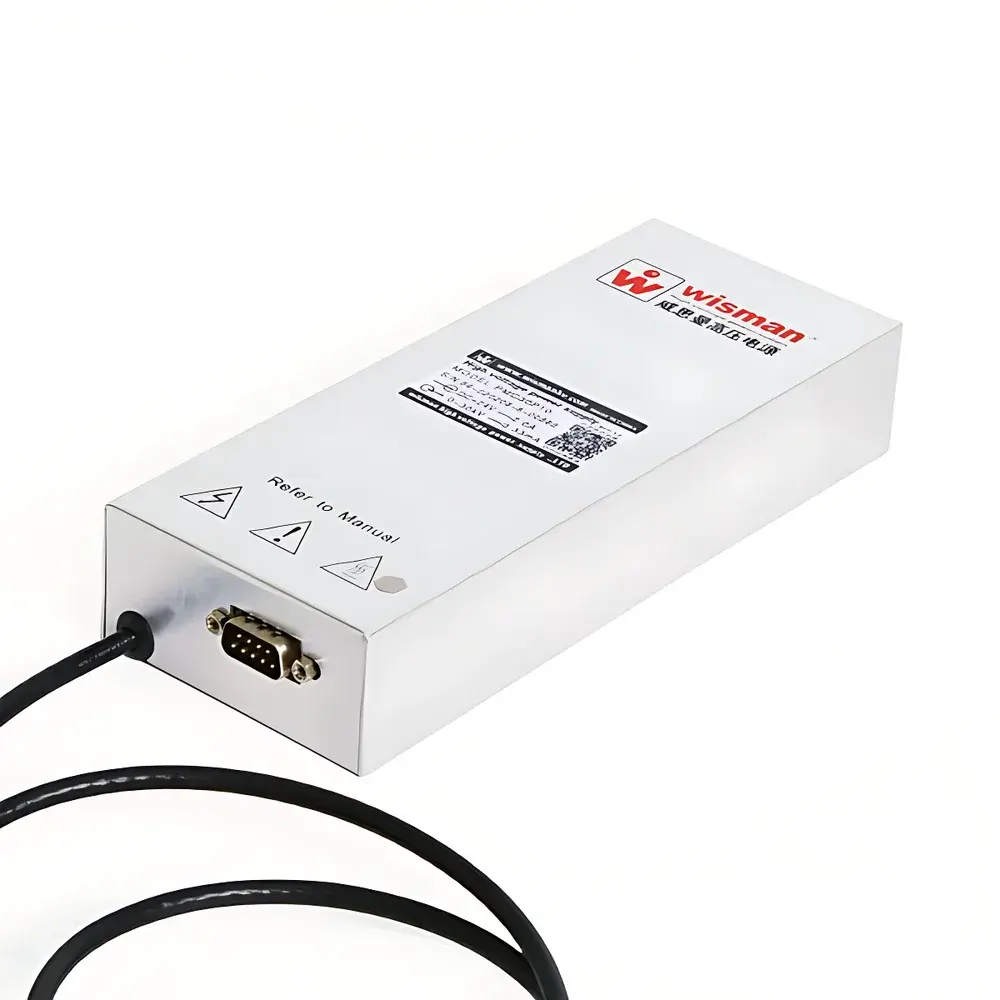
Wiseman PMC20kV/30W High-Voltage Power Supply Module
| Brand | Wiseman |
|---|---|
| Model | PMC |
| Output Voltage | Up to 20 kV (configurable from 1–30 kV) |
| Output Power | 30 W (max) |
| Ripple & Noise | ≤3 mVpp (typ.), <5 mVpp (max) |
| Stability | 0.005 %/hr (standard), 0.001 %/hr (TC10 option) |
| Temp. Coefficient | 25 ppm/°C (standard), 10 ppm/°C (optional) |
| Control Interface | RS-232, RS-485 (addressable), 0–10 V analog, potentiometer |
| Compliance | CE certified |
| Input | 24 VDC ±2 %, ≤1 A |
| Dimensions (30 kV variant) | 200 × 75 × 35 mm |
| Weight (30 kV variant) | 950 g |
| Shielding | Full 6-side electromagnetic shielding |
| Protection | Reverse polarity, overcurrent, short-circuit, arc detection, continuous overload |
Overview
The Wiseman PMC20kV/30W is a compact, high-stability DC-DC high-voltage power supply module engineered for precision instrumentation requiring ultra-low noise, exceptional voltage regulation, and robust electromagnetic compatibility. Designed using a hybrid linear-switching architecture, the PMC series delivers regulated output voltages ranging from 1 kV to 30 kV (standard configurations include 1, 2, 2.5, 3, 5, 10, 15, 20, and 30 kV), with maximum output power up to 30 W. Its core application domain includes biasing critical components in analytical and imaging systems—particularly mass spectrometers, electron microscopes, photomultiplier tubes (PMTs), ion detectors, electrostatic lenses, and radiation detection assemblies such as proportional counters, Geiger-Müller tubes, and scintillation detectors. The module operates on a nominal 24 VDC input (±2 % tolerance) and features intrinsic galvanic isolation, zero-current resonant topology, and proprietary high-voltage insulation design—enabling low power loss, high efficiency (>75 % typical), and extended operational lifetime under continuous duty.
Key Features
- Ultra-low output ripple: ≤3 mVpp (typical at full load and rated voltage); ≤5 mVpp (maximum)
- High long-term stability: 0.005 %/hr (standard), improved to 0.001 %/hr with optional TC10 temperature-compensated reference
- Low temperature coefficient: 25 ppm/°C (standard), down to 10 ppm/°C with precision compensation
- Full six-face conductive shielding for EMI/RFI suppression—critical for low-signal applications like PMT gain control and mass spec detector biasing
- Dual polarity output: configurable for positive or negative high-voltage output; OEM custom polarity and pinout available
- Comprehensive protection suite: reverse-input polarity, overvoltage lockout, continuous overcurrent limiting, arc detection with auto-recovery, and short-circuit hard shutdown
- Flexible control architecture: analog 0–10 V remote voltage setpoint, 50 kΩ potentiometer interface, plus digital RS-232 and addressable RS-485 (up to 255 units on one bus)
- Compact mechanical footprint: dimensions scale incrementally with voltage rating (e.g., 200 × 75 × 35 mm for 30 kV model); weight from 280 g (1 kV) to 950 g (30 kV)
- Wide environmental tolerance: operating temperature range 0–50 °C; storage range –35 to +85 °C; non-condensing humidity ≤50 % RH (operational), ≤85 % RH (storage)
Sample Compatibility & Compliance
The PMC20kV/30W is routinely integrated into OEM analytical platforms where signal integrity and voltage fidelity directly impact measurement accuracy—including time-of-flight (TOF) and quadrupole mass spectrometers, scanning/transmission electron microscopes (SEM/TEM), and radiation-hardened detection systems. Its low-noise performance meets stringent requirements for charge-sensitive amplifiers and pulse-height analysis circuits. The module complies with EU Directive 2014/30/EU (EMC Directive) and carries CE marking, confirming conformity with essential health, safety, and electromagnetic compatibility requirements. While not inherently 21 CFR Part 11 compliant (as a component-level device), its RS-485 interface supports traceable parameter logging when embedded in validated instrument software architectures adhering to GLP/GMP data integrity principles. It is suitable for use in ISO/IEC 17025-accredited laboratories when installed per manufacturer-specified grounding, shielding, and layout guidelines.
Software & Data Management
The PMC module does not include embedded firmware-based user interfaces or onboard data storage. Instead, it provides deterministic, low-latency digital communication via RS-232 (point-to-point) or RS-485 (multi-drop, addressable). Each unit can be assigned a unique node ID (0–254), enabling centralized control of distributed HV subsystems—for example, synchronizing bias voltages across multiple detector channels in a multi-anode PMT array or coordinating lens potentials in an electrostatic energy analyzer. ASCII command protocol supports real-time readback of actual output voltage, current, status flags (e.g., “ARC”, “OVLD”, “TEMP”), and fault history registers. Integration with LabVIEW, Python (pySerial), or MATLAB is straightforward via standard serial drivers. For regulated environments, audit trails must be implemented at the host system level; the module itself logs no timestamps or user actions—consistent with IEC 62304 Class B software safety expectations for ancillary power components.
Applications
- Mass spectrometry: Ion source acceleration, detector dynode chain biasing, reflectron/orthogonal extraction grid control
- Electron microscopy: Wehnelt bias, anode acceleration, stigmator and deflector electrode supplies
- Radiation detection: PMT anode/base voltage, proportional counter anode bias, G-M tube quenching circuits
- Electrophoresis & capillary electrophoresis: High-field separation voltage generation
- Electrostatic applications: Precision electrostatic printing, ESD test equipment bias stages, ion beam focusing
- Scientific instrumentation: Capacitor charging for pulsed lasers, electro-optic modulator biasing, vacuum chamber conditioning
- OEM integration: Custom form factors, conformal coating, extended temperature variants, and safety interlock interfaces available upon request
FAQ
What is the minimum output voltage resolution achievable via analog control?
The 0–10 V analog input corresponds linearly to the full output voltage range; with a 16-bit DAC (typical in industrial controllers), resolution is better than 0.0015 % of full scale.
Can the PMC operate continuously at maximum rated power and voltage?
Yes—provided ambient temperature remains ≤40 °C and airflow ≥0.5 m/s is maintained across the module’s heatsink surface. Derating is recommended above 40 °C per datasheet thermal curves.
Is remote sensing supported for load regulation compensation?
No—PMC modules use local feedback only. For applications demanding <0.01 % load regulation over variable cable impedance, external Kelvin-sense feedback must be implemented at the system level.
Does Wiseman provide calibration certificates traceable to NIST standards?
Calibration reports (with uncertainty budgets) are available as an optional service; all production units undergo factory verification against metrology-grade HV meters calibrated to national standards.
What is the mean time between failures (MTBF) under nominal conditions?
Based on accelerated life testing and field return data, MTBF exceeds 100,000 hours at 25 °C ambient and 70 % of rated load.



