
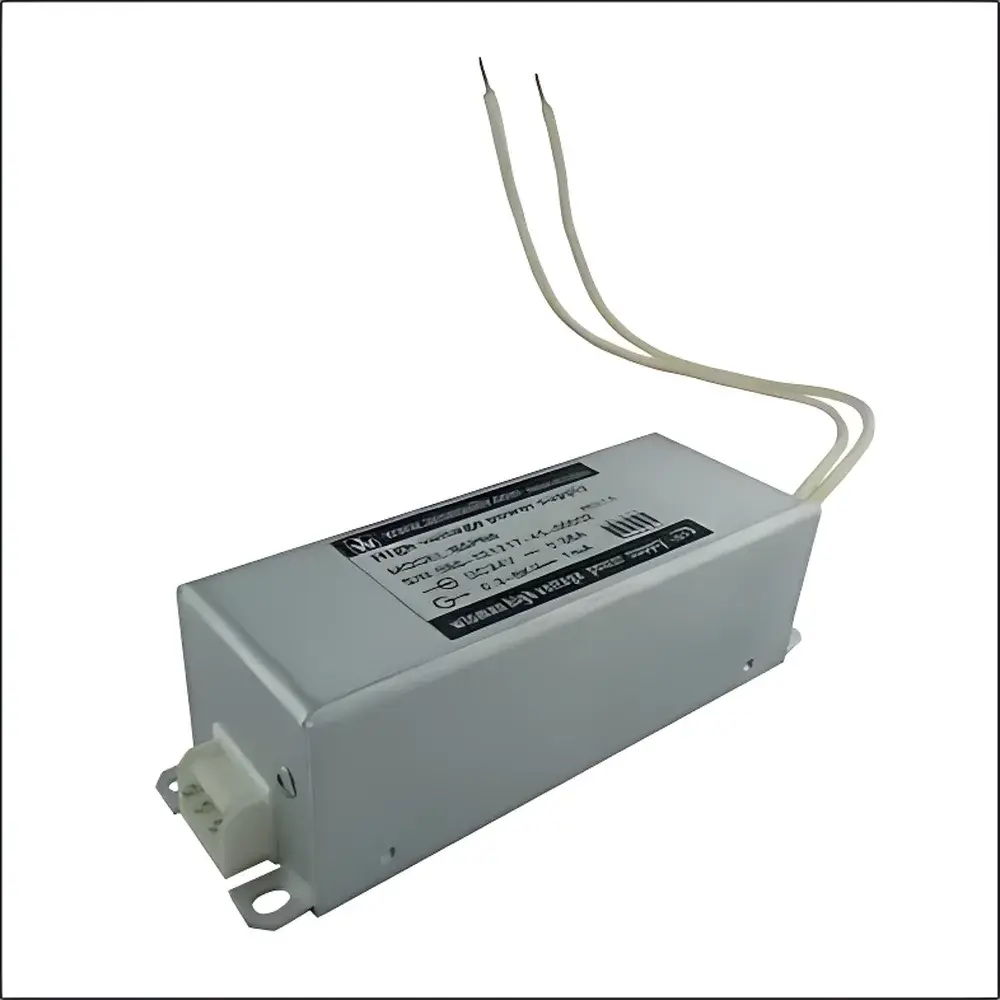
Wiseman B-Series Bipolar High-Voltage Power Supply Module, 25 kV / 6 W
| Brand | Wiseman |
|---|---|
| Origin | Shaanxi, China |
| Manufacturer Type | Authorized Distributor |
| Country of Origin | China |
| Model | B |
| Output Voltage Range | 0.3–25 kV (selectable in standard steps) |
| Output Power | 6 W |
| Input Voltage | 2–24 VDC |
| Input Current | ≤360 mA |
| Polarity | Reversible Bipolar (±) |
| Isolation Voltage | ±7 kV DC (≤6 kV models) |
| Load Regulation | 12% (for 50% load change) |
| Protection | Arc detection & transient short-circuit protection |
| Operating Temperature | −10 °C to +60 °C |
| Humidity | 30–85% RH (non-condensing) |
| Compliance | Designed for OEM integration in analytical instrumentation requiring IEC 61010-1 safety isolation and EMC robustness |
| Primary Applications | Mass spectrometry ion sources, PMTs, MCPs, electron/ion beam focusing, electrostatic chucks, piezoelectric actuators, avalanche photodiodes |
Overview
The Wiseman B-Series is a compact, bipolar, proportional high-voltage power supply module engineered for precision OEM integration in scientific instrumentation where stable, polarity-reversible biasing is critical. Unlike conventional unipolar HV supplies, the B-Series employs a fully isolated, transformer-coupled architecture enabling true floating operation—allowing the entire output stage to be elevated above ground or referenced to an external potential (e.g., detector bias rails or RF electrode stacks). Its core operating principle relies on zero-current resonant (ZCR) switching topology, which minimizes switching noise, ensures low output ripple (<0.05% RMS typical), and delivers exceptional long-term stability under variable load conditions. With output voltage linearly proportional to input control voltage (e.g., 0–10 V analog command → 0–25 kV), the module eliminates the need for complex digital feedback loops while maintaining traceable linearity across its full range. It is explicitly designed for applications demanding high dielectric integrity, such as mass spectrometer ion optics, microchannel plate (MCP) gain control, and electrostatic lens arrays—where even minor voltage drift or EMI-induced transients can compromise signal-to-noise ratio or spectral resolution.
Key Features
- Fully reversible bipolar output (± polarity selectable via external wiring configuration—no internal hardware modification required)
- True floating output stage: primary-to-secondary isolation rated to ±7 kV DC (models ≤6 kV); enables biasing relative to elevated potentials in multi-stage detectors or RF-driven systems
- Proportional analog control: output scales linearly with input voltage (e.g., 2–24 VDC input → 0.3–25 kV output), supporting seamless integration with DAQ-controlled ramping or closed-loop stabilization circuits
- Low-noise ZCR topology: achieves <50 mVp-p ripple at full load and minimal conducted EMI—critical for charge-sensitive amplifiers and photon-counting electronics
- Compact OEM form factor: standardized mechanical footprint compatible with C1–C6 housing variants; weight <120 g (module-only)
- Integrated arc suppression and momentary short-circuit protection: recovers automatically after fault clearance without latch-up or manual reset
- Input/output galvanic isolation compliant with IEC 61010-1 reinforced insulation requirements for measurement category CAT II
Sample Compatibility & Compliance
The B-Series is validated for direct integration into vacuum-compatible and radiation-hardened subsystems used in analytical instruments. It meets creepage and clearance requirements per IEC 61010-1 for pollution degree 2 environments and supports continuous operation in ambient humidity up to 85% RH (non-condensing). While not certified to UL/CSA standalone standards due to its OEM-module classification, it is routinely deployed in FDA-regulated mass spectrometry platforms (e.g., LC-MS, MALDI-TOF) where final system-level validation includes electromagnetic compatibility (EMC) testing per CISPR 11 Group 1 Class A and safety assessment per 21 CFR Part 11 data integrity guidelines. The module’s low leakage current (<1 µA at rated voltage) and absence of high-frequency harmonics ensure compatibility with grounded Faraday cages and shielded detector housings common in PMT- and MCP-based spectroscopy systems.
Software & Data Management
As an analog-controlled module, the B-Series does not include embedded firmware or digital communication interfaces (e.g., RS-232, USB, or Ethernet). However, it is fully compatible with industry-standard analog I/O modules from National Instruments (PCIe-6363), Keysight (U2531A), and Beckhoff (EL3102) for programmable voltage ramping, sweep generation, and real-time monitoring via external DAQ systems. When integrated into GLP/GMP-compliant workflows, users implement audit-trail-capable control software (e.g., LabVIEW with NI Audit Trail Toolkit or MATLAB Production Server with logging enabled) to record setpoint history, timestamps, and operational status. All analog control lines are referenced to module-local ground, eliminating ground-loop risks in multi-supply instrument architectures.
Applications
- Mass spectrometry: Ion source acceleration, quadrupole/dc biasing, reflectron voltage control, and collision cell potential tuning
- Photodetection systems: High-gain biasing of photomultiplier tubes (PMTs) and microchannel plates (MCPs) with dynamic polarity reversal for pulse-height discrimination
- Electron and ion beam instrumentation: Electrostatic lens focusing, beam blanking, and deflection plate biasing in SEM, TEM, and focused ion beam (FIB) tools
- Electrophoresis and capillary electrophoresis: High-field separation voltage generation with rapid polarity switching
- Piezoelectric actuation: Nanopositioner and adaptive optic mirror biasing requiring low-noise, high-impedance voltage sourcing
- Avalanche photodiode (APD) and silicon photomultiplier (SiPM) biasing: Stable overvoltage operation with sub-millisecond recovery from microdischarges
FAQ
Can the B-Series module operate with its output referenced to a high-voltage rail (e.g., +10 kV) rather than earth ground?
Yes—the module’s reinforced isolation allows the entire secondary side to float up to ±7 kV relative to primary ground, enabling direct connection to elevated potentials in multi-stage detector stacks.
Is remote polarity reversal possible without physical rewiring?
No—polarity reversal requires changing the external output terminal connections per the wiring diagram in the datasheet; no internal relay or solid-state switch is provided.
What is the maximum allowable input voltage ripple for stable 25 kV output?
Input ripple should be limited to <100 mVp-p at frequencies below 10 kHz to prevent modulation artifacts on the high-voltage output.
Does the module support constant-current mode?
No—it operates exclusively in constant-voltage mode with inherent current limiting during overload or arcing events.
Are calibration certificates available for traceable voltage output?
Wiseman provides factory calibration reports (NIST-traceable via internal HV divider verification); full ISO/IEC 17025 calibration is available upon request for system integrators requiring documented uncertainty budgets.
Related Products



