
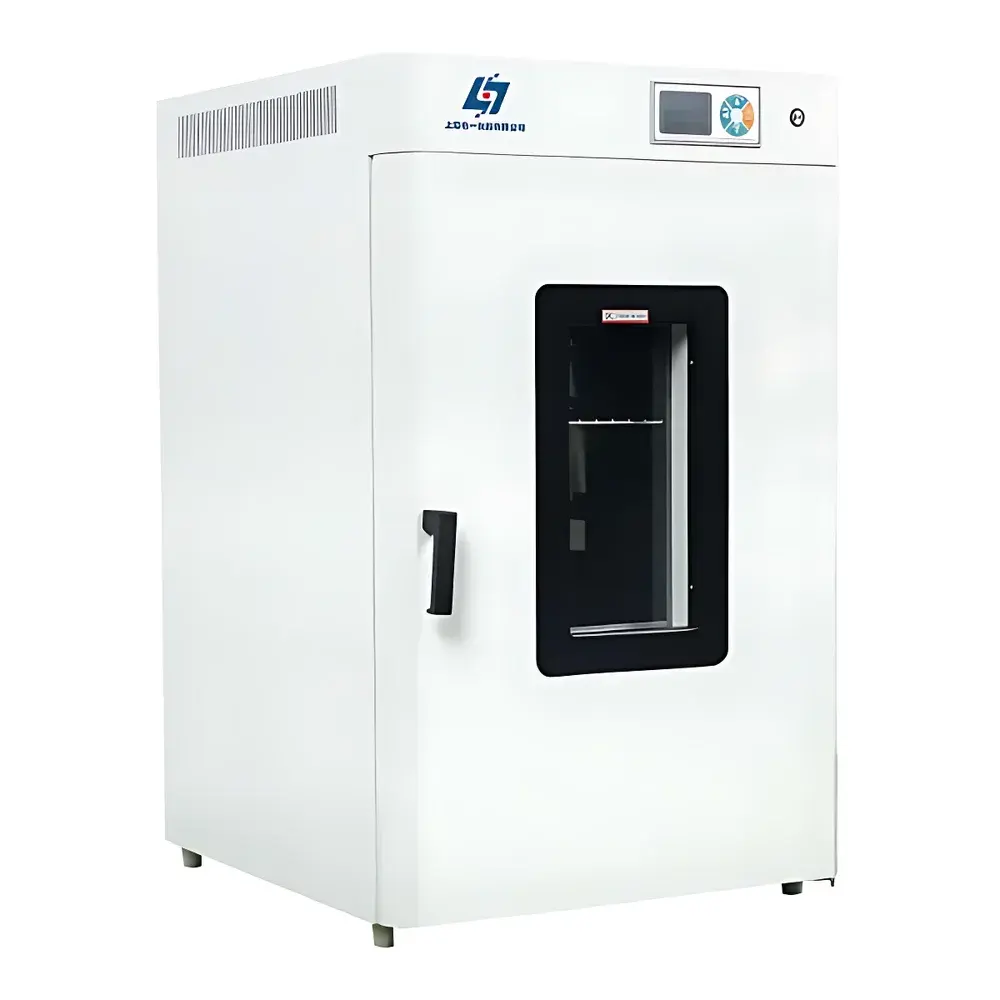
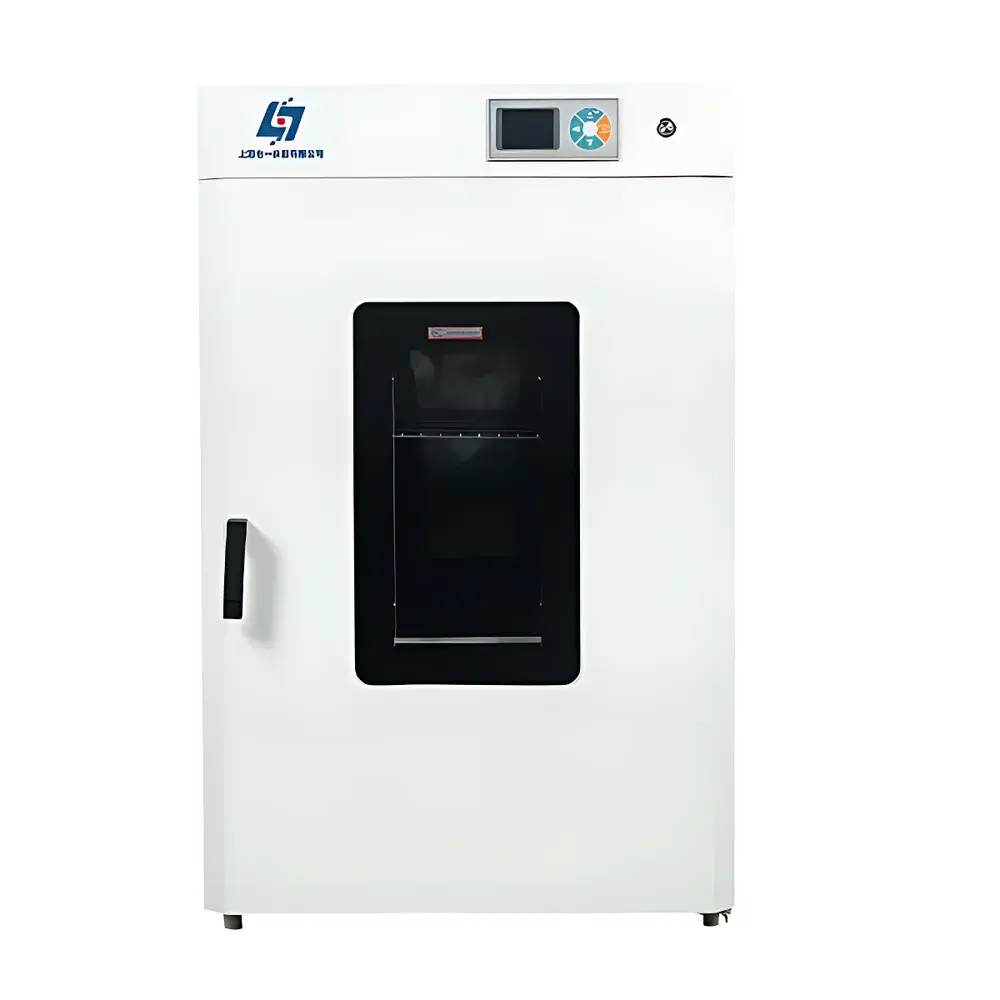
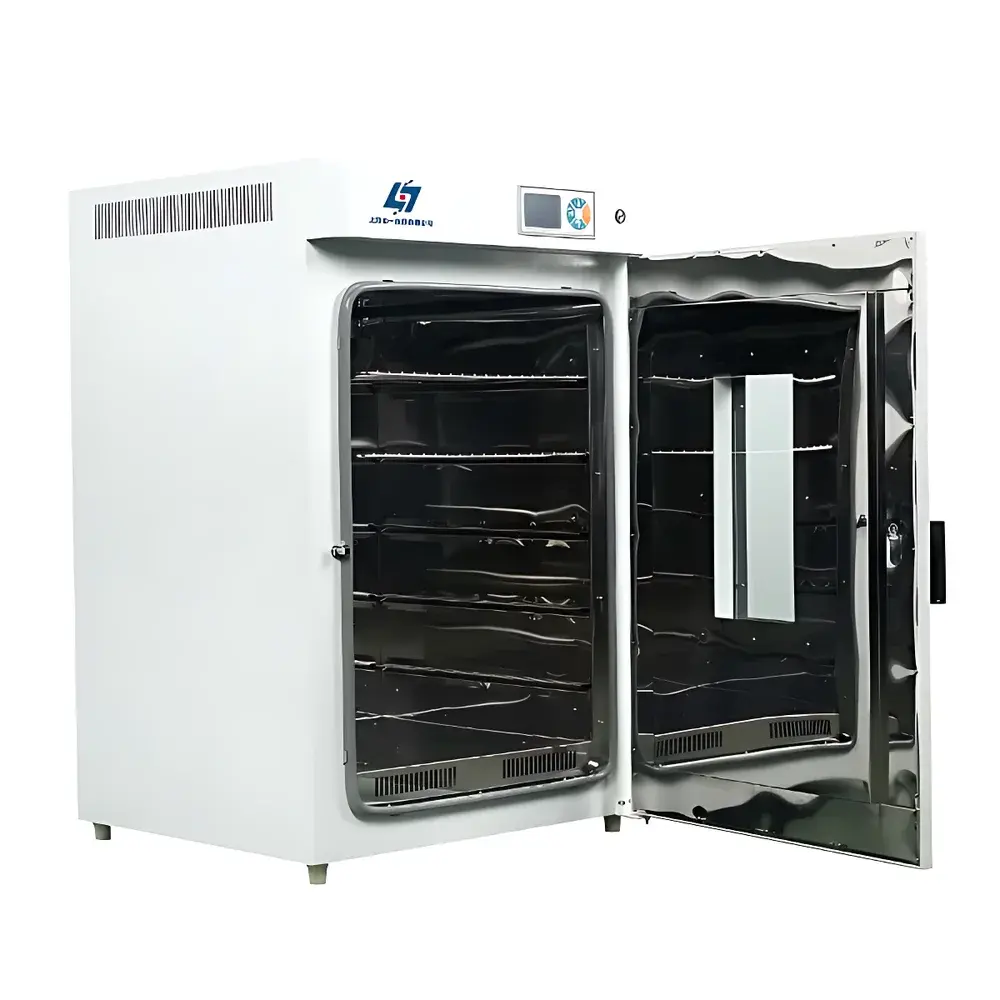
Yoyi DHG-9146A Precision Forced-Air Constant-Temperature Drying Oven
| Brand | Yoyi |
|---|---|
| Origin | Shanghai, China |
| Manufacturer Type | Direct Manufacturer |
| Product Category | Domestic |
| Model | DHG-9146A |
| Instrument Type | Precision Drying Oven |
| Temperature Range | RT+10°C to 300°C |
| Temperature Uniformity | ±2.5% (at 100°C, empty chamber) |
| Temperature Fluctuation | ±1.0°C |
| External Dimensions (W×D×H) | 640×710×905 mm |
| Internal Chamber Dimensions (W×D×H) | 450×550×550 mm |
| Chamber Material | Mirror-Finish Stainless Steel (SUS304) |
| Heating Method | Electric Resistive Heating |
| Power Input | 1550 W |
| Timer Range | 1–9999 minutes |
| Temperature Resolution | 0.1°C |
| Compliance | GB/T 30435–2013 |
Overview
The Yoyi DHG-9146A is a vertically oriented, microprocessor-controlled forced-air drying oven engineered for precision thermal processing in regulated laboratory and industrial quality control environments. It operates on the principle of convection-driven heat transfer, utilizing an optimized rear-mounted air circulation system with adjustable airflow distribution to ensure uniform thermal exposure across the entire working chamber. Designed to meet the structural and performance requirements of GB/T 30435–2013, this oven delivers stable, repeatable temperature control within a wide operational range of RT+10°C to 300°C—making it suitable for applications demanding thermal stability beyond standard ambient conditions, including polymer curing, moisture loss analysis, pre-weighing sample conditioning, sterilization validation support, and residual solvent removal.
Key Features
- Microcomputer-based PID temperature controller with intuitive LCD menu interface: simultaneous display of setpoint, real-time chamber temperature, and remaining timer duration
- Intelligent data retention logic: automatically preserves user-defined parameters—including temperature setpoints, timing sequences, and alarm thresholds—during unexpected power interruption or system reset
- Double-layer tempered glass observation window with large viewing area, enabling non-intrusive visual monitoring without compromising thermal integrity
- High-efficiency forced-air circulation architecture: rear-mounted blower, symmetrical ducting, and directional venting ensure rapid thermal equilibration and minimize axial/radial gradients
- Dual safety protection system: primary electronic thermostat + optional independent mechanical overtemperature cutoff (UL/IEC-compliant limit switch), interrupting power supply if preset safety threshold is exceeded
- Modular chamber design: interior constructed from electropolished SUS304 stainless steel; removable, height-adjustable stainless steel shelves (standard: 2 pcs); high-temperature silicone door gasket ensures long-term sealing integrity
- Integrated passive ventilation: rear-mounted automatic intake/exhaust ports maintain controlled atmospheric exchange during prolonged operation, mitigating internal condensation and pressure buildup
Sample Compatibility & Compliance
The DHG-9146A accommodates a broad spectrum of sample formats—including Petri dishes, weighing boats, crucibles, glass vials, aluminum pans, and custom fixtures—within its 136 L usable chamber volume. Its stainless-steel interior resists corrosion from acidic vapors, organic solvents, and saline residues, supporting extended use in pharmaceutical stability testing (ICH Q1), food moisture content determination (AOAC 950.46), and materials science preconditioning per ASTM D618. The unit complies with national standard GB/T 30435–2013 for electrically heated forced-convection ovens and incorporates design elements aligned with ISO/IEC 17025 laboratory infrastructure requirements. Optional RS485 communication enables integration into GLP/GMP audit trails when paired with validated data logging software.
Software & Data Management
While the base configuration features embedded firmware with local parameter storage and time-stamped event logging (e.g., door open/close, overtemperature alert), optional digital interfaces expand traceability capabilities. The RS485 port supports Modbus RTU protocol for bidirectional communication with SCADA systems or centralized lab management platforms. When connected to compatible software, users can generate CSV-formatted temperature logs compliant with FDA 21 CFR Part 11 requirements—including electronic signatures, audit trail activation, and user-level access control. An optional embedded thermal printer provides hard-copy output of temperature profiles and cycle completion reports—ideal for SOP-driven workflows requiring immediate documentation.
Applications
- Moisture content analysis in food, feed, and agricultural commodities (per AOAC, ISO 712)
- Pre-drying of filter papers, gravimetric filters, and ceramic crucibles prior to ashing or residue quantification
- Thermal stabilization of reference standards and calibration weights under controlled humidity-avoidant conditions
- Accelerated aging studies of polymeric packaging materials and adhesives (ASTM F1980)
- Baking and curing of thin-film coatings, PCB substrates, and sensor components in electronics manufacturing
- Supporting microbiological sterility assurance protocols via dry-heat depyrogenation cycles (USP )
- Residual solvent evaporation in pharmaceutical intermediate processing (ICH Q5C)
FAQ
What is the maximum operating temperature of the DHG-9146A?
The unit is rated for continuous operation up to 300°C, verified under no-load conditions per GB/T 30435–2013 test methodology.
Does the oven support programmable multi-segment temperature ramps?
Multi-stage programming is available as an optional accessory—the Yoyi Multi-Step Temperature Controller (Model: MSTC-3)—enabling up to 30 segments with independent ramp rates, soak times, and hold temperatures.
Can inert gas purging be implemented safely inside the chamber?
Yes—an optional inert gas inlet kit (including stainless-steel quick-connect fitting and calibrated rotameter) allows controlled nitrogen or argon flow to suppress oxidation during thermal treatment of sensitive samples.
Is the temperature uniformity specification validated at all setpoints?
Uniformity data (±2.5% at 100°C, empty chamber) is representative; actual performance varies with load configuration and airflow settings—users are advised to perform in-house mapping per ISO/IEC 17025 Annex A.3 for critical applications.
How is calibration traceability maintained?
The unit accepts external Class A PT100 probes for periodic verification; Yoyi provides NIST-traceable calibration certificates upon request for both temperature sensor and controller assembly.



