
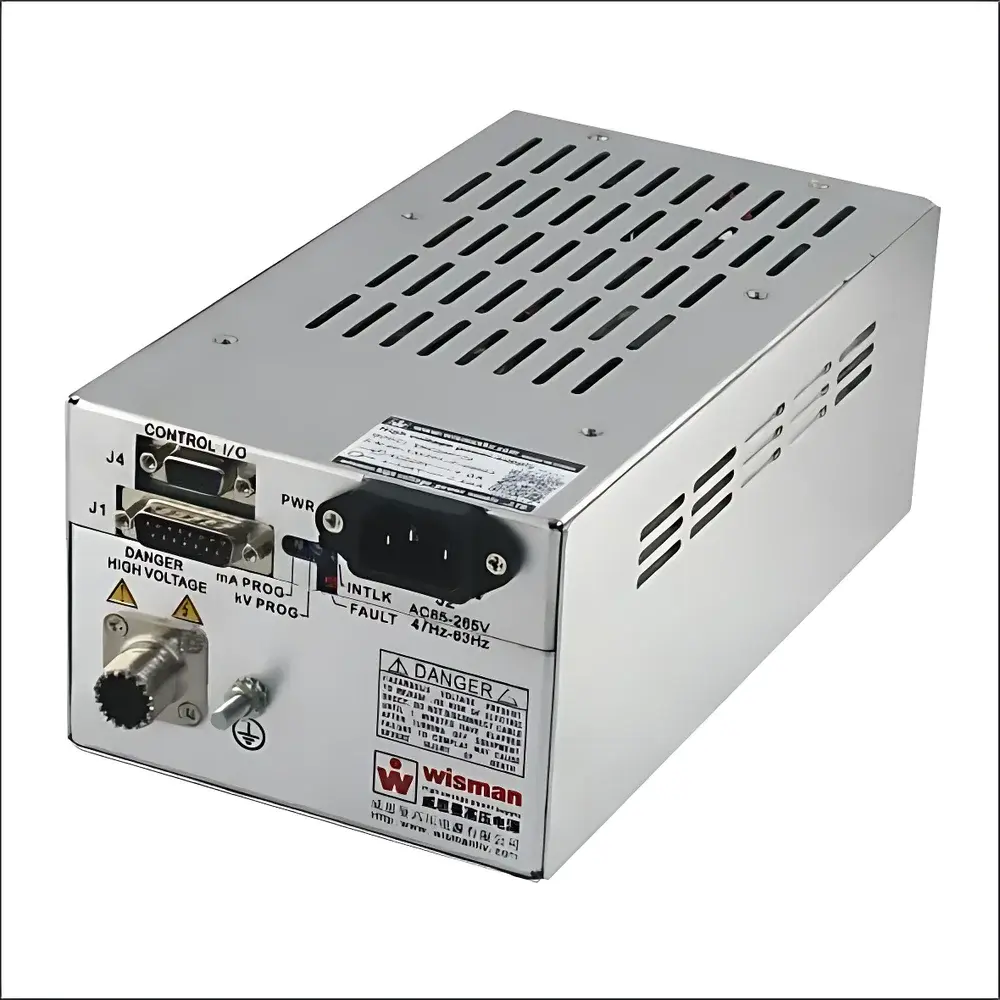
Wiseman MRC Series 70 kV / 120 W High-Voltage Power Supply Module
| Brand | Wiseman |
|---|---|
| Output Voltage | ±70 kV (selectable polarity) |
| Output Power | 120 W |
| Input Voltage | 86–265 VAC, 47–63 Hz |
| Ripple | ≤0.1% P-P (of rated output voltage) |
| Stability | ≤0.02% over 8 hours |
| Temperature Coefficient | ≤25 ppm/°C |
| Control Interfaces | Analog 0–10 V, USB 2.0, RS-232, RS-422 (optional) |
| Protection | Overvoltage, Overcurrent, Arc Detection, Interlock |
| Cooling | Convection |
| Dimensions | 240 × 92 × 140 mm |
| Operating Temperature | 0–50 °C |
| Compliance | Designed for OEM integration in analytical and scientific instrumentation |
Overview
The Wiseman MRC Series is a high-stability, precision DC high-voltage power supply module engineered for demanding laboratory and industrial applications requiring tightly regulated, low-noise, and highly reproducible DC potentials. Based on zero-current resonant converter topology and advanced high-voltage insulation design, the MRC series delivers up to ±70 kV at 120 W continuous output with exceptional long-term stability and minimal electromagnetic interference. Its architecture supports both positive and negative polarity configurations, making it suitable for electrostatic field generation, dielectric strength testing, electrophoresis systems, and other applications where controlled, ultra-stable HV bias is critical. Unlike general-purpose HV supplies, the MRC is specifically optimized for instrument-grade integration—featuring analog and digital control interfaces, real-time monitoring outputs, and comprehensive safety interlocks compliant with IEC 61010-1 requirements for measurement and laboratory equipment.
Key Features
- Precise output regulation: Stability of ≤0.02% over 8 hours after warm-up; temperature coefficient ≤25 ppm/°C ensures minimal drift across ambient variations.
- Ultra-low ripple and noise: ≤0.1% peak-to-peak of full-scale output voltage, essential for sensitive electrostatic and analytical measurements.
- Flexible control architecture: Internal multi-turn potentiometer for local adjustment; external 0–10 V analog interface for remote voltage/current programming; optional digital communication via USB 2.0, RS-232, or RS-422 for automated test system integration.
- Robust protection suite: Comprehensive safeguards include overvoltage lockout, overcurrent limiting, arc detection with auto-recovery, and hardware-enforced safety interlock circuitry compatible with external emergency stop or chamber door sensors.
- OEM-optimized form factor: Compact 240 × 92 × 140 mm convection-cooled chassis with DB15 I/O connector (carrying control signals, monitor outputs, and interlock lines) and recessed insulated HV output port with 1 m shielded cable.
- Wide input tolerance: Operates from 86–265 VAC, 47–63 Hz, enabling global deployment without external transformers or line conditioners.
Sample Compatibility & Compliance
The MRC module is designed for integration into instruments where high-voltage bias must remain stable under variable load conditions—particularly electrophoresis systems, corona discharge chambers, electrostatic separators, and dielectric withstand testers. It meets fundamental safety requirements per IEC 61010-1 (Edition 3) for electrical equipment for measurement, control, and laboratory use. While not certified as a standalone medical device, its design principles align with FDA 21 CFR Part 11 data integrity expectations when embedded in validated analytical platforms. The module supports GLP/GMP-aligned workflows through deterministic analog control, traceable voltage/current monitor outputs (0–10 V, ±1% accuracy), and deterministic fault logging via digital interface. It is not intended for direct human exposure and must be installed within an interlocked enclosure per local electrical safety regulations.
Software & Data Management
Digital control options (USB 2.0, RS-232, RS-422) provide bidirectional communication using ASCII-based command protocols. Users can configure output setpoints, enable/disable outputs, query real-time voltage/current readings, and retrieve status flags (e.g., arc event count, interlock state, thermal warning). All commands support checksum verification for robustness in noisy industrial environments. Monitor outputs (0–10 V proportional to actual V/I) allow connection to DAQ systems or PLCs for closed-loop process control or audit-trail recording. Firmware updates are performed via USB without hardware modification. No proprietary runtime software is required—integration is supported via standard serial libraries (e.g., PySerial, LabVIEW VISA, MATLAB Instrument Control Toolbox).
Applications
- Electrophoresis instrumentation: Provides stable, programmable HV bias for capillary electrophoresis (CE), gel electrophoresis, and microchip-based separation systems.
- Dielectric strength testing: Used in benchtop and automated test fixtures for evaluating insulation integrity of capacitors, cables, PCB substrates, and polymer films per ASTM D149 and IEC 60243 standards.
- Electrostatic processes: Enables precise field control in electrostatic coating, particle charging, agricultural seed sorting, and air ionization systems.
- Scientific research: Supports plasma initiation, electron gun biasing, mass spectrometer ion optics, and nanomaterial synthesis setups requiring stable kilovolt-level potentials.
- OEM instrumentation: Serves as a drop-in HV subsystem in X-ray generator controls, laser driver stages, and custom analytical sensor excitation circuits.
FAQ
Is the MRC module suitable for use in CE-certified analytical instruments?
Yes—the module’s isolation ratings, creepage/clearance design, and compliance with IEC 61010-1 fundamentals make it appropriate for incorporation into CE-marked equipment, provided final system-level validation is completed.
Can output polarity be switched remotely during operation?
No—polarity (positive or negative) is fixed at time of order and cannot be reversed electronically. Dual-polarity versions require separate hardware configuration.
What is the maximum allowable load capacitance?
For stable operation and arc suppression, total connected capacitance should not exceed 10 nF. Higher values may require external snubbing or derating per application note AN-MRC-02.
Does the module support 21 CFR Part 11-compliant audit trails?
The module itself does not store logs, but its digital interface enables timestamped command logging and monitor-output acquisition by host systems meeting Part 11 requirements.
Is convection cooling sufficient for continuous 120 W operation at 70 kV?
Yes—thermal design validates full-rated output at +50 °C ambient with unrestricted airflow. Forced-air cooling is not required but may extend service life in enclosed enclosures.



