
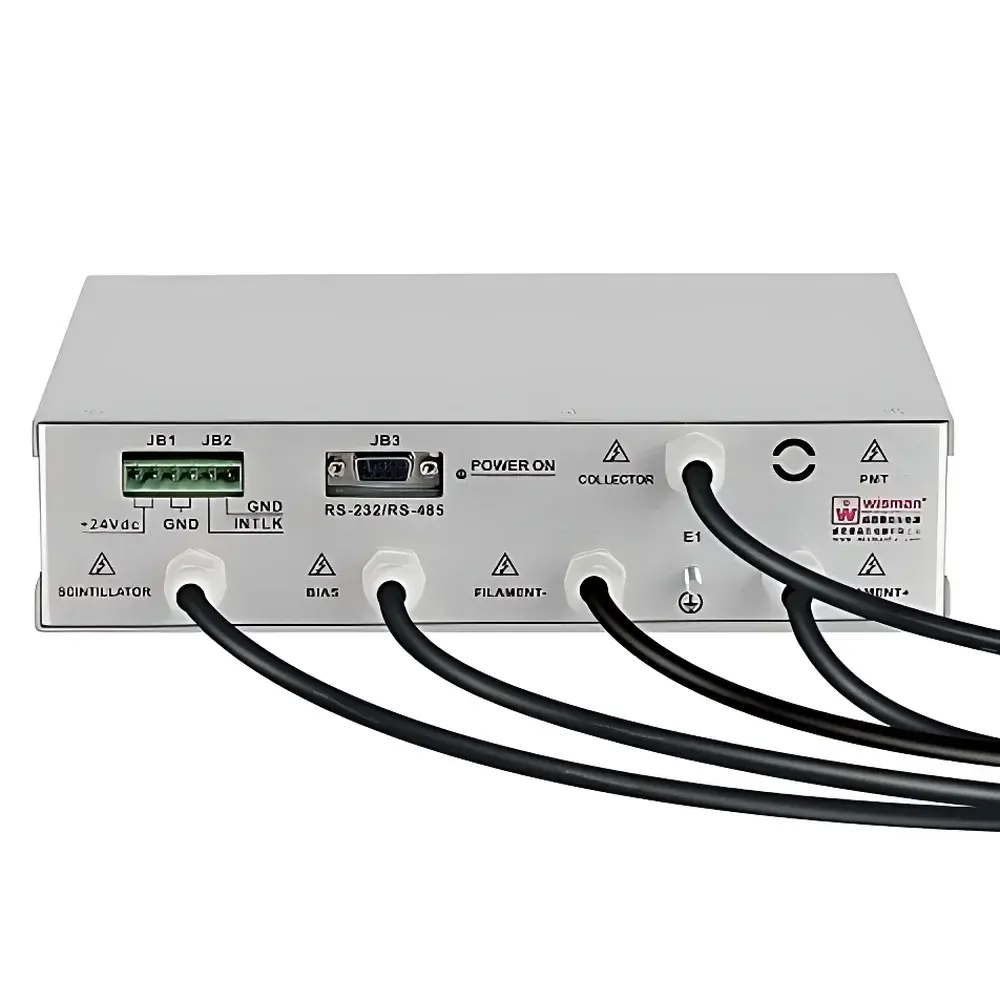
Wiseman EM30kV/9W Instrument-Dedicated High-Voltage Power Supply for Mass Spectrometry
| Brand | Wiseman |
|---|---|
| Model | EM30kV/9W |
| Output Voltage Range (Accelerator) | –30 kV to +30 V |
| Output Current | 200 µA |
| Load Regulation | < ±100 ppm (0–100% load) |
| Line Regulation | < ±100 ppm (±10% input variation) |
| Ripple | ≤10 ppm |
| Temperature Coefficient | 100 ppm/°C |
| Short-Term Stability | 10 ppm / 3 min (after 1-hr warm-up) |
| BIAS Output | 0 to –2000 V, 0–150 µA |
| FIL+ Output | 0–3 A @ 1 Ω |
| SCI Output | 0–10 kV, 0–250 µA |
| COL Output | 0–400 V, 0–500 µA |
| PMT/MCP Output | 0–1500 V, 0–1000 µA |
| Operating Temperature | 0–40 °C |
| Cooling | Forced-air (front intake / rear exhaust) |
| Weight | 5 kg |
Overview
The Wiseman EM30kV/9W is a precision-engineered, multi-channel instrument-dedicated high-voltage power supply designed specifically for demanding analytical instrumentation—most notably mass spectrometers requiring stable, low-noise biasing and acceleration potentials. Built upon Wiseman’s proprietary zero-current resonant topology and advanced high-voltage insulation architecture, the EM30kV/9W delivers exceptional voltage stability, ultra-low ripple, and minimal electromagnetic interference—critical parameters for maintaining ion trajectory fidelity, signal-to-noise ratio, and quantitative reproducibility in high-resolution mass analysis. Unlike general-purpose HV supplies, this unit integrates six independently regulated output channels—Accelerator (EM30N6), BIAS, FIL+, SCI, COL, and PMT/MCP—each optimized for its functional role within the detector or ion optics chain. Its compact 5 kg chassis employs forced-air cooling with front-intake/rear-exhaust airflow, enabling reliable operation in standard laboratory environments (0–40 °C, 10–90% RH non-condensing) without external chillers or water loops.
Key Features
- Multi-channel architecture: Six fully isolated, independently adjustable outputs—accelerator (–30 kV to +30 V), BIAS (0 to –2000 V), filament (0–3 A @ 1 Ω), scintillator (0–10 kV), collector (0–400 V), and PMT/microchannel plate (0–1500 V)—all synchronized via internal timing logic.
- Sub-ppm stability performance: Accelerator channel achieves ≤10 ppm/3 min short-term stability after 1-hour thermal equilibrium; SCI, COL, and PMT outputs maintain ≤0.007%/hr drift—meeting stringent requirements for long-duration acquisition protocols under GLP/GMP conditions.
- Ultra-low noise design: All outputs exhibit ≤10 ppm RMS ripple (accelerator) and ≤0.001% ripple (SCI/COL/PMT), minimizing baseline fluctuations and spectral artifacts in time-of-flight (TOF) and quadrupole-based systems.
- High line and load regulation: <±100 ppm line regulation (±10% input variation) and <±100 ppm load regulation (0–100% load) ensure consistent voltage delivery across dynamic operational states—including rapid scanning and pulsed ionization modes.
- Ruggedized industrial packaging: Aluminum chassis with conformal-coated PCBs, reinforced HV connectors, and integrated EMI filtering compliant with CISPR 11 Class B emissions limits—suitable for integration into OEM mass spectrometer platforms and certified cleanroom installations.
Sample Compatibility & Compliance
The EM30kV/9W is engineered for seamless integration with benchtop and high-end mass spectrometry systems—including magnetic sector, TOF, Orbitrap, and triple-quadrupole configurations—where precise control of ion acceleration, electron multiplier gain, and detector biasing directly impacts mass accuracy, resolution, and detection limits. Its outputs meet the electrical interface specifications defined in ASTM E1598 (Standard Practice for Calibration of Mass Spectrometers), ISO/IEC 17025:2017 (clause 6.4.8 on equipment suitability), and USP (Analytical Instrument Qualification). The unit supports audit-ready operation through optional analog monitoring ports and RS-232/RS-485 interfaces compatible with FDA 21 CFR Part 11-compliant SCADA and LIMS environments when paired with validated firmware and electronic logbook modules.
Software & Data Management
While the EM30kV/9W operates as a stand-alone analog-controlled supply, it includes standardized 0–10 V analog input/output ports for remote setpoint programming and real-time voltage/current monitoring. For automated workflows, Wiseman provides optional communication modules supporting Modbus RTU over RS-485—enabling bidirectional parameter control, fault logging, and event-triggered shutdown sequences. All firmware versions undergo traceable revision control per IEC 62304 Class B software lifecycle requirements. Configuration files, calibration certificates, and test reports are archived in accordance with ISO 9001:2015 clause 7.5.3 and retained for ≥15 years for regulatory audit purposes.
Applications
- Mass spectrometer ion acceleration and deceleration stages (e.g., reflectron TOF, electrostatic mirrors)
- Electron multiplier and microchannel plate (MCP) gain control in secondary electron detectors
- Scintillation detector biasing for time-resolved ion counting (e.g., in MALDI-TOF and SIMS instruments)
- Filament current regulation for electron ionization (EI) and chemical ionization (CI) sources
- Collector electrode biasing in Faraday cup and beam current measurement subsystems
- OEM integration into compact, portable, or field-deployable MS platforms requiring low SWaP-C (Size, Weight, Power, and Cost) constraints
FAQ
Is the EM30kV/9W compatible with FDA-regulated mass spectrometry workflows?
Yes—the unit supports traceable calibration, configurable alarm thresholds, and optional electronic audit trails when deployed with Wiseman’s validated communication firmware and third-party LIMS integration packages compliant with 21 CFR Part 11 Annex 11 requirements.
What safety certifications does this power supply hold?
The EM30kV/9W conforms to IEC 61010-1:2010 (Measurement, Control, and Laboratory Equipment Safety Requirements), including double-reinforced insulation for all HV outputs and automatic current limiting at 200 µA on the accelerator channel.
Can multiple EM30kV/9W units be synchronized for phased-array detector systems?
Yes—via external trigger inputs and shared reference clocks, up to eight units can be daisy-chained for time-aligned voltage ramping in multi-stage ion optics assemblies.
Does Wiseman provide application-specific qualification documentation?
Yes—upon request, Wiseman supplies IQ/OQ documentation templates, risk assessments per ISO 14971, and installation verification checklists tailored to mass spectrometry OEM integration projects.
What is the recommended recalibration interval?
Annual recalibration is advised per ISO/IEC 17025 and manufacturer guidelines; however, stability data from accelerated life testing supports extended intervals (up to 24 months) under controlled lab conditions with documented environmental monitoring.



