
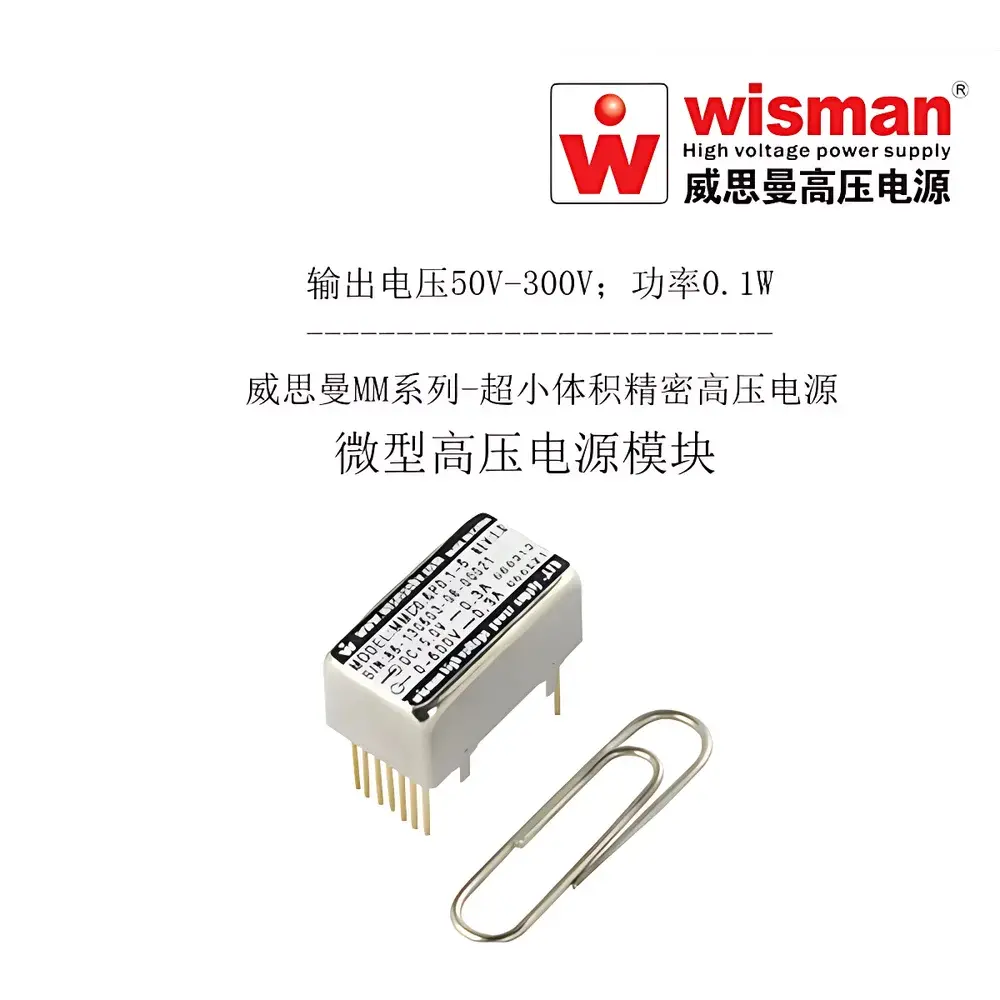


Wiseman MMC Miniature High-Voltage Power Supply Module – 0.6 kV / 0.1 W
| Brand | Wiseman |
|---|---|
| Origin | Shaanxi, China |
| Model | MMC |
| Output Voltage | 0.6 kV (600 V) |
| Output Power | 0.1 W |
| Output Ripple & Noise | ≤5 mV<sub>PP</sub> |
| Stability | 0.001% per hour |
| Temperature Coefficient | 10 ppm/°C |
| Input Voltage | +5 V ±0.5 V (optional: ±12 V, ±15 V, ±24 V) |
| Dimensions | Ø20 mm × 11 mm × 9 mm |
| Weight | 9 g |
| Protection | Reverse polarity, overcurrent, short-circuit, arc detection |
| Mounting | PCB-mount |
| Shielding | Full 6-side electromagnetic shielding |
| Compliance | Designed for OEM integration in analytical instrumentation |
Overview
The Wiseman MMC Miniature High-Voltage Power Supply Module is an ultra-compact, DC/DC-conversion-based high-voltage source engineered for precision biasing and excitation in sensitive scientific instrumentation. Operating on zero-current resonant topology and advanced high-voltage insulation design, the MMC delivers regulated output voltages up to 600 V DC with exceptional stability and minimal electromagnetic interference. Its core architecture targets applications requiring low-noise, high-reproducibility HV bias—particularly where space constraints, thermal management, and signal integrity are critical. Unlike rack-mounted or chassis-integrated HV supplies, the MMC is designed as a surface-mountable module optimized for direct integration into printed circuit assemblies of mass spectrometers, photomultiplier tube (PMT) detectors, microchannel plates (MCPs), and ion optics subsystems. It meets the stringent electrical performance demands of laboratory-grade analytical systems while adhering to fundamental safety and EMC principles applicable to Class I medical and industrial equipment.
Key Features
- Ultra-miniaturized form factor: Ø20 mm × 11 mm × 9 mm, weight 9 g — ideal for embedded OEM designs and multi-channel detector arrays
- Low-noise output: ≤5 mVPP ripple under full load; typical noise <2 mVPP at mid-range voltages
- High short-term stability: 0.001% per hour; long-term drift minimized via thermally compensated feedback network
- Temperature coefficient of 10 ppm/°C ensures consistent output across commercial (–10 °C to +50 °C), industrial (–25 °C to +65 °C), and extended-temperature (–40 °C to +95 °C) operating ranges
- Full six-sided mu-metal and conductive polymer shielding provides EMI/RFI suppression compliant with CISPR 22 Class B emission limits
- Comprehensive protection suite: reverse input polarity, overvoltage lockout, continuous overcurrent limiting, arc-sensing shutdown, and control voltage fault detection
- Flexible analog control interface: 0–2.5 V input for precise remote voltage programming; 100 kΩ input impedance ensures compatibility with standard DAC outputs
- Polarity-selectable output (positive or negative) configurable at manufacturing stage to match detector electrode requirements
- Fast dynamic response: 50 ms rise time (0–99%) enables synchronized pulsing in time-of-flight (TOF) and gated detection schemes
Sample Compatibility & Compliance
The MMC module is specifically validated for use in vacuum-compatible, low-power HV subsystems where leakage current must remain below 1 µA and dielectric withstand exceeds 1.5 kV RMS. It supports direct integration with PMT dynode chains, quadrupole rod bias networks, electrostatic lens stacks, and G-M tube anodes. While not certified to IEC 61010-1 or UL 61010B as a standalone end-product, the MMC conforms to key underlying safety and EMC design practices referenced in those standards—including creepage/clearance spacing per IPC-2221, PCB material selection (FR-4 with HV-rated solder mask), and isolation testing (≥1.5 kV AC for 60 s). Its compact construction and absence of external potentiometers or exposed HV terminals reduce field-installation risk. For FDA-regulated instruments (e.g., clinical mass spectrometers), the MMC may be included within the system-level 21 CFR Part 11 validation scope when deployed with traceable calibration and firmware-controlled parameter logging.
Software & Data Management
As a hardware-only analog module, the MMC does not incorporate onboard firmware, USB interfaces, or digital communication protocols. Voltage regulation and monitoring rely entirely on external analog control signals and system-level supervision circuits. However, its predictable transfer function (linear 0–2.5 V → 0–600 V), fast settling time, and low output impedance make it fully compatible with programmable logic controllers (PLCs), FPGA-based timing engines, and DAQ systems implementing closed-loop HV calibration routines. When integrated into instruments supporting GLP/GMP workflows, the MMC’s stability specifications support documented uncertainty budgets for HV-dependent measurements—such as mass calibration drift in quadrupole MS or gain calibration in scintillation counters. Traceability is maintained through batch-specific test reports covering output line/load regulation, temperature coefficient, and ripple performance.
Applications
- Photomultiplier tube (PMT) and microchannel plate (MCP) dynode chain biasing in spectroscopy and radiation detection systems
- Quadrupole mass filter and ion trap electrode biasing in benchtop and portable mass spectrometers
- Electrostatic lens focusing and deflection in electron/ion beam columns (SEM, TEM, TOF-MS)
- High-voltage bias for proportional counters, Geiger-Müller tubes, and ionization chambers
- Electrophoresis and capillary electrophoresis power stages requiring stable, low-current HV
- OEM integration in laser driver circuits, RF amplifier bias networks, and pulsed X-ray generator trigger modules
- Scientific instrumentation requiring distributed HV nodes with minimal board real estate and thermal footprint
FAQ
Is the MMC module suitable for use in vacuum environments?
Yes — the MMC uses conformal-coated PCBs and solid-state components rated for operation under low-pressure conditions. Vacuum outgassing data (per ASTM E595) is available upon request for specific batch lots.
Can multiple MMC modules be paralleled for higher current capability?
No — the MMC is not designed for parallel operation due to lack of current-sharing circuitry and potential instability from output impedance mismatches. For >0.1 W requirements, Wiseman offers the MHC or MHV series with scalable output configurations.
Does the MMC support remote sensing or feedback compensation?
No — it operates in open-loop regulation mode. Load regulation is specified at ≤0.01%, but for applications demanding sub-0.005% accuracy, external feedback amplification or system-level calibration compensation is recommended.
What is the expected lifetime under continuous operation at 600 V and 167 µA?
Based on accelerated life testing per MIL-HDBK-217F, MTBF exceeds 100,000 hours at 40 °C ambient, assuming proper PCB thermal relief and derating per Wiseman’s application notes.
Are custom output voltage ranges available beyond the standard 50–600 V options?
Yes — Wiseman provides OEM customization including non-standard voltage steps (e.g., 375 V, 420 V), polarity inversion, and tailored control voltage scaling (0–5 V, 0–10 V) with NDA-protected design documentation.



