
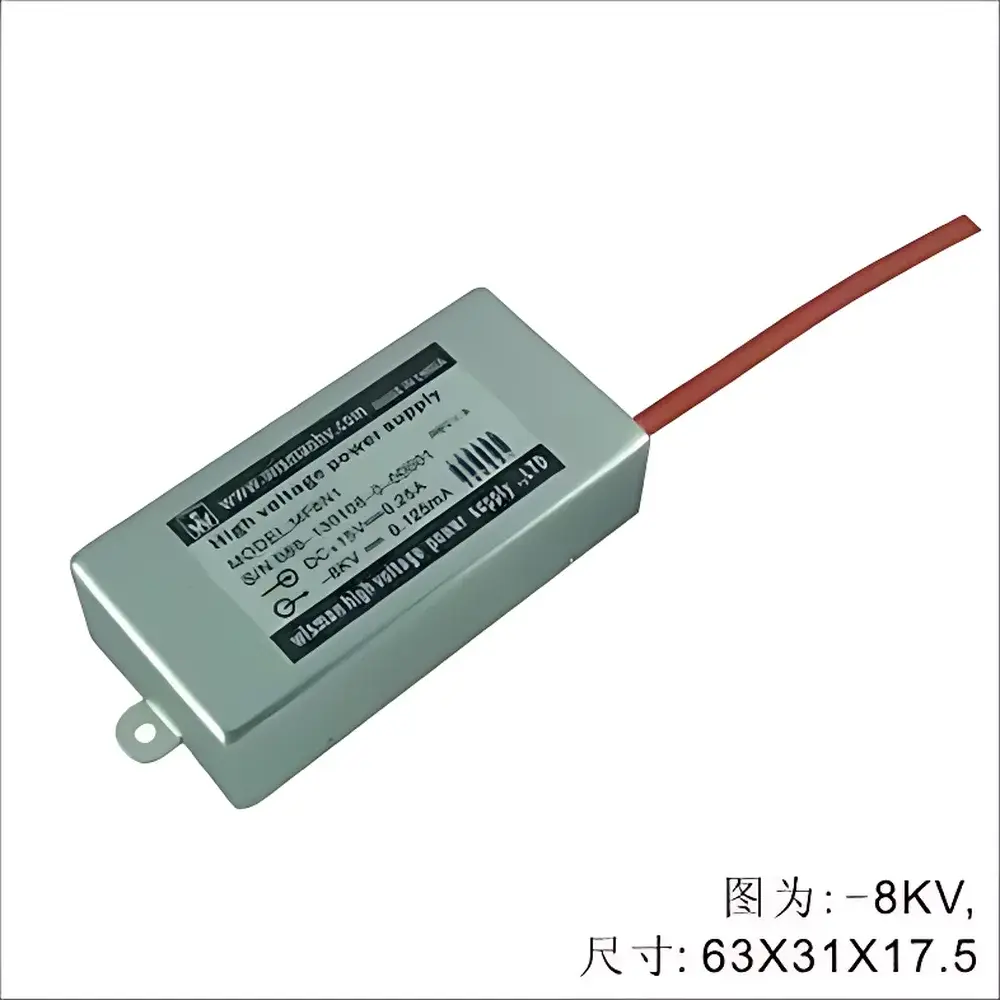

Wiseman MF10KV/2W Miniature High-Voltage DC-DC Power Module
| Brand | Wiseman |
|---|---|
| Origin | Shaanxi, China |
| Model | MF10KV/2W |
| Output Voltage Range | 0–10 kV (selectable in 0.5 kV increments) |
| Output Power | 2 W |
| Input Voltage | 15 VDC ±1 V |
| Output Ripple & Noise | <0.001% P-P |
| Stability | ±0.001% per hour |
| Temperature Coefficient | ±25 ppm/°C |
| Load Regulation | ±0.01% |
| Line Regulation | ±0.001% |
| Protection | Arc Detection, Short-Circuit, Overvoltage |
| Shielding | Full 6-Side Metal Enclosure |
| Mounting | PCB Through-Hole or Surface-Mount |
| Polarity | Selectable Positive or Negative Output |
| Operating Temperature (Commercial Grade) | –10°C to +50°C (case) |
| Dimensions | 76.2 × 31.75 × 17.34 mm |
| Weight | 65 g (typ.) |
Overview
The Wiseman MF10KV/2W is a miniature, PCB-mountable high-voltage DC-DC power module engineered for precision integration into space-constrained analytical and scientific instrumentation. Designed using zero-current resonant topology and proprietary high-voltage insulation techniques, it delivers stable, low-noise output voltages up to 10 kV with minimal electromagnetic interference (EMI) and exceptional long-term drift performance. Its core architecture employs regulated feedback control with internal high-voltage calibration circuitry, enabling accurate voltage setpoint programming via analog input (0–10 V) or external potentiometer. The module operates from a single 15 VDC input and is optimized for applications requiring clean, repeatable bias voltages—particularly where microamp-level current stability and sub-ppm-level ripple are critical, such as in mass spectrometry detector arrays, electrostatic lens systems, and solid-state radiation detectors.
Key Features
- Programmable output voltage range: 3 kV to 10 kV in 0.5 kV increments (factory-configurable)
- Maximum continuous output power: 2 W at rated voltage; supports 0.5 W and 1 W variants for lower-power integration
- Ultra-low output ripple: <0.001% peak-to-peak (measured across full load and temperature range)
- High short-term stability: ±0.001% per hour under constant thermal and load conditions
- Low temperature coefficient: ±25 ppm/°C (±0.0025% per °C), ensuring consistent performance across industrial operating environments
- Comprehensive protection suite: automatic arc detection, current-limiting short-circuit response, and overvoltage shutdown
- Full six-sided metal shielding provides >80 dB EMI attenuation and meets CISPR 32 Class B radiated emission limits
- PCB-compatible footprint with through-hole or surface-mount options; designed for automated assembly
- Selectable polarity (positive or negative high-voltage output) without hardware modification
- Three thermal grades available: Commercial (S), Industrial (G), and Extended (T), supporting operation up to +95°C case temperature
Sample Compatibility & Compliance
The MF10KV/2W is widely deployed in OEM instruments subject to rigorous regulatory oversight—including mass spectrometers compliant with IEC 61010-1 (safety) and IEC 61326-1 (EMC). Its low EMI profile and stable output support GLP/GMP-aligned workflows where voltage reproducibility directly impacts data integrity (e.g., ion optics calibration, detector gain stabilization). While not inherently certified to FDA 21 CFR Part 11, the module’s analog control interface and deterministic response time enable seamless integration into audit-trail-capable systems when paired with validated host controllers. It conforms to RoHS 3 and REACH directives, and its PCB layout adheres to IPC-2221 spacing rules for ≥10 kV working voltage (minimum creepage/clearance: 12.7 mm).
Software & Data Management
The MF10KV/2W operates as a standalone analog-controlled module and does not incorporate embedded firmware or digital communication interfaces (e.g., RS-232, USB, or CAN). Voltage setpoint is adjusted via 0–10 V analog input (20 kΩ input impedance) or 10 kΩ external potentiometer—ensuring deterministic latency (<100 µs step response) and immunity to software-induced jitter. For systems requiring programmable control, Wiseman provides reference schematics and application notes for interfacing with LabVIEW, Python (via DAQ cards), or PLC-based analog output modules. All factory calibration data—including voltage accuracy (±0.1% of full scale), line/load regulation, and thermal drift curves—is supplied in NIST-traceable test reports upon request, supporting IQ/OQ documentation for regulated laboratories.
Applications
- Mass spectrometer ion optics and detector biasing (e.g., electron multipliers, microchannel plates)
- Electrostatic focusing lenses in electron/ion beam instrumentation
- Bias supply for photomultiplier tubes (PMTs), silicon photomultipliers (SiPMs), and proportional counters
- Charging circuits for pulsed electro-optic (EO) modulators and high-voltage capacitors
- ESD simulation and testing equipment requiring calibrated, low-noise HV sources
- Capillary electrophoresis and dielectrophoresis (DEP) platforms
- Industrial X-ray source pre-bias and filament regulation subsystems
- Research-grade particle detectors, scintillation counters, and G-M tube arrays
FAQ
Is the MF10KV/2W suitable for use in UL/CE-certified medical devices?
Yes—when integrated into a system meeting IEC 60601-1 requirements, its reinforced insulation design (basic insulation + supplementary barrier per IEC 60664-1) and low leakage current (<1 µA at 10 kV) support compliance. Final certification remains the responsibility of the end-system manufacturer.
Can output voltage be digitally controlled via I²C or SPI?
No—the module uses analog voltage or potentiometer input only. Digital control requires an external DAC stage; Wiseman offers design guidance for such implementations.
What is the maximum allowable load capacitance?
For stable operation, total connected capacitance must not exceed 1 nF. Higher values require external snubbing networks, detailed in Application Note AN-MF-01.
Does Wiseman provide custom voltage/current combinations outside standard offerings?
Yes—OEM engineering support includes tailored output specs (e.g., 12 kV/1.5 W), modified thermal grading, or specialized shielding configurations, subject to minimum order quantities.
How is calibration maintained over product lifetime?
The module includes onboard high-voltage calibration trim points accessible via test pads. Annual recalibration using a NIST-traceable HV meter (e.g., Keysight B2987A) is recommended for metrology-critical applications.



