
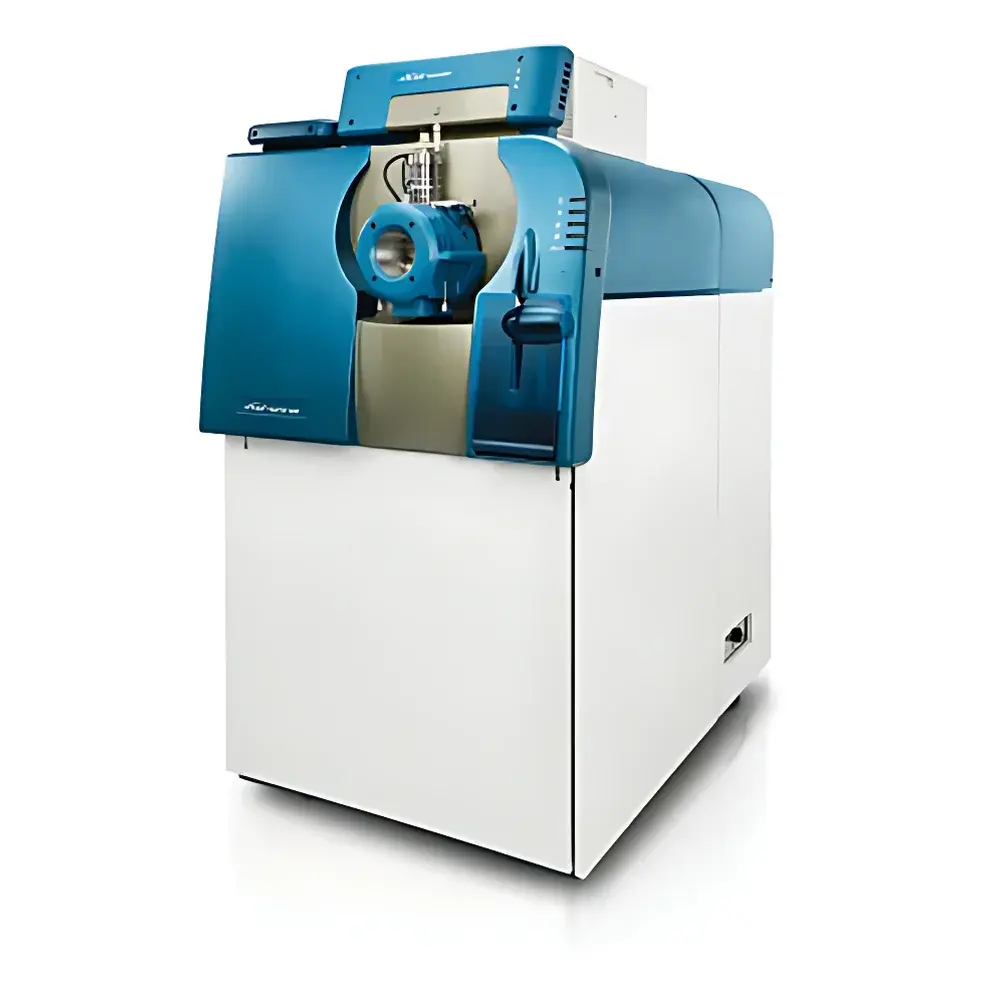
SCIEX TripleTOF® 6600 System
| Brand | SCIEX |
|---|---|
| Origin | USA |
| Model | TripleTOF® 6600 |
| Instrument Type | Quadrupole Time-of-Flight (QTOF) Mass Spectrometer |
| Ion Source | Turbo V™ Electrospray Ionization (ESI) / Atmospheric Pressure Chemical Ionization (APCI) |
| Additional Technology | SelexION® Differential Ion Mobility Spectrometry (DIMS) |
| Data Acquisition Mode | SWATH® Acquisition (Data-Independent Acquisition, DIA) |
| LC Compatibility | Analytical-, Micro-, Nano-flow LC and Capillary Electrophoresis–Electrospray Ionization (CESI) |
Overview
The SCIEX TripleTOF® 6600 System is a high-performance quadrupole time-of-flight (QTOF) mass spectrometer engineered for comprehensive, high-resolution, accurate-mass (HRAM) liquid chromatography–mass spectrometry (LC-MS) analysis. Built upon a hybrid QqTOF architecture, it integrates a robust RF-only quadrupole collision cell, orthogonal acceleration time-of-flight (oa-TOF) analyzer with reflectron optics, and advanced ion optics to deliver simultaneous high sensitivity, high mass accuracy (< 1 ppm RMS), and fast spectral acquisition rates (up to 100 Hz in MS mode, 50 Hz in MS/MS mode). Its core design supports both data-dependent acquisition (DDA) and data-independent acquisition (DIA) workflows—most notably SWATH® Acquisition—which enables consistent, reproducible, and unbiased fragmentation of all detectable precursor ions within user-defined m/z windows. This makes the TripleTOF 6600 particularly suited for untargeted discovery proteomics, metabolomics, lipidomics, and small-molecule characterization where deep coverage, quantitative reproducibility, and retrospective data mining are critical.
Key Features
- Hybrid QqTOF platform delivering high-resolution MS and MS/MS spectra with mass accuracy 35,000 FWHM (at m/z 400) in standard operating mode.
- SelexION® differential ion mobility spectrometry integrated as an orthogonal separation dimension prior to mass analysis—enhancing selectivity for isobaric and isomeric species without compromising throughput.
- Turbo V™ dual-mode ion source supporting electrospray ionization (ESI) and atmospheric pressure chemical ionization (APCI), optimized for stable, low-noise signal generation across analytical-, micro-, and nano-flow LC regimes as well as capillary electrophoresis–electrospray ionization (CESI).
- SWATH® Acquisition technology enabling programmable, wide-scope DIA with variable isolation window widths (e.g., 25 Da at low m/z, narrowing to 1 Da at high m/z), ensuring uniform fragmentation coverage across complex biological matrices.
- Extended linear dynamic range (> 5 orders of magnitude) supported by intelligent detector gain switching and digital signal processing—critical for reliable relative and absolute quantitation in heterogeneous samples.
- Robust vacuum architecture with dual-stage turbo pumping system and active temperature stabilization for long-term instrument stability and minimal mass drift during extended acquisition runs.
Sample Compatibility & Compliance
The TripleTOF 6600 accommodates a broad range of sample types—from intact proteins and post-translationally modified peptides to polar metabolites, lipids, pharmaceuticals, and environmental contaminants. It supports direct infusion, offline fractionation, and online coupling with UHPLC, 2D-LC, and CESI systems. The platform complies with regulatory data integrity requirements including FDA 21 CFR Part 11 (when used with compliant software configurations), ISO/IEC 17025, and GLP/GMP-aligned laboratory practices. All acquisition and processing methods support full audit trails, electronic signatures, and version-controlled method storage—facilitating compliance in regulated environments such as clinical biomarker validation or pharmaceutical impurity profiling.
Software & Data Management
Operation and data analysis are enabled through SCIEX OS software (v2.4+), which provides unified control of instrumentation, real-time spectrum visualization, and integrated processing pipelines for peptide identification (via ProteinPilot™), small-molecule annotation (via MasterView™), and quantitative analysis (via PeakView® and MarkerView®). Raw data files (.wiff) are stored in a structured binary format compatible with third-party open-source tools (e.g., OpenMS, Skyline, MS-DIAL). The system supports automated calibration, lock-mass correction, and batch processing with customizable reporting templates. All software modules adhere to ALCOA+ principles (Attributable, Legible, Contemporaneous, Original, Accurate, plus Complete, Consistent, Enduring, Available) for traceable data lifecycle management.
Applications
- Discovery proteomics: Deep, reproducible identification and label-free quantitation of thousands of proteins from tissue, plasma, or single-cell lysates.
- Metabolite ID and biotransformation studies: Structural elucidation of unknown Phase I/II metabolites using HRAM MS/MS spectral libraries and in silico fragmentation prediction.
- Clinical research: Biomarker panel development with longitudinal tracking across cohorts using SWATH®-based targeted extraction workflows.
- Pharmaceutical analysis: Impurity profiling, degradation product identification, and forced degradation studies per ICH Q5A/Q5C guidelines.
- Food safety and environmental testing: Multi-residue screening of pesticides, mycotoxins, and veterinary drugs with confirmatory-level specificity and sensitivity.
FAQ
What distinguishes TripleTOF 6600 from earlier TripleTOF models?
The 6600 introduces enhanced ion transmission efficiency, improved mass accuracy stability over extended run times, and tighter integration of SelexION® DIMS—enabling higher peak capacity and reduced chimeric spectra in complex DIA experiments.
Is SWATH® Acquisition compatible with quantitative statistical analysis?
Yes—SWATH® data supports both label-free and reference-based quantitation; peak areas are extracted using ion library–guided alignment, and statistical significance is evaluated via ANOVA, PCA, or machine learning–based multivariate modeling.
Can the system be operated under 21 CFR Part 11-compliant conditions?
When deployed with SCIEX OS in validated configuration—including role-based access control, electronic signatures, and audit-trail logging—the system meets core technical requirements for Part 11 compliance in regulated laboratories.
What front-end separation techniques are validated for use with this system?
SCIEX provides application notes and performance validation for analytical-flow UHPLC (2.1 mm ID), micro-flow LC (1.0 mm ID), nano-flow LC (75 µm ID), and CESI, with documented retention time stability and sensitivity benchmarks.
Does the TripleTOF 6600 support real-time data processing during acquisition?
While full database searching occurs post-run, real-time spectral quality metrics (e.g., TIC, base peak intensity, mass error distribution) are displayed and logged continuously, enabling immediate troubleshooting of ion suppression or calibration drift.






