
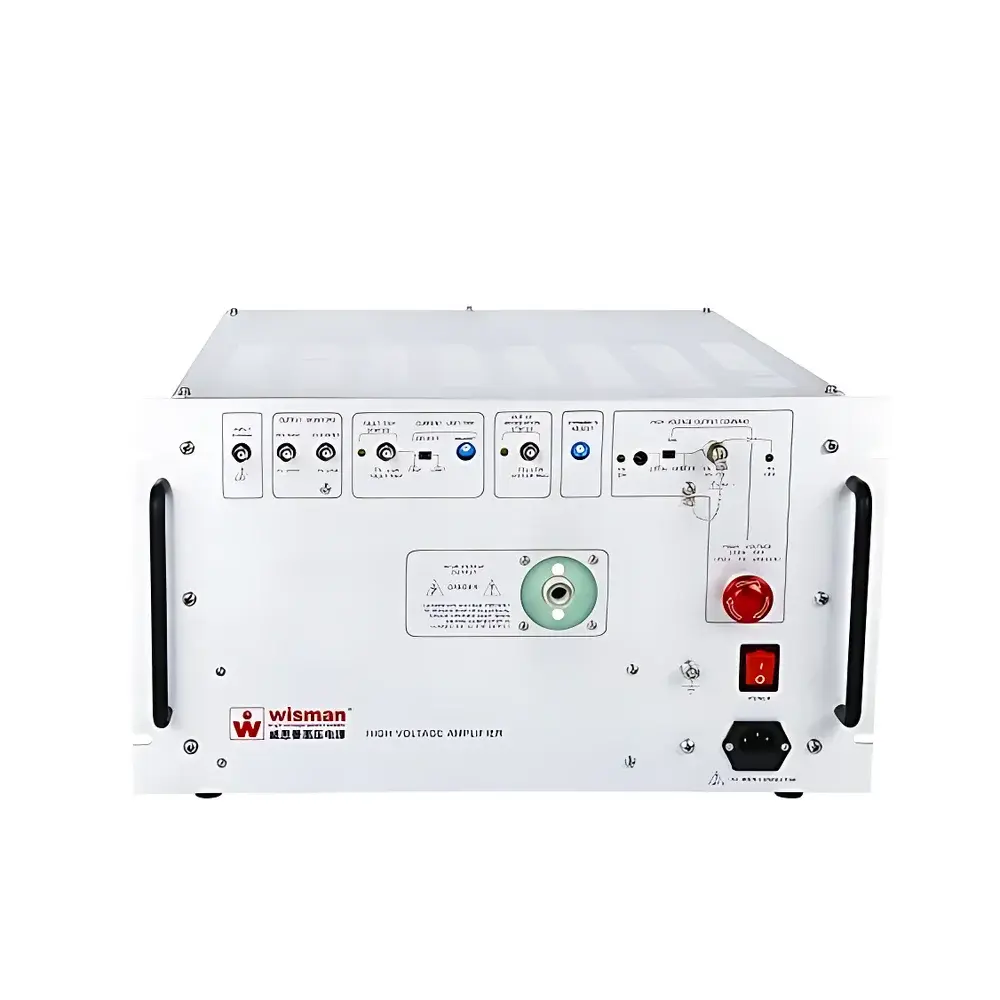
Wisman AMK ±5 kV / 400 W High-Voltage Power Amplifier
| Brand | Wisman |
|---|---|
| Origin | Shaanxi, China |
| Model | AMK |
| Output Voltage | ±5 kV (DC or AC peak) |
| Output Power | 400 W |
| Output Current | ±80 mA (DC or AC peak) |
| Gain | 500 V/V (DC) |
| Gain Accuracy | < 0.1% of full scale |
| Slew Rate | > 1000 V/µs (10–90%) |
| Small-Signal Bandwidth | DC to > 75 kHz (−3 dB) |
| Large-Signal Bandwidth | DC to > 50 kHz (1% THD) |
| Output Noise | < 0.5 V RMS (voltage), < 10 mV RMS (voltage monitor), < 30 mV RMS (current monitor) |
| Stability | < 50 ppm/hr (non-cumulative) |
| Temperature Coefficient | < 25 ppm/°C |
| Input Impedance | 25 kΩ |
| Display Scale | 500:1 (voltage), 1 V/8 mA (current) |
| Dimensions | 264 mm H × 483 mm W × 635 mm D |
| Weight | 25 kg |
| Operating Temperature | 0–40 °C |
| Relative Humidity | ≤85% RH (non-condensing) |
| Max Altitude | 2000 m |
| Compliance | Designed for integration into ISO/IEC 17025-compliant laboratories and GLP/GMP-adjacent instrumentation environments |
| Application Focus | Mass spectrometry biasing, electro-optic modulation, ferroelectric poling, dielectric barrier discharge, ion beam steering |
Overview
The Wisman AMK ±5 kV / 400 W High-Voltage Power Amplifier is a precision-engineered, fully solid-state instrument designed for demanding laboratory and industrial applications requiring stable, low-noise, high-slew-rate bipolar high-voltage excitation. Based on four-quadrant active output architecture, the AMK delivers both sourcing and sinking current across its full ±5 kV output range—enabling precise control of reactive, capacitive, and resistive loads without signal distortion or phase lag. Unlike passive high-voltage transformers or switched-mode supplies, the AMK employs linear amplification topology with direct-coupled feedback, ensuring DC stability, sub-millisecond transient response, and minimal harmonic content. Its design meets the stringent voltage fidelity and temporal accuracy requirements of mass spectrometer detector biasing, electro-optic modulator drive, ferroelectric domain alignment, and plasma actuation systems where output integrity directly impacts measurement reproducibility and physical interpretation.
Key Features
- Four-Quadrant Active Output: Simultaneously sources and sinks up to ±80 mA across the full ±5 kV range—essential for driving highly capacitive loads (e.g., piezoelectric transducers, electrostatic deflectors) without oscillation or settling delay.
- Ultra-High Slew Rate & Bandwidth: >1000 V/µs (10–90%) and small-signal bandwidth exceeding 75 kHz (−3 dB) support dynamic waveform replication—including fast-rising pulses, sinusoidal sweeps, and arbitrary waveforms—for time-resolved material characterization and beam modulation.
- Low-Noise, High-Stability Architecture: Voltage output noise < 0.5 VRMS, drift < 50 ppm/hr (non-cumulative), and temperature coefficient < 25 ppm/°C ensure long-duration experiments maintain calibration traceability under ambient lab conditions.
- Integrated Monitoring & Programmability: Front-panel analog monitors provide isolated, calibrated voltage (500:1 scaling) and current (1 V/8 mA) outputs with independent accuracy specifications (<0.1% FS for voltage, <0.5% FS for current), compatible with data acquisition systems and automated test platforms.
- Robust Protection System: Short-circuit protection with automatic recovery, over-temperature shutdown, and continuous load monitoring safeguard both amplifier and connected instrumentation—critical in multi-user core facilities and regulated QC environments.
- Lab-Grade Mechanical Design: 19-inch rack-mountable chassis (264 × 483 × 635 mm), 25 kg mass, and conformal-coated PCBs ensure mechanical stability and EMI resilience in shared instrumentation suites.
Sample Compatibility & Compliance
The AMK interfaces seamlessly with high-impedance, high-capacitance, or mixed-impedance loads typical in analytical and materials science instrumentation—including quadrupole and time-of-flight mass spectrometer detector arrays, electro-optic crystals (LiNbO₃, KTP), ferroelectric thin-film test fixtures, atmospheric pressure plasma jets, and dielectric barrier discharge reactors. Its output stage complies with IEC 61000-4-5 surge immunity (Level 3) and meets CE marking requirements for electromagnetic compatibility (EMC Directive 2014/30/EU). While not certified as a medical device or safety-critical system, the AMK’s design principles align with ISO/IEC 17025 clause 5.5.2 (equipment verification) and supports audit-ready documentation for GLP and GMP-adjacent workflows—particularly when integrated into validated mass spec or plasma diagnostic platforms.
Software & Data Management
The AMK operates as an analog-controlled amplifier with no embedded firmware or network interface; it accepts standard ±10 V input signals and provides proportional high-voltage output. For automated operation, it integrates with third-party DAQ systems (e.g., National Instruments PXI, Keysight U2300A) via its analog monitor outputs and external trigger inputs. All voltage and current monitor signals are referenced to chassis ground and isolated to ≥1 kV, enabling safe connection to grounded oscilloscopes or digitizers. Traceable calibration records—including gain linearity, offset drift, and noise spectral density—are supplied with each unit and maintained per ISO/IEC 17025 Section 6.6. Calibration intervals are recommended annually or after 2000 operating hours, with recalibration performed using NIST-traceable high-voltage standards (e.g., Fluke 8508A with HV divider).
Applications
- Mass spectrometry: High-stability DC/AC bias for electron multipliers, microchannel plates, and ion trap electrodes
- Electro-optic modulation: Driving LiNbO₃ Mach-Zehnder interferometers and Q-switches with sub-nanosecond edge fidelity
- Ferroelectric characterization: Bipolar poling and hysteresis loop tracing of PZT, BTO, and polymer films
- Plasma physics: Sustaining and modulating dielectric barrier discharges (DBD) and atmospheric plasma jets
- Particle beam control: Electrostatic deflection and focusing in low-energy ion optics setups
- Electrophoresis & electrorotation: Precise field generation for biomolecular manipulation and cell dielectrophoresis
- Material polarization studies: High-field charging of electrets, polymer nanocomposites, and relaxor ferroelectrics
FAQ
Is the AMK suitable for use with mass spectrometers requiring ultra-low ripple bias?
Yes—the AMK’s <0.5 VRMS broadband noise floor and <50 ppm/hr thermal drift meet the stability requirements of high-resolution TOF and Orbitrap detector bias circuits when operated within specified ambient conditions.
Can the AMK drive a 10 nF capacitive load at 20 kHz without instability?
Yes—its four-quadrant output stage and >1000 V/µs slew rate enable stable closed-loop operation with capacitive loads up to 20 nF at frequencies below 50 kHz, provided proper grounding and cable shielding protocols are followed.
Does the AMK support remote programming via USB or Ethernet?
No—it is an analog-input-only amplifier. Digital control requires integration with external DAQ hardware or programmable function generators.
What safety certifications does the AMK carry?
It bears CE marking per EMC Directive 2014/30/EU and Low Voltage Directive 2014/35/EU. It is not UL-listed or IEC 61010-1 certified for standalone safety-critical deployment.
Is calibration documentation included with shipment?
Yes—each unit ships with a factory calibration report listing measured gain error, offset voltage, output noise spectrum, and thermal drift over 8-hour soak, traceable to national metrology institutes.



