
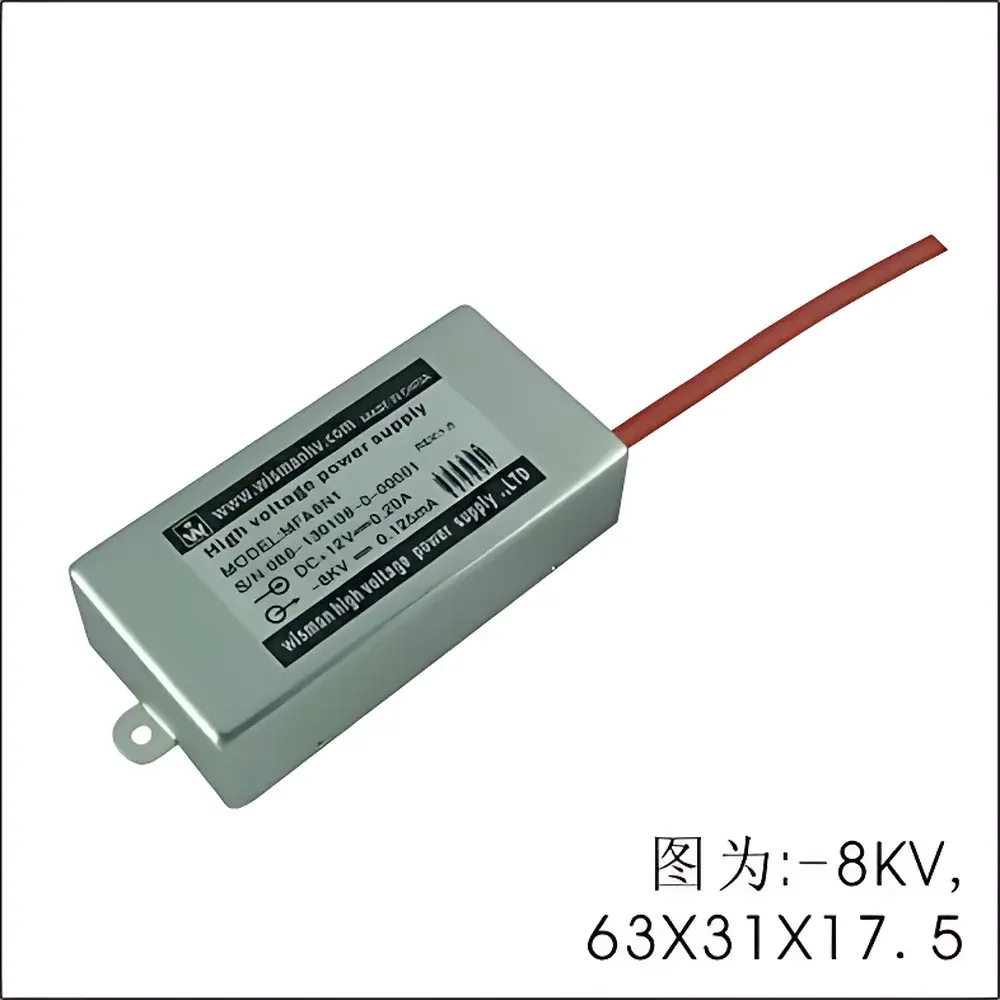

Wiseman MFA Series Miniature PCB-Mount High-Voltage DC-DC Power Module
| Brand | Wiseman |
|---|---|
| Origin | Shaanxi, China |
| Model | MFA |
| Output Voltage Range | 0–10 kV (selectable: 3–10 kV in 0.5 kV increments) |
| Output Power Options | 0.5 W, 1 W, 2 W |
| Input Voltage Options | 5 VDC ±1 V, 12 VDC ±1 V (standard), 15 VDC ±1 V, 24 VDC ±1 V |
| Ripple & Noise | <10 ppm (0.001% p-p) |
| Stability | ±0.001% per hour |
| Temperature Coefficient | 25 ppm/°C (standard) |
| Voltage Regulation | ±0.001% (line & load) |
| Protection | Arc detection, short-circuit shutdown, current limiting |
| Shielding | Full 6-side mu-metal + aluminum EMI/RFI enclosure |
| Mounting | Surface-mount PCB installation |
| Dimensions | 63.5 mm × 31.75 mm × 17.5 mm (2.5″ × 1.25″ × 0.69″) |
| Weight | 56.6 g (2.0 oz) |
| Operating Temperature | Commercial (–10 to +50 °C case), Industrial (–25 to +65 °C case), Extended (–40 to +95 °C case) |
| Storage Temperature | Up to +125 °C (Extended grade) |
| Humidity | 20–80% RH, non-condensing |
| Compliance | Designed for integration into IEC 61010-1 compliant analytical instruments |
Overview
The Wiseman MFA Series is a miniature, high-stability, PCB-mountable high-voltage DC-DC power module engineered for precision integration into space-constrained analytical and scientific instrumentation. Based on zero-current resonant (ZCR) topology and proprietary high-voltage insulation design, the MFA delivers tightly regulated output voltages from 3 kV to 10 kV with exceptional long-term stability and ultra-low electromagnetic interference. Its core architecture eliminates traditional transformer-based bulk and thermal drift limitations—enabling consistent performance across temperature gradients and extended operational cycles. Designed specifically for OEM integration in mass spectrometry systems, the MFA serves as a critical bias supply for ion optics, electron multipliers, and detector arrays where voltage fidelity directly impacts signal-to-noise ratio, mass resolution, and quantitative reproducibility.
Key Features
- PCB-level integration: Surface-mount footprint compatible with automated assembly; no external heatsinking required at ≤2 W continuous operation.
- Ultra-low output ripple: <10 ppm (0.001% p-p) measured across full load and temperature range—critical for low-noise detector biasing and electrostatic lens control.
- High temporal stability: ±0.001% per hour drift under constant thermal conditions; optimized for applications requiring >24-hour unattended acquisition.
- Low temperature coefficient: 25 ppm/°C standard; optional OEM calibration achieves 10 ppm/°C for mission-critical environmental deployments.
- Comprehensive protection suite: Real-time arc detection with sub-microsecond response, foldback current limiting, and auto-recovery short-circuit handling.
- Flexible control interface: Analog voltage programming (0–10 V input), potentiometer adjustment, or digital command via optional I²C/SPI add-on board (not included).
- Full six-face EMI shielding: Mu-metal inner layer + aluminum outer casing meets CISPR 32 Class B emissions limits without additional chassis filtering.
- Polarity versatility: Configurable for positive or negative high-voltage output during manufacturing—no field modification required.
- OEM scalability: Custom voltage setpoints, enhanced thermal grading, conformal coating, and pinout optimization available without NRE fees for volume orders ≥500 units.
Sample Compatibility & Compliance
The MFA module is routinely deployed as the high-voltage bias source in time-of-flight (TOF), quadrupole, and orbitrap mass spectrometers—particularly where compact detector stacks (e.g., microchannel plates, discrete dynode electron multipliers) demand stable, low-noise kilovolt-level potentials. It complies with the electrical safety and EMC requirements relevant to subsystem integration within IEC 61010-1 Class I equipment. While the module itself carries no standalone regulatory certification, its design aligns with essential requirements for inclusion in FDA-regulated diagnostic instruments (21 CFR Part 820) and GLP/GMP-compliant analytical workflows. When integrated with traceable calibration protocols and version-controlled firmware, the MFA supports audit-ready documentation per ISO/IEC 17025 Clause 5.10 and USP analytical instrument qualification (AIQ) frameworks.
Software & Data Management
The MFA operates as a hardware-level analog subsystem and does not embed onboard firmware or communication interfaces. However, it is fully compatible with third-party instrument control platforms—including LabVIEW, Python (PyVISA), and MATLAB—when paired with an external DAC/ADC controller (e.g., National Instruments USB-6211 or Analog Devices ADALM2000). For OEM customers, Wiseman provides detailed analog control schematics, voltage calibration lookup tables (per unit serial number), and traceable factory test reports (including 72-hour burn-in data and temperature sweep logs). Optional digital interface modules support I²C or SPI bus communication for remote voltage setpoint adjustment, status monitoring (arc event timestamping, overtemperature flag), and health diagnostics—enabling compliance with FDA 21 CFR Part 11 electronic record and signature requirements when implemented with appropriate audit-trail software layers.
Applications
- Mass spectrometry: Ion source acceleration, collision cell biasing, reflectron/TOF pusher electrodes, MCP detector bias networks.
- Nuclear and particle detection: Proportional counters, Geiger-Müller tubes, scintillation photomultiplier tube (PMT) dynode chains, solid-state radiation detectors.
- Electrophoretic and electrostatic systems: Capillary electrophoresis high-voltage drivers, electrostatic precipitators, ESD test fixtures, corona discharge sources.
- Optical and beam instrumentation: EO lens actuation, electron/ion beam focusing columns, piezoelectric transducer biasing, capacitive charging for pulsed lasers.
- Industrial QA/QC: In-line thickness gauging, X-ray fluorescence (XRF) tube excitation (in low-power portable systems), material defect scanning via electrostatic contrast enhancement.
FAQ
Is the MFA module CE or UL certified?
No—the MFA is supplied as a component-level power module intended for integration into end-equipment. Final system-level certification (e.g., CE, UL 61010-1) remains the responsibility of the OEM integrator.
Can the output polarity be reversed in the field?
No—polarity (positive or negative HV output) is fixed at manufacture. Selection must be specified at order entry.
What is the recommended method for external voltage programming?
A 0–10 V analog input is standard; impedance should be ≤1 kΩ, with noise filtering (e.g., 10 nF ceramic + 100 Ω series resistor) recommended for high-EMI environments.
Does Wiseman provide calibration certificates with NIST traceability?
Yes—each production batch undergoes metrological verification using Keysight B2912B SMUs and Fluke 8508A multimeters; full calibration reports are provided upon request for qualified OEMs.
How is thermal management handled at 2 W continuous output?
The module relies on PCB copper pour (≥2 oz Cu, ≥4 cm² per side minimum) and ambient convection. Forced airflow (>1 m/s) extends maximum case temperature by up to 15 °C; derating curves are provided in the engineering datasheet.



