
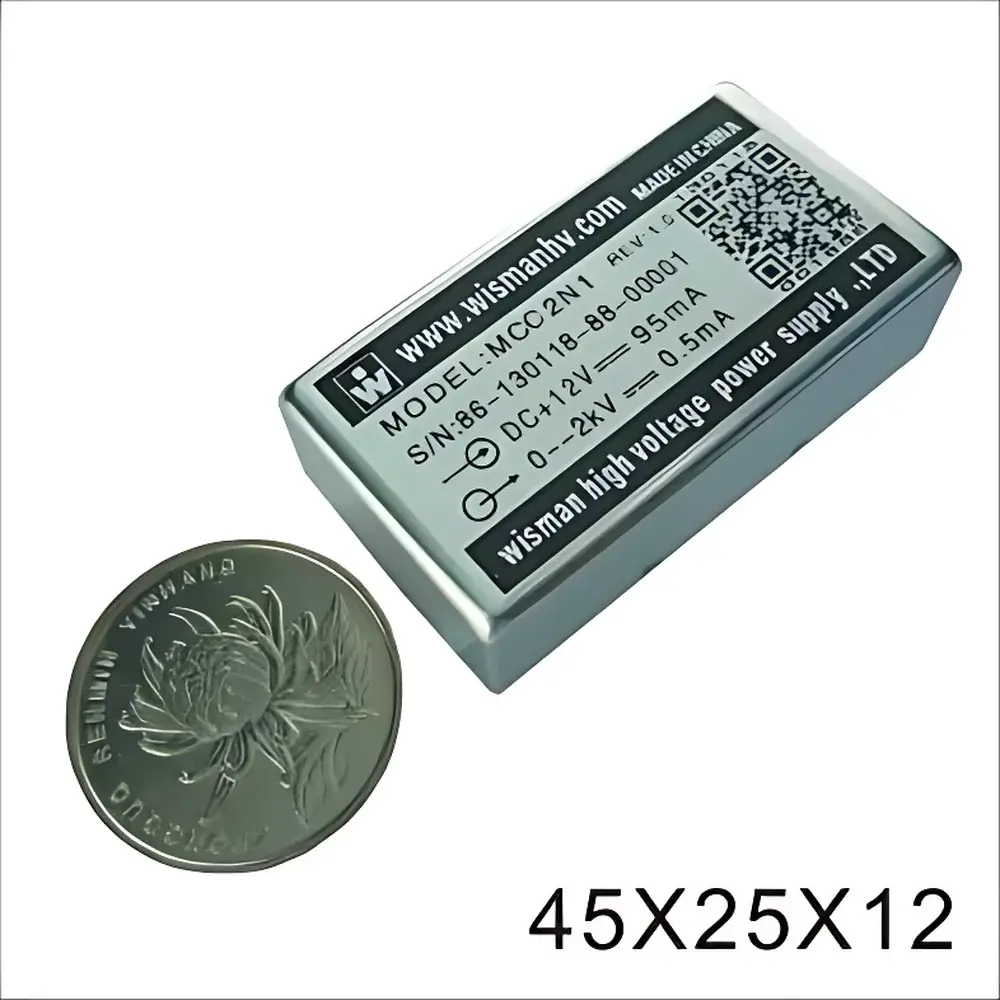
Wiseman MCC Series Miniature High-Voltage DC-DC Power Supply Module (3 kV, 2 W)
| Brand | Wiseman |
|---|---|
| Origin | Shaanxi, China |
| Model | MCC |
| Output Voltage | 0–3000 V (or 0 to –3000 V) |
| Output Power | 2 W |
| Ripple & Noise | < 0.001% P-P (at full load) |
| Stability | ±0.001% per hour |
| Temperature Coefficient | 10 ppm/°C |
| Input Voltage | 12 V ±0.5 V (optional: ±5 V, ±15 V, ±24 V) |
| Control Interface | 0–2.5 V analog or 20 kΩ potentiometer |
| Dimensions | 46 × 24 × 12 mm |
| Weight | 25 g |
| Protection | Reverse polarity, overcurrent, short-circuit, arc suppression |
| Operating Temperature | –10°C to +50°C (Commercial Grade S) |
| Compliance | Designed for OEM integration in analytical and scientific instrumentation |
Overview
The Wiseman MCC Series is a miniature, high-voltage DC-DC power supply module engineered for precision biasing applications in analytical and scientific instrumentation. Based on zero-current resonant converter topology and proprietary high-voltage insulation design, the MCC delivers tightly regulated unipolar output voltages up to ±3 kV with exceptional stability and ultra-low electromagnetic emissions. Its core architecture eliminates line-frequency harmonics and minimizes switching transients—critical for noise-sensitive detectors such as photomultiplier tubes (PMTs), electron multipliers in mass spectrometers, and ionization chambers. Unlike general-purpose HV supplies, the MCC is purpose-built for embedded OEM integration: it operates from a single low-voltage DC rail (e.g., 12 V), requires no external cooling, and maintains performance across wide ambient temperature gradients without derating. The module complies with IEC 61010-1 safety requirements for measurement, control, and laboratory equipment, and its PCB-mount form factor enables direct integration into compact instrument chassis.
Key Features
- Output voltage range: 0–3000 V or 0 to –3000 V, selectable polarity at assembly
- Maximum continuous output power: 2 W at rated voltage and current
- Ripple and noise: ≤0.001% peak-to-peak (measured at full output voltage and current, 10 Hz–20 MHz bandwidth)
- Long-term stability: ±0.001% per hour; ±0.005% over 8 hours (after thermal stabilization)
- Temperature coefficient: 10 ppm/°C (equivalent to ±0.001% per °C at 3 kV)
- Full six-face mu-metal and conductive polymer shielding for EMI/RFI suppression
- Programmable voltage control via 0–2.5 V analog input (100 kΩ input impedance) or 20 kΩ potentiometer
- Comprehensive protection suite: reverse-input polarity, overvoltage lockout, sustained overload, short-circuit, and arc detection with auto-recovery
- Fast output rise time: 50 ms (0–99% of setpoint), enabling dynamic bias sequencing in time-resolved experiments
- Ultra-compact footprint: 46 mm × 24 mm × 12 mm; mass: 25 g — optimized for space-constrained PCB layouts
Sample Compatibility & Compliance
The MCC module is routinely deployed as the high-voltage bias source for detector subsystems requiring stable, low-noise DC potentials. It is certified for use in instruments compliant with ISO/IEC 17025 calibration environments and supports GLP/GMP-aligned system validation when integrated with traceable monitoring circuits. Its low EMI signature ensures compatibility with sensitive front-end electronics in mass spectrometry systems meeting ASTM E1592 (standard practice for mass spectrometer performance verification) and IEC 61326-1 (EMC requirements for laboratory equipment). The module’s isolation rating exceeds 5 kVDC between input and output, satisfying reinforced insulation requirements for Class I medical devices per IEC 60601-1. No external filtering or shielding is required to meet CISPR 11 Group 1, Class A emission limits.
Software & Data Management
As a hardware-only analog module, the MCC does not include embedded firmware or digital interfaces. However, its analog control architecture enables seamless integration with host instrument control systems using standard DAQ hardware (e.g., National Instruments USB-6009, Keysight 34972A). When paired with calibrated voltage monitors and timestamped acquisition software (e.g., LabVIEW, Python-based PyVISA frameworks), the MCC supports audit-trail-capable operation under FDA 21 CFR Part 11 when implemented with appropriate electronic signature and data integrity controls. For OEM customers, Wiseman provides detailed test reports—including burn-in data, thermal drift curves, and long-term stability logs—for inclusion in Design History Files (DHF) and Risk Management Files (RMF).
Applications
- Mass spectrometer electron multipliers and Faraday cup biasing
- Photomultiplier tube (PMT) dynode chain supply in fluorescence and scintillation detectors
- Electrostatic lens focusing in electron and ion beam columns
- Bias voltage for proportional counters, Geiger-Müller tubes, and ionization chambers
- High-voltage electrophoresis and capillary electrophoresis systems
- Static charge control in semiconductor metrology and particle sizing instruments
- OEM integration in portable X-ray fluorescence (XRF) analyzers and handheld radiation detectors
- Lab-on-chip electrophoretic separation platforms requiring microampere-level current stability
FAQ
Is the MCC module suitable for use in regulated medical devices?
Yes — its reinforced insulation, low leakage current (<1 µA at 3 kV), and compliance with IEC 60601-1 Clause 8.8 make it appropriate for incorporation into Class I and Class IIa medical instruments when validated within the final system.
Can multiple MCC modules be paralleled for higher current?
No — the MCC is not designed for parallel operation. For higher power requirements, Wiseman offers the MCM or MCP series with master-slave synchronization capability.
What is the recommended method for verifying output stability during qualification?
Use a high-impedance, calibrated electrometer (e.g., Keithley 6517B) with 10-second averaging and temperature-controlled enclosure; record drift over 24 hours with 1-hour intervals under constant load and ambient conditions.
Does the module support remote sensing?
No — remote sense terminals are not provided. Load regulation is maintained via internal feedback; for loads >1 m cable length, users should compensate for voltage drop in the control loop algorithm.
Are RoHS and REACH declarations available?
Yes — Wiseman provides full material declarations and third-party test reports (SGS) upon request for all MCC variants.



