
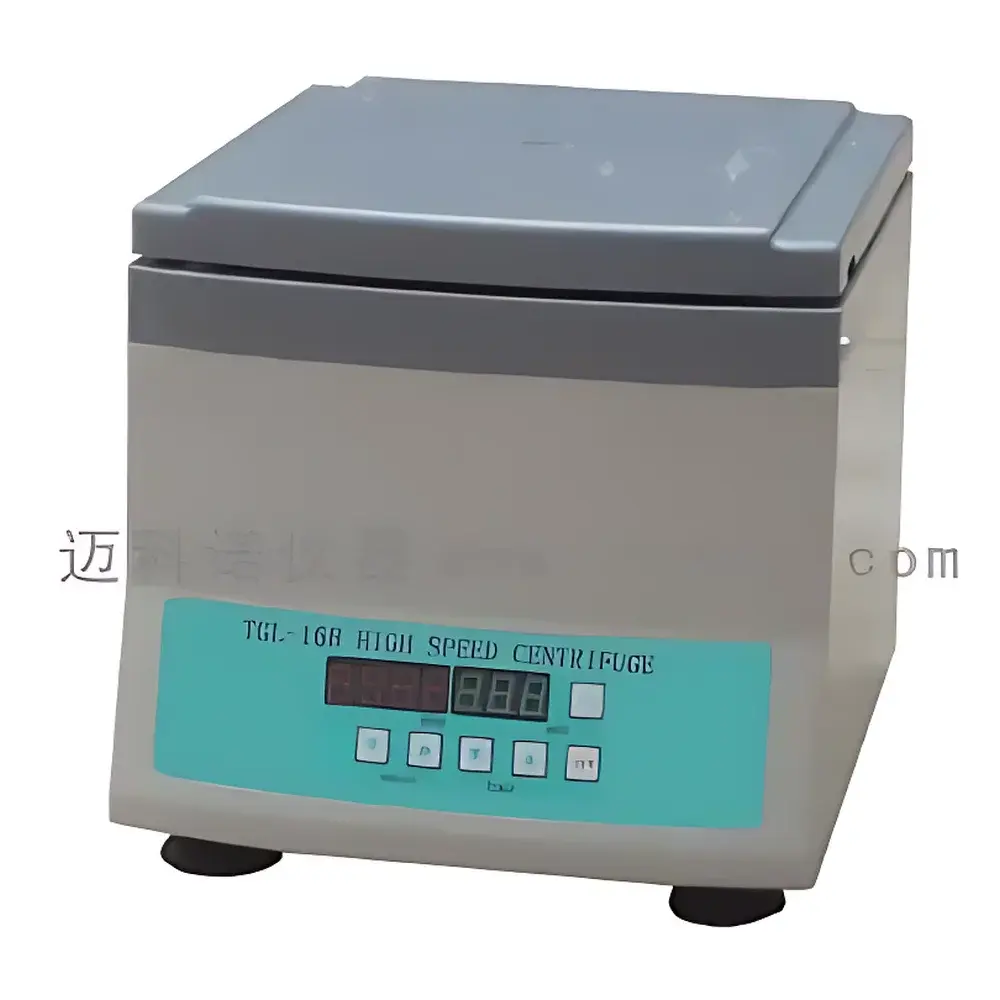
MKN TGL-16B Benchtop High-Speed Centrifuge
| Brand | MKN |
|---|---|
| Model | TGL-16B |
| Max Speed | 16,000 rpm |
| RCF | 17,000 × g |
| Capacity | 12 × 1.5 mL / 12 × 0.5 mL / 8 × 5 mL |
| Timer Range | 0–30 min |
| Noise Level | ≤60 dB(A) |
| Power Supply | AC 220 V, 50 Hz, 5 A |
| Construction | Die-cast aluminum rotor chamber with precision-balanced rotor assembly |
| Control | Touchscreen digital speed and time display with stepless speed regulation |
| Compliance | Designed to meet general laboratory safety and electromagnetic compatibility requirements per IEC 61010-1 |
Overview
The MKN TGL-16B Benchtop High-Speed Centrifuge is an engineered solution for rapid, reproducible separation of biological and chemical samples in research, clinical, and quality control laboratories. Utilizing the principle of centrifugal sedimentation—where differential densities and particle sizes respond to radial acceleration—the instrument achieves efficient phase separation of suspensions, emulsions, and cell lysates. Its compact footprint and robust mechanical architecture make it ideal for space-constrained benchtop environments without compromising operational stability or thermal management. The centrifuge operates on a precisely balanced rotor system driven by a brushless DC motor, delivering consistent rotational performance across its full speed range (0–16,000 rpm), with real-time digital monitoring of both speed and elapsed time via an intuitive touchscreen interface.
Key Features
- Touchscreen digital control panel with dynamic RPM and RCF readout, enabling precise parameter selection and immediate verification of operational settings
- Stepless speed regulation ensures fine-grained control over centrifugal force application—critical for sensitive sample integrity in serum, plasma, and immunoprecipitation workflows
- Auto-balancing rotor mechanism minimizes vibration and extends bearing life, contributing to long-term mechanical reliability and low-noise operation (≤60 dB[A])
- Die-cast aluminum rotor chamber provides superior thermal dissipation and structural rigidity, reducing temperature rise during extended runs
- Three interchangeable rotor configurations support common microcentrifuge tube formats: 12 × 1.5 mL, 12 × 0.5 mL, and 8 × 5 mL—enabling flexibility across routine QC assays and exploratory research protocols
- Programmable timer (0–30 minutes) with automatic rotor deceleration and audible end-of-run alert enhances protocol repeatability and operator safety
Sample Compatibility & Compliance
The TGL-16B is routinely deployed in clinical diagnostics labs for serum/plasma separation prior to ELISA, electrophoresis, or immunoassay analysis; in academic biochemistry labs for subcellular fractionation and nucleic acid purification; and in industrial QA/QC settings for particulate removal from reagent stocks. While not certified to ISO 13485 or FDA 21 CFR Part 11 out-of-the-box, its design adheres to core electrical safety and mechanical stability provisions outlined in IEC 61010-1 for laboratory equipment. Users implementing this instrument within GLP- or GMP-regulated environments are advised to validate operational parameters—including speed accuracy, timer fidelity, and temperature profile—against internal SOPs and applicable standards such as CLSI EP05-A3 for precision assessment.
Software & Data Management
This model operates as a standalone instrument with no embedded data logging or network connectivity. All operational parameters are set and monitored locally via the integrated touchscreen interface. For laboratories requiring audit trails or electronic record retention, integration with external lab information management systems (LIMS) may be achieved through manual entry or third-party hardware-based serial/USB data capture solutions. No proprietary software suite is supplied; however, rotor calibration certificates and basic operating instructions conform to ISO/IEC 17025 documentation practices for equipment qualification.
Applications
- Routine separation of whole blood into serum or plasma fractions in hospital core labs and point-of-care testing units
- Pelleting of mammalian cells, bacteria, and yeast for downstream lysis and protein extraction
- Clarification of crude lysates and supernatant filtration prior to HPLC or mass spectrometry analysis
- Concentration of viral particles, exosomes, and extracellular vesicles using fixed-angle rotor protocols
- Removal of precipitates from buffer solutions and reagent preparations in pharmaceutical development labs
- Preparative isolation of nucleic acids and polysaccharides in molecular biology workflows
FAQ
What is the maximum relative centrifugal force (RCF) achievable with the TGL-16B?
The instrument delivers up to 17,000 × g at its rated maximum speed of 16,000 rpm when using the standard 12-position 1.5 mL rotor.
Does the centrifuge include rotor calibration documentation?
Yes—each unit ships with a factory-verified rotor balance certificate and nominal RCF calculation sheet based on rotor geometry and moment of inertia.
Can the TGL-16B be used for continuous operation over multiple cycles?
It is rated for intermittent duty; users should allow ≥10 minutes of cooling between consecutive 30-minute runs to maintain thermal stability and bearing longevity.
Is the rotor compatible with autoclaving?
The aluminum rotor is not autoclavable; cleaning is recommended with 70% ethanol or mild non-corrosive disinfectants followed by air drying.
What safety certifications does this model hold?
It complies with IEC 61010-1 for electrical safety and EN 61326-1 for electromagnetic compatibility, verified during factory acceptance testing.



