
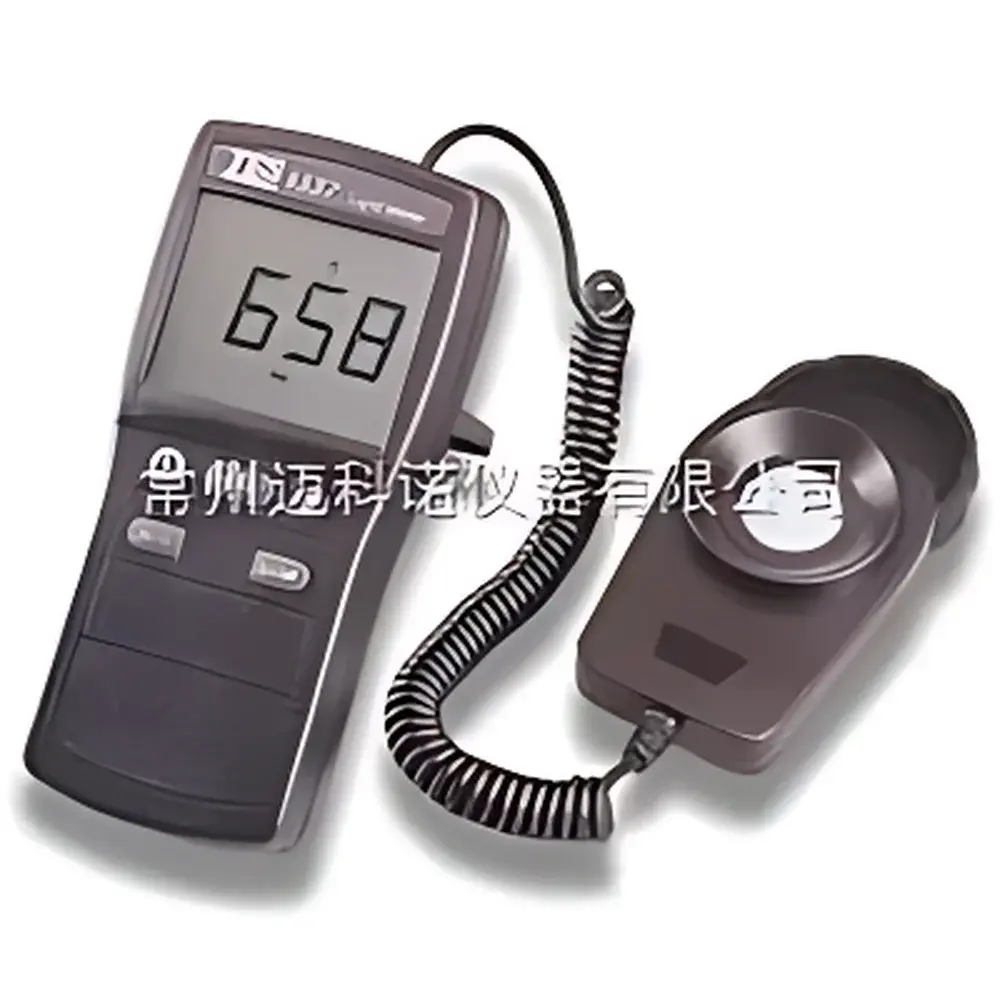
MKN TES-1337 Digital Illuminance Meter
| Brand | MKN |
|---|---|
| Model | TES-1337 |
| Sensor Type | Silicon Photodiode with CIE Photopic Filter |
| Measurement Range | 0.01–20,000 Lux (0.01–20,000 fc) |
| Resolution | 0.01 Lux (0.01 fc) |
| Accuracy | ±3% rdg ±0.5% f.s. (±4% rdg ±10 digits above 10 klux, calibrated at 2856 K standard lamp) |
| Spectral Match Error (f₁′) | ≤6% |
| Temperature Coefficient | ±0.1% / °C |
| Sampling Rate | 2.5 Hz |
| Display | 3½-digit LCD + analog bar graph |
| Operating Temp./RH | 0–40°C / <80% RH |
| Storage Temp./RH | −10–50°C / <70% RH |
| Power | 6 × AAA (1.5 V) batteries |
| Battery Life | ~400 h (carbon-zinc) |
| Detector Cable Length | 150 cm |
| Detector Dimensions | 92 × 60 × 29 mm |
| Meter Dimensions/Weight | 150 × 72 × 35 mm / 320 g |
| Overload Indication | OL |
| Hold/Max/Min Functions | Yes |
| Compliance | CIE photopic luminosity function (V(λ)) standard |
Overview
The MKN TES-1337 Digital Illuminance Meter is a precision handheld instrument engineered for reliable, traceable measurement of visible light intensity in photometric units—lux (lx) and foot-candles (fc). It operates on the fundamental principle of photometry: conversion of incident visible radiation into an electrical signal proportional to luminous flux per unit area, weighted by the standardized CIE photopic luminosity function V(λ). This spectral response ensures metrological alignment with human photopic vision under daylight-adapted conditions (2856 K correlated color temperature calibration source), satisfying international photometric reference frameworks defined by CIE Publication No. 15 and ISO/CIE 19476:2014. Designed for field and laboratory use in lighting validation, workplace safety compliance, architectural daylighting analysis, and quality assurance of illumination systems, the TES-1337 delivers high reproducibility across its full 0.01–20,000 lx dynamic range without auto-ranging artifacts.
Key Features
- CIE-Compliant Spectral Response: Integrated silicon photodiode paired with precision optical filter achieves f₁′ ≤6%, meeting IEC 60825-1 and ISO/CIE 19476 requirements for photometric accuracy in general-purpose illuminance measurement.
- High-Resolution Dual-Unit Display: 3½-digit LCD with real-time analog bar graph provides simultaneous lux and foot-candle readouts; selectable ranges include 20.00 lx, 200.0 lx, 2000 lx, 20.00 klx (and equivalent fc scales), enabling rapid visual trend assessment.
- Functional Measurement Modes: Includes manual hold, maximum/minimum value capture, and automatic overload indication (OL), supporting transient light evaluation and comparative benchmarking in variable environments.
- Thermal & Temporal Stability: Temperature coefficient of ±0.1% per °C ensures minimal drift during extended operation within 0–40°C ambient conditions; 2.5 Hz sampling rate supports stable averaging for steady-state assessments.
- Robust Portable Architecture: Detachable 150 cm sensor cable decouples detector placement from meter handling—critical for measurements in confined or elevated locations—while maintaining mechanical integrity and electrical shielding.
- Long-Duration Field Operation: Optimized low-power circuitry enables ~400 hours of continuous use on six AAA alkaline or carbon-zinc cells, with no requirement for external power adapters or charging infrastructure.
Sample Compatibility & Compliance
The TES-1337 is compatible with all common artificial and natural light sources—including LED, fluorescent, incandescent, metal halide, and daylight—provided spectral output falls within the CIE V(λ) weighting envelope (380–780 nm). Its silicon photodiode sensor exhibits negligible UV/IR leakage due to integrated filtering, minimizing non-photopic contribution errors. The instrument conforms to ANSI/IES RP-27.1-22 recommendations for general lighting measurement instrumentation and supports documentation workflows aligned with OSHA 1910.141 (industrial lighting standards), EN 12464-1 (lighting of work places), and LEED v4.1 EQ Credit: Daylight. While not individually certified to ISO/IEC 17025, its calibration traceability path (via 2856 K tungsten standard lamp) supports internal verification protocols required under GLP and facility-level QA programs.
Software & Data Management
The TES-1337 operates as a standalone, battery-powered measurement node with no embedded data logging or USB/Bluetooth connectivity. All recorded values—including max/min/held readings—are manually transcribed for downstream analysis. This architecture eliminates firmware dependencies, cybersecurity exposure, or software validation burdens associated with regulated environments. Users may integrate readings into validated spreadsheets or LIMS platforms following documented SOPs for manual data entry (e.g., FDA 21 CFR Part 11-compliant audit trails when paired with electronic lab notebooks). Calibration certificates—when obtained from accredited third-party labs—include uncertainty budgets referenced to NIST-traceable standards.
Applications
- Verification of lighting levels in offices, classrooms, hospitals, and manufacturing facilities per IESNA LM-79 and EN 12464-1 thresholds.
- Commissioning and periodic maintenance of emergency egress lighting systems (NFPA 101, UL 924).
- Photobiological safety pre-screening for LED lighting products (IEC 62471).
- Daylight harvesting system commissioning and seasonal performance trending.
- Ergonomic workstation assessments for visual task compatibility (ISO 8995-1).
- Validation of cleanroom and pharmaceutical facility illumination per EU GMP Annex 1 and USP <1053>.
FAQ
What is the spectral match error (f₁′) specification, and why does it matter?
The f₁′ ≤6% value quantifies deviation between the instrument’s actual spectral responsivity and the ideal CIE V(λ) curve. Lower f₁′ ensures minimal measurement bias under non-incandescent sources—especially critical for modern white LEDs with narrow blue-pump + phosphor emission profiles.
Can this meter be used for UV or infrared irradiance measurements?
No. The TES-1337 is strictly a photopic illuminance meter. Its optical filter blocks wavelengths outside 380–780 nm; dedicated radiometric sensors are required for UV-A/B/C or IR-A/B/C quantification.
Is calibration traceable to national standards?
Factory calibration uses a 2856 K tungsten-filament standard lamp traceable to national metrology institutes. End-user recalibration should follow ISO/IEC 17025-accredited laboratories using CIE-compliant reference lamps and gonioscopic setups.
Does the device support data export or PC interface?
No. The TES-1337 has no serial, USB, or wireless interface. Data capture requires manual recording or optional third-party optical character recognition (OCR) integration.
What is the recommended recalibration interval?
Annual recalibration is advised for routine QA/QC use. In high-use or thermally unstable environments, semi-annual verification against a check standard is recommended per ISO 10012 guidelines.




