
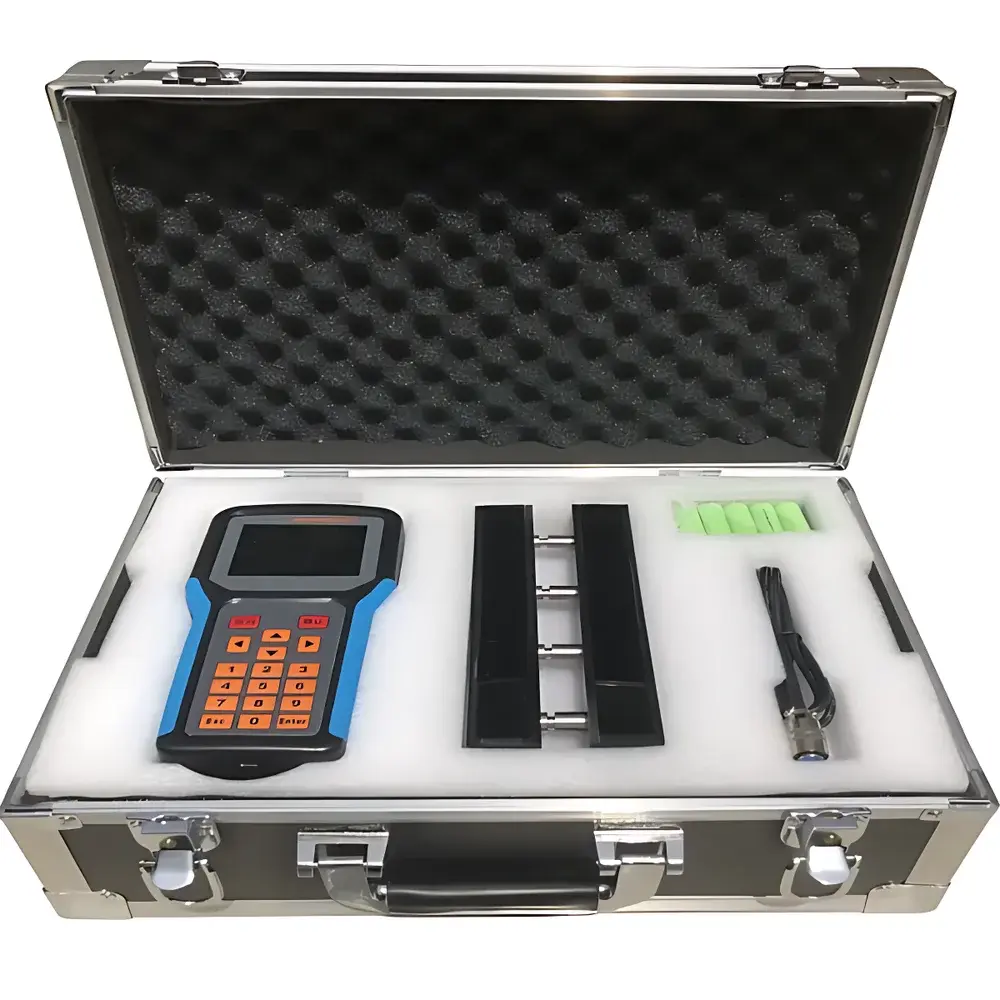
HengaoDe HAD-L4000 Portable Concrete Resistivity Meter for Corrosion Assessment (Compliant with GB/T 50344)
| Brand | HengaoDe |
|---|---|
| Origin | Beijing, China |
| Manufacturer Type | Authorized Distributor |
| Country of Origin | China |
| Model | HAD-L4000 |
| Price | USD 135 (FOB) |
| Measurement Principle | Four-Electrode Wenner Array (50 mm spacing) |
| Power Supply | Rechargeable AA battery pack (5 × 1.5 V, up to 12 h continuous operation) |
| Display | Full-color LCD with on-screen resistivity (kΩ·cm), real-time stability indicator, and auto-zero confirmation |
| Range | 0–2000 kΩ·cm |
| Resolution | 0.1 kΩ·cm |
| Accuracy | ±1 kΩ·cm |
| Dimensions | 205 × 100 × 35 mm |
| Weight | 396 g (instrument only, including batteries) |
| Electrode Type | Sponge-tipped Wenner probe with integrated moisture retention |
| Data Retention | On-device storage with timestamped logging |
| Output | Integrated thermal micro-printer (USB interface optional for PC export) |
| Compliance | GB/T 50344-2004, GB 50204-2002, ASTM C876 (indirect correlation), ISO 12625-7 (electrode interface standard) |
Overview
The HengaoDe HAD-L4000 Portable Concrete Resistivity Meter is an engineered field instrument designed for non-destructive assessment of chloride-induced reinforcement corrosion risk in reinforced concrete structures. It operates on the four-electrode Wenner array principle—applying a known current between outer electrodes and measuring the resulting potential drop across inner electrodes—to determine bulk electrical resistivity of the concrete matrix. As resistivity inversely correlates with ionic conductivity, this measurement serves as a validated proxy for corrosion activity: values below 5 kΩ·cm indicate high probability of active corrosion; 5–20 kΩ·cm suggest moderate risk; and above 20 kΩ·cm reflect low electrochemical activity and effective passivation. The device complies with the Chinese national standard GB/T 50344-2004 “Technical Standard for Inspection of Building Structures”, and its methodology aligns with internationally recognized practice frameworks such as ASTM C876 (Standard Test Method for Half-Cell Potentials of Uncoated Reinforcing Steel in Concrete) when used in conjunction with potential mapping.
Key Features
- Sponge-integrated Wenner probe ensures consistent electrode–concrete interfacial contact under variable surface moisture conditions, minimizing contact resistance artifacts.
- Full-color LCD display with intuitive icon-driven interface provides real-time resistivity readout, measurement stability feedback, and battery status indication.
- Rechargeable alkaline AA battery pack (5 cells) delivers ≥12 hours of uninterrupted field operation—optimized for multi-point surveys on bridges, parking structures, marine piers, and precast elements.
- Onboard data logging retains timestamped measurements with user-assignable location tags; data export via USB supports traceable reporting per GLP requirements.
- Integrated thermal micro-printer enables immediate hard-copy documentation at point of measurement—critical for QA/QC sign-off and third-party inspection audits.
- Ruggedized ABS housing with IP54-rated ingress protection withstands typical construction site environmental stressors including dust, light rain, and incidental impact.
Sample Compatibility & Compliance
The HAD-L4000 is validated for use on cured, hardened concrete surfaces with compressive strength ≥15 MPa and surface moisture content ≤8% by mass. It accommodates both horizontal slabs and vertical walls, provided the test surface is free of standing water, loose laitance, or thick polymer coatings that impede ionic conduction. While not a direct replacement for half-cell potential mapping, resistivity data from the HAD-L4000 is routinely accepted in structural health monitoring reports submitted to municipal engineering departments and infrastructure asset managers in China and Southeast Asia. Its operational parameters satisfy the functional equivalency criteria outlined in GB/T 50344-2004 Annex F and are referenced in technical guidance documents issued by the China Academy of Building Research (CABR). For regulatory submissions requiring audit trails, the instrument’s timestamped internal memory meets basic ALCOA+ (Attributable, Legible, Contemporaneous, Original, Accurate, Complete, Consistent, Enduring, Available) data integrity expectations.
Software & Data Management
The HAD-L4000 does not require proprietary software for basic operation but supports optional Windows-compatible desktop utility (HAD-DataLink v2.1) for advanced post-processing. This application enables geotagged dataset aggregation, resistivity contour mapping, trend analysis across multiple inspection cycles, and automated report generation compliant with ISO/IEC 17025 documentation templates. All stored records include instrument serial number, calibration date, operator ID (manually entered), ambient temperature, and measurement duration—supporting traceability in GMP-aligned environments where concrete durability testing forms part of facility qualification protocols. No firmware updates are required during normal service life; calibration verification is performed annually using certified reference blocks (included in standard configuration).
Applications
- Pre-commissioning verification of chloride barrier performance in marine-exposed concrete elements.
- Routine condition assessment of aging highway overpasses and railway viaducts subject to de-icing salt exposure.
- Quality control during placement of high-performance concrete (HPC) with supplementary cementitious materials (SCMs).
- Correlation studies between resistivity, chloride ion penetration depth (per RILEM TC 178-TMC), and carbonation front progression.
- Baseline data acquisition for long-term structural health monitoring (SHM) programs integrating IoT-enabled sensor networks.
- Field validation of electrochemical chloride extraction (ECE) treatment efficacy prior to and following intervention.
FAQ
Does the HAD-L4000 require electrode gel or coupling agent?
No—its sponge-tipped Wenner probe retains sufficient moisture to establish stable electrical contact on surfaces with natural humidity ≥40% RH. For dry or highly carbonated substrates, a single drop of distilled water applied to each sponge tip prior to measurement is sufficient and does not compromise result validity.
Can resistivity measurements be correlated directly to corrosion rate in µm/year?
Not quantitatively. Resistivity is a qualitative-to-semiquantitative indicator of corrosion likelihood—not a direct measure of metal loss. ASTM C876 and EN 14630 recommend combining resistivity with half-cell potential mapping and visual inspection for comprehensive assessment.
Is the instrument suitable for use on epoxy-coated or stainless-steel-reinforced concrete?
Yes, for matrix evaluation—but interpretation must account for altered ionic pathways. Epoxy-coated rebar increases apparent resistivity; stainless steel reduces galvanic driving force. Results remain valid for comparative condition ranking within the same structure.
What is the recommended calibration frequency?
Annual verification against NIST-traceable resistivity standards (e.g., 10.0 ± 0.2 kΩ·cm ceramic block) is advised. Field checks using the supplied reference block should be conducted before each day’s measurements.
Does the device meet IEC 61000-4 electromagnetic immunity requirements?
It complies with IEC 61000-4-2 (ESD), -4-3 (radiated RF), and -4-4 (electrical fast transients) at Level 3 (industrial environment), verified per manufacturer test report HAD-EMC-2023-089.






