
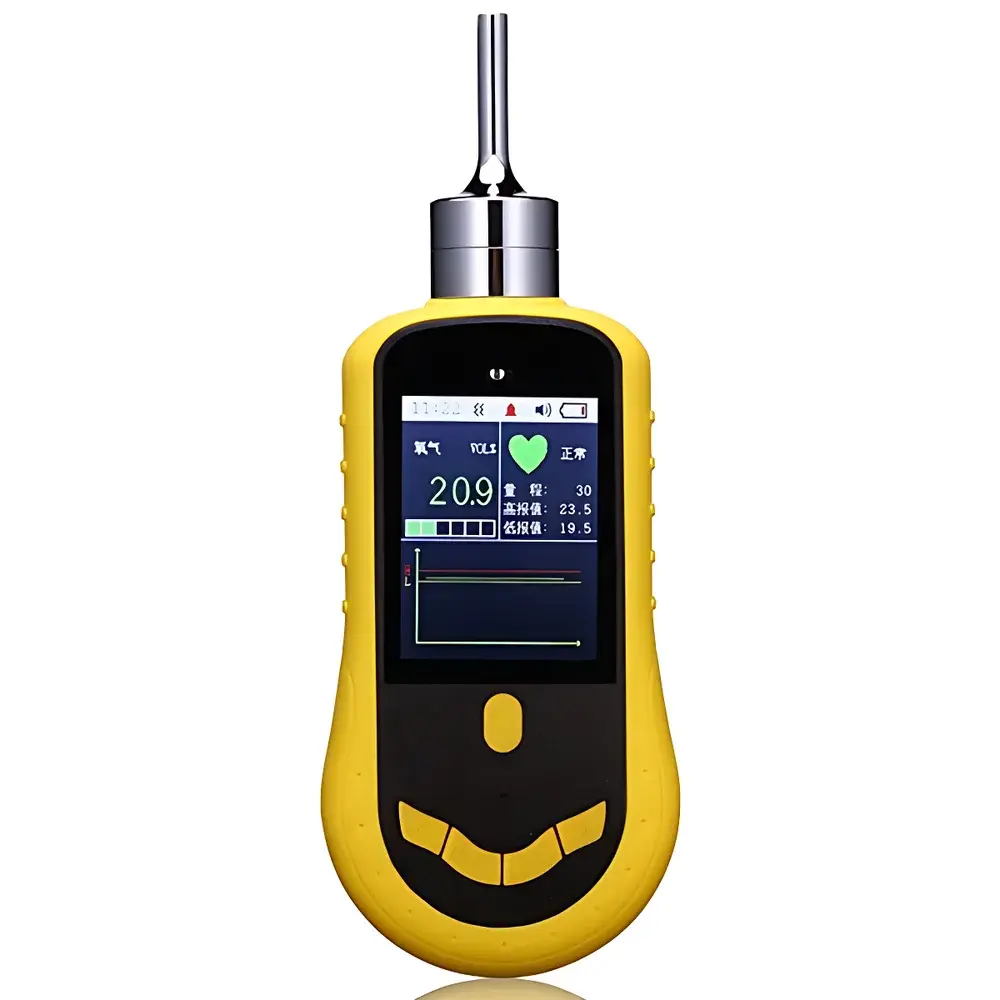
HengaoDe HAD-VO2 Portable Color LCD Pump-Suction VOC Gas Detector
| Brand | HengaoDe |
|---|---|
| Origin | Beijing, China |
| Manufacturer Type | Authorized Distributor |
| Country of Origin | China |
| Model | HAD-VO2 |
| Price | USD 42.50 (FOB) |
| Detection Gas | VOC |
| Measurement Range | 0–100 ppm |
| Minimum Resolution | 0.01 ppm |
| Response Time | ≤20 s |
| Sensor Type | Electrochemical |
| Sensor Lifetime | 24 months |
| Accuracy | ±3% FS |
| Display | 2.8" Full-Color TFT LCD |
| Data Storage | 3000 internal records + optional 32 GB SD card |
| Units | ppm / mg/m³ (switchable) |
| Operating Temperature | −40 °C to +70 °C |
| Operating Humidity | 0–95% RH (non-condensing) |
| Ingress Protection | IP65 |
| Explosion Protection | Exib IIB T4 Gb |
| Battery | 7.4 V Li-ion, 1600 mAh |
| Runtime | ~5 h (continuous sampling) |
| Dimensions | 223 × 66 × 26 mm |
| Weight | 300 g |
Overview
The HengaoDe HAD-VO2 Portable Color LCD Pump-Suction VOC Gas Detector is an intrinsically safe, field-deployable instrument engineered for real-time quantitative monitoring of volatile organic compounds (VOCs) in ambient air or confined spaces. It operates on the electrochemical sensing principle—where target VOC molecules undergo controlled oxidation/reduction at a catalytic working electrode, generating a current proportional to gas concentration. The integrated micro-diaphragm sampling pump enables active draw-through sampling with ten adjustable suction levels, ensuring consistent volumetric flow across variable environmental pressures and filter loadings. Designed for compliance with occupational exposure monitoring requirements, the HAD-VO2 delivers trace-level detection (down to 0.01 ppm) with documented linearity and repeatability per ISO 16000-22 and OSHA Method 1007 validation frameworks. Its dual-unit display (ppm and mg/m³) supports both regulatory reporting (e.g., OELs in ppm) and industrial hygiene assessments (mass-based exposure limits).
Key Features
- Active pump-suction sampling with 10-step vacuum control for stable flow under low-pressure or high-resistance filter conditions
- High-contrast 2.8-inch color TFT LCD supporting simultaneous display of gas name, concentration, peak value, timestamp, and unit
- Bilingual interface (English/Chinese) with intuitive icon-driven navigation compliant with IEC 61000-4 EMC immunity standards
- Onboard data logging: 3000 records stored internally with time-stamped list view and trend curve visualization
- Optional 32 GB SD card expansion enabling long-term unattended monitoring; data exportable via USB to PC for CSV/Excel analysis
- Dual-stage alarm system: visual (flashing LED) and audible (≥85 dB at 30 cm) with user-configurable thresholds per ACGIH TLV® guidelines
- Robust mechanical architecture: IP65-rated enclosure with reinforced polycarbonate housing and TPE-grip ergonomics for glove-compatible operation
Sample Compatibility & Compliance
The HAD-VO2 is calibrated for broad-spectrum VOC detection—including benzene, toluene, xylene (BTX), acetone, ethanol, and formaldehyde—using certified calibration gases traceable to NIST SRM 1861a. It meets international safety and performance benchmarks including EN 60079-0 (explosive atmospheres), EN 61000-6-3 (EMC emissions), and IEC 61010-1 (electrical safety). For workplace monitoring, it aligns with OSHA 29 CFR 1910.1200 (HazCom), EU Directive 2014/34/EU (ATEX), and ISO 16000-22 (indoor air quality). Calibration verification is supported by built-in zero/span check routines, and sensor drift compensation algorithms maintain accuracy over the full 24-month service life. All firmware and calibration logs are retained with timestamped audit trails, satisfying GLP documentation requirements.
Software & Data Management
Data retrieval and analysis are facilitated through HengaoDe’s proprietary PC software suite (v3.2+), compatible with Windows 10/11. The application enables batch import of SD card logs, spectral overlay of multiple test sessions, and automated report generation per ISO/IEC 17025 Annex A.2 format—exportable as PDF, Excel, or XML. Raw sensor output (mV vs. time), temperature/humidity metadata, and pump status flags are preserved for forensic review. The software enforces role-based access control and supports digital signature authentication for QA/QC sign-off. Audit trail functionality complies with FDA 21 CFR Part 11 requirements, including electronic record retention for ≥2 years and immutable log entries for all configuration changes or calibration events.
Applications
The HAD-VO2 serves critical roles across industrial hygiene, environmental remediation, and process safety domains. Field technicians use it for leak detection in petrochemical facilities (per API RP 2016), indoor air quality audits in commercial buildings (per ASHRAE Standard 62.1), and post-remediation verification after VOC abatement projects. In manufacturing, it validates fume hood containment efficiency (ANSI/AIHA Z9.5), monitors solvent vapor concentrations during coating operations, and supports confined space entry permits (OSHA 1910.146). Laboratories employ it for method development validation and QC checks of sorbent tube desorption efficiency. Its compact form factor and extended battery life make it suitable for mobile surveying—particularly where fixed-grid monitoring is impractical or cost-prohibitive.
FAQ
What calibration gases are required for routine verification?
Certified 50 ppm isobutylene in air (NIST-traceable) is recommended for daily bump testing; full multi-point calibration (0, 25, 50, 100 ppm) should be performed quarterly using EPA Protocol Gas Mixtures.
Can the instrument measure total VOCs without compound-specific identification?
Yes—the HAD-VO2 reports total VOC concentration as ppm-equivalent isobutylene; it does not perform speciation but maintains cross-sensitivity correction factors per IUPAC-recommended response curves.
Is the SD card data export compliant with ISO/IEC 17025 documentation requirements?
Yes—exported files include embedded metadata (instrument ID, operator ID, GPS coordinates if enabled, calibration certificate hash), and the software generates a checksum-verified audit log for each export session.
How often must the electrochemical sensor be replaced?
Sensor replacement is mandated every 24 months or after 8,000 operating hours—whichever occurs first—as validated by accelerated aging tests per ASTM D7260.
Does the device support Bluetooth or Wi-Fi connectivity?
No—wireless interfaces are intentionally omitted to preserve intrinsic safety certification and eliminate RF interference risks in hazardous locations. Data transfer is exclusively via physical USB or SD card.





