
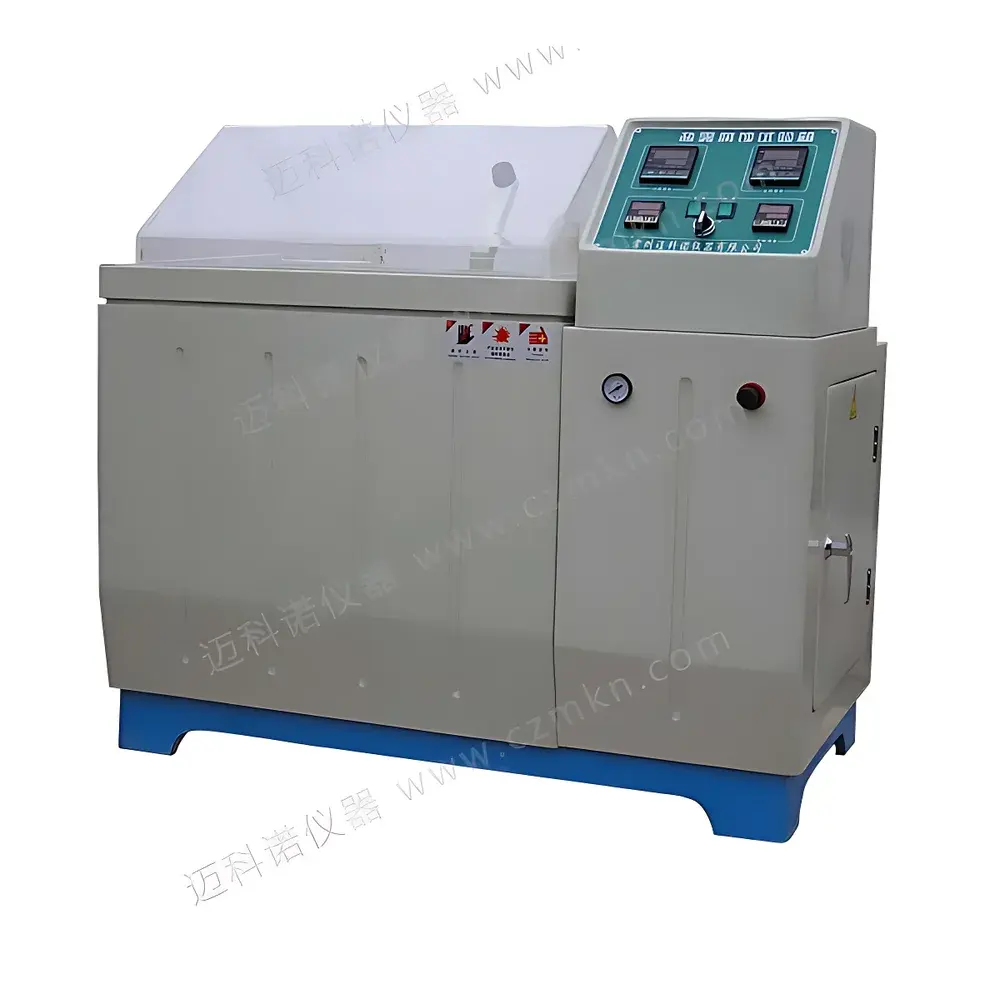
YWX-025 Export-Grade Salt Spray Test Chamber
| Origin | Zhejiang, China |
|---|---|
| Manufacturer Type | Authorized Distributor |
| Origin Category | Domestic (China) |
| Model | YWX-025 |
| Pricing | Upon Request |
| Temperature Range | RT+10 to 55 °C |
| Temperature Uniformity | ≤ ±2 °C |
| Temperature Fluctuation | ≤ ±0.5 °C |
| Salt Spray Deposition Rate | 1–2 mL/80 cm²·h |
| Saturated Air Pressure | 0.8–2.0 ± 0.01 kg/cm² |
| Test Chamber Temperature (Neutral Salt Spray) | 35 ± 1 °C |
| Air Saturator Temperature (Neutral Salt Spray) | 47 ± 1 °C |
| Test Chamber Volume | 250 L |
| Water Reservoir Capacity | 25 L |
| Power Supply | 220 V, 50 Hz (Optional: 380 V, 50 Hz, 3-phase 4-wire) |
Overview
The YWX-025 Export-Grade Salt Spray Test Chamber is a precision-engineered environmental test system designed to accelerate corrosion evaluation under controlled saline atmospheric conditions. It operates on the principle of continuous or cyclic nebulization of a standardized sodium chloride (NaCl) solution—typically 5 wt%—into a thermally stabilized test chamber, where aerosolized salt particles settle uniformly onto test specimens. This method replicates key degradation mechanisms observed in marine and coastal environments, enabling quantitative assessment of protective coatings, metallic substrates, electroplated layers, anodized films, organic/inorganic conversion coatings, and rust inhibitors. As a core component of the “Three-Defense” (Moisture-Heat, Salt Spray, Mold) environmental simulation suite, the YWX-025 supports accelerated life-cycle validation for components used in aerospace, defense electronics, automotive powertrain systems, marine instrumentation, and industrial control enclosures. Its design complies with internationally harmonized test protocols—including ISO 9227 (2022), IEC 60068-2-11, and GB/T 2423.17—ensuring data comparability across global R&D, quality assurance, and regulatory submission workflows.
Key Features
- Corrosion-resistant chamber construction using imported rigid PVC plastic panels—non-reactive to acidic/alkaline salt mists, UV-stable, and surface-smooth for easy decontamination.
- Hermetic water-sealed door design with transparent rigid PVC viewing window for real-time observation of specimen condition and spray uniformity without interrupting test cycles.
- Tower-type atomization system with quartz glass nozzles—eliminates crystallization-induced clogging and ensures consistent droplet size distribution (median diameter < 10 µm) and gravitational sedimentation pattern.
- Dual-stage compressed air regulation with precision pressure control (0.8–2.0 kg/cm² ± 0.01) and integrated saturator pre-heating to maintain stable fog generation across ambient humidity variations.
- High-accuracy PID temperature controller (±0.1 °C setpoint stability) for independent regulation of both test chamber (35 °C ±1 °C for NSS; 50 °C ±1 °C for ASS/CASS) and air saturator (47 °C ±1 °C / 63 °C ±1 °C).
- Comprehensive safety architecture: dry-run protection, overtemperature cutoff, phase-loss monitoring, and gas-assisted lid support mechanism for ergonomic access and operator safety.
Sample Compatibility & Compliance
The YWX-025 accommodates flat, cylindrical, or irregularly shaped samples up to 250 L chamber volume, supporting standard test specimen racks per ISO 9227 Annex A. It enables execution of Neutral Salt Spray (NSS), Acetic Acid Salt Spray (AASS), and Copper-Accelerated Acetic Acid Salt Spray (CASS) tests with full traceability. All operational parameters—including temperature, pressure, deposition rate, and cycle duration—are documented and verifiable against calibration records aligned with ISO/IEC 17025 requirements. The chamber meets structural and performance criteria specified in GB/T 10587 (“Technical Requirements for Salt Spray Test Chambers”) and supports GLP-compliant test reporting when integrated with validated data logging systems.
Software & Data Management
While the base configuration features a front-panel digital controller with manual parameter input, optional RS-485/Modbus RTU interface enables integration with centralized laboratory management platforms (e.g., LabWare LIMS, Siemens Desigo CC). Time-stamped temperature and pressure logs can be exported for audit trails compliant with FDA 21 CFR Part 11 (when paired with electronic signature-capable software). Calibration certificates for temperature sensors and pressure transducers are supplied with each unit, and annual verification procedures follow ASTM E74 or ISO 17025-accredited protocols.
Applications
- Evaluation of coating adhesion, blistering resistance, and cathodic disbondment in automotive OEM paint systems.
- Qualification of printed circuit board (PCB) conformal coatings and connector plating integrity under high-chloride exposure.
- Comparative lifetime modeling of galvanized steel vs. aluminum alloy housings in offshore instrumentation.
- Validation of passivation efficacy on stainless steel surgical instruments per ASTM A967.
- Support for MIL-STD-810H Method 509.6 (Salt Fog) and DO-160 Section 10 (Environmental Conditions and Test Procedures for Airborne Equipment).
FAQ
What standards does the YWX-025 fully comply with for international export?
It conforms to ISO 9227:2022, IEC 60068-2-11, GB/T 2423.17, and GB/T 10587—certified documentation includes factory calibration reports and material compliance declarations (RoHS, REACH).
Can the chamber perform CASS testing without hardware modification?
Yes—CASS operation requires only reconfiguration of solution composition (CuCl₂ addition) and adjustment of air saturator temperature to 63 °C ±1 °C; no retrofitting is needed.
Is remote monitoring supported out-of-the-box?
Standard units include analog output signals (4–20 mA) for temperature and pressure; Ethernet or Wi-Fi telemetry modules are available as configurable add-ons.
What maintenance intervals are recommended for sustained accuracy?
Quartz nozzles should be inspected weekly; saturator water must be replaced daily; full system calibration (temperature, pressure, deposition rate) is recommended every 6 months or per ISO/IEC 17025 internal audit schedule.



