
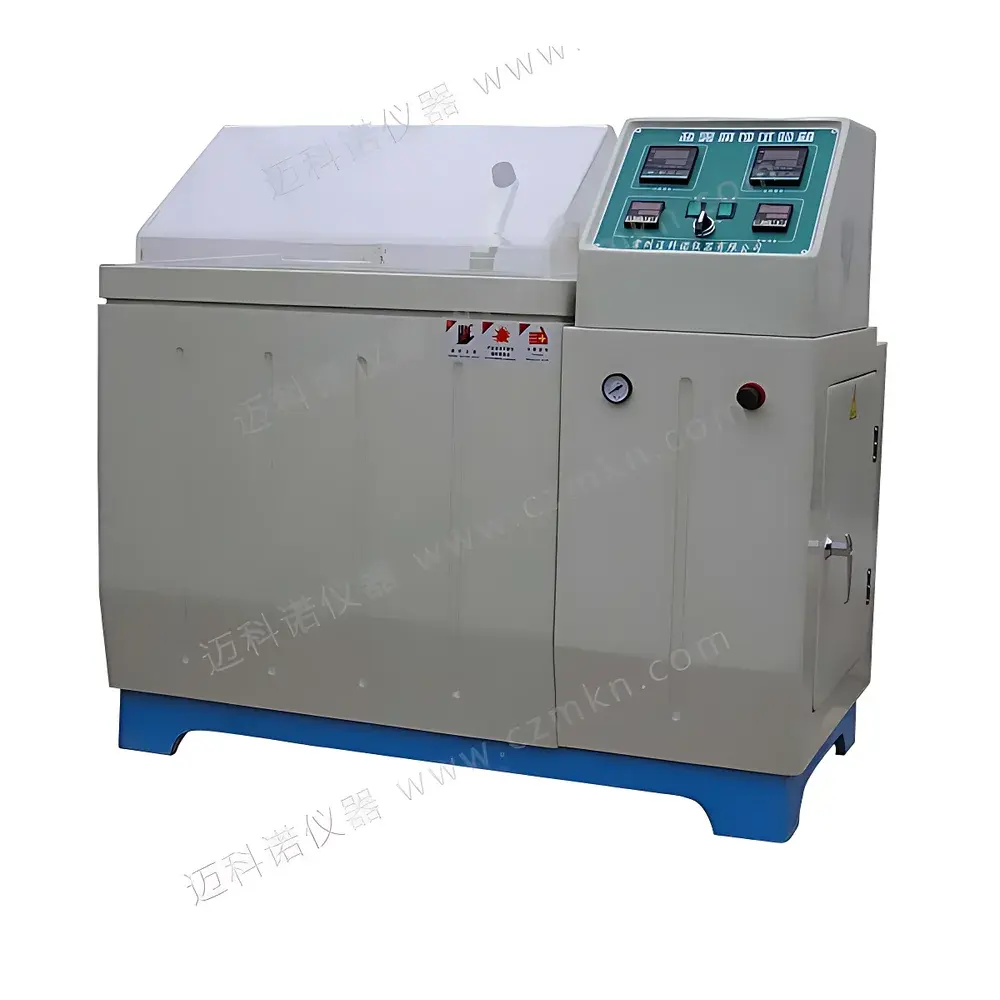
YWX-100 Salt Spray Test Chamber (Export-Grade Environmental Corrosion Test Chamber)
| Origin | Zhejiang, China |
|---|---|
| Manufacturer Type | Authorized Distributor |
| Origin Category | Domestic (China) |
| Model | YWX-100 |
| Pricing | Upon Request |
| Temperature Range | RT+10 to 55 °C |
| Temperature Uniformity | ≤ ±2 °C |
| Temperature Fluctuation | ≤ ±0.5 °C |
| Salt Spray Deposition Rate | 1–2 mL / 80 cm²·h |
| Saturated Air Pressure | 0.8–2.0 ± 0.01 kg/cm² |
| Test Chamber Temperature (Neutral Salt Spray) | 35 ± 1 °C |
| Air Saturation Tower Temperature (NSS) | 47 ± 1 °C |
| Test Chamber Volume | 100 L |
| Water Reservoir Capacity | 15 L |
| Power Supply | 220 V, 50 Hz (Optional: 380 V, 3-phase, 4-wire) |
Overview
The YWX-100 Salt Spray Test Chamber is a precision-engineered environmental test system designed to accelerate corrosion evaluation under controlled saline atmospheric conditions. Based on the fundamental principle of continuous or cyclic salt fog generation—where compressed air is saturated with humidity in a temperature-controlled bubble tower and then atomized with sodium chloride solution through a quartz glass nozzle—the chamber replicates aggressive marine or industrial coastal environments. This enables standardized assessment of corrosion resistance for metallic substrates, electroplated coatings, anodized layers, organic/inorganic conversion films, passivation treatments, and corrosion-inhibiting oils. As a core component of the “Three-Defense” (humidity-heat, salt spray, mold) environmental simulation suite, the YWX-100 supports reliability validation across aerospace, defense electronics, automotive components, maritime instrumentation, and consumer electronics manufacturing.
Key Features
- Corrosion-resistant construction: Inner and outer chambers fabricated from imported high-purity PVC rigid sheet—exhibiting exceptional chemical inertness against NaCl solutions, long-term UV stability, and smooth non-porous surfaces that prevent residue accumulation.
- Hermetic water-sealed design with transparent PVC lid: Enables real-time visual monitoring of specimen condition and uniform spray distribution without compromising chamber integrity or operator safety.
- Quartz glass nozzle assembly: Eliminates crystallization-induced clogging, ensuring consistent droplet size (<10 µm median diameter) and stable deposition rates over extended test durations.
- Tower-type spray system: Delivers isotropic, gravity-driven fog dispersion with adjustable spray interval and continuous operation capability—compliant with ISO 9227-defined “natural fall” criteria.
- PID temperature control system: Maintains chamber and saturation tower temperatures within ±0.1 °C setpoint accuracy; optional Fuji or RKC controllers available for enhanced traceability and calibration logging.
- Dual-stage pressure regulation with gas-assisted lid actuation: Ensures precise air saturation pressure control (0.8–2.0 kg/cm²) and ergonomic, vibration-free lid operation.
- Integrated safety architecture: Includes dry-run protection, overtemperature cutoff, phase-loss detection, and grounded leakage current monitoring per IEC 61000-6-2 EMC requirements.
Sample Compatibility & Compliance
The YWX-100 accommodates flat panels, fasteners, PCB assemblies, coated metal coupons (e.g., ASTM G101 reference specimens), and small enclosures up to 100 L internal volume. It is fully compliant with internationally recognized test standards including GB/T 2423.17 (equivalent to IEC 60068-2-11), ISO 9227 (NSS, AASS, CASS variants), ASTM B117, JIS Z2371, and DIN 50021. All thermal and spray performance parameters are verified per GB/T 10587—“Technical Specifications for Salt Spray Test Chambers”—ensuring metrological consistency for GLP-compliant laboratories and ISO/IEC 17025-accredited testing facilities. The chamber supports full audit trails when integrated with validated data acquisition systems meeting FDA 21 CFR Part 11 requirements.
Software & Data Management
While the base configuration features analog PID controllers with manual setpoint adjustment, optional digital controllers provide RS485/Modbus RTU interfaces for integration into centralized laboratory information management systems (LIMS). Logged parameters—including chamber temperature, saturation tower temperature, elapsed spray time, and fault event timestamps—are exportable as CSV files. Optional firmware upgrades enable automated test sequencing (e.g., alternating wet/dry cycles per ISO 14993), alarm escalation via email/SMS, and electronic signature-enabled report generation aligned with ISO 17025 documentation practices.
Applications
- Qualification testing of zinc-nickel, chromium VI-free, and trivalent chromium electroplated parts per OEM specifications (e.g., GMW14872, Ford CETP).
- Comparative evaluation of paint adhesion and blistering resistance on aluminum die-cast housings per ASTM D714.
- Validation of conformal coating integrity on printed circuit boards subjected to IPC-CC-830B Class 3 environments.
- Accelerated aging of stainless steel fasteners in offshore oil & gas applications per NORSOK M-501 Annex A.
- Process control monitoring for anodizing lines using Q-panel AA2024-T3 reference coupons.
- Regulatory submission support for medical device enclosures (IEC 60601-1 Clause 11.2.2) and railway signaling equipment (EN 50125-3).
FAQ
What standards does the YWX-100 comply with for neutral salt spray (NSS) testing?
It meets GB/T 2423.17, IEC 60068-2-11, ISO 9227 NSS, ASTM B117, and JIS Z2371—verified through third-party calibration reports traceable to NIM (National Institute of Metrology, China).
Can the chamber perform acetic acid salt spray (AASS) or copper-accelerated acetic acid salt spray (CASS) tests?
Yes—when equipped with pH-adjusted solution delivery and elevated saturation tower temperature (63 ± 1 °C), it supports AASS (ISO 9227) and CASS protocols without hardware modification.
Is remote monitoring supported out-of-the-box?
Standard units include local analog indicators; Ethernet-enabled controllers with web-based HMI and SNMP alerting are available as configurable options.
How is temperature uniformity validated inside the working zone?
Per GB/T 10587, nine thermocouple probes are placed in a 3×3 grid at mid-height; deviation across all points must remain ≤ ±2 °C during steady-state operation.
What maintenance intervals are recommended for long-term operational reliability?
Daily: Solution level check and nozzle inspection; Quarterly: Saturation tower cleaning and pressure regulator calibration; Annually: Full thermal sensor verification and electrical safety testing per IEC 61010-1.



