
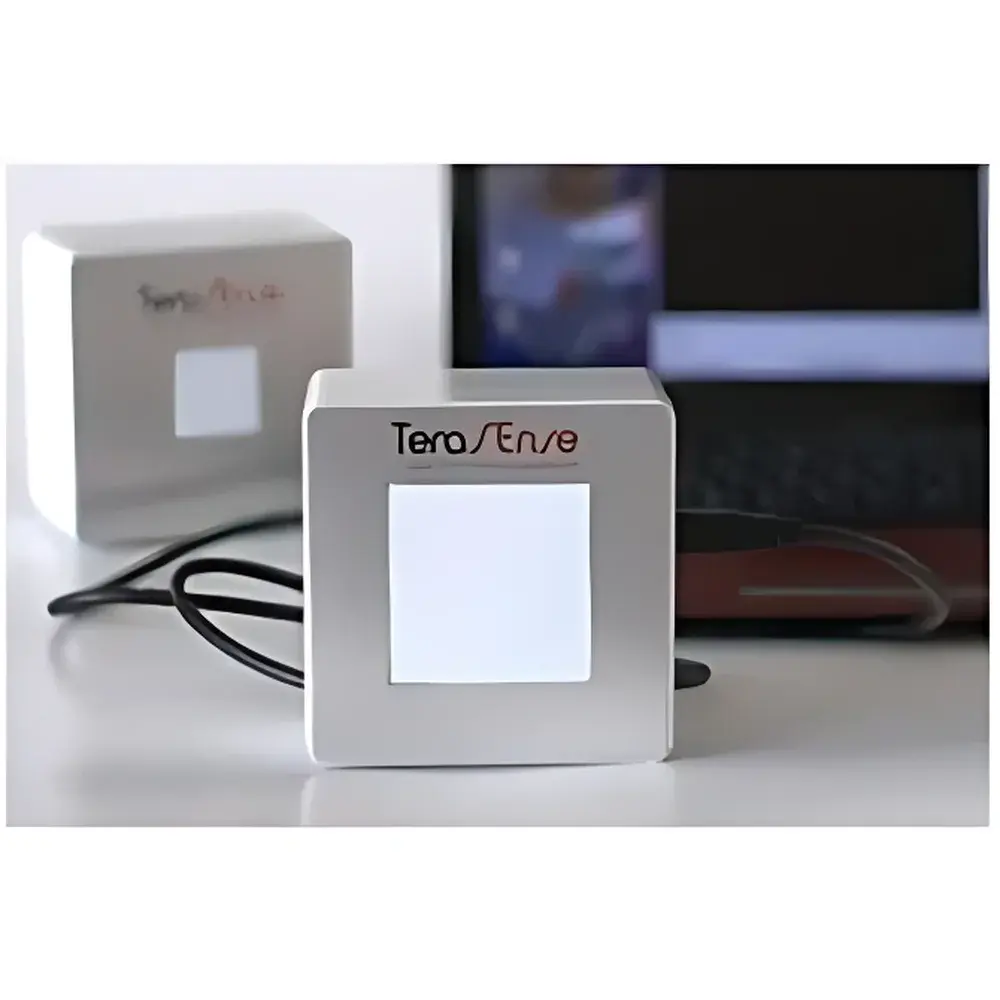
TeraSense TERA-256 Room-Temperature Terahertz Imaging Camera
| Brand | TeraSense |
|---|---|
| Origin | Germany |
| Model | TERA-256 |
| Effective Pixels | 256 (16×16) |
| Pixel Size | 1.5 × 1.5 mm |
| Responsivity | 50 kV/W (at room temperature) |
| NEP | 1 nW/Hz¹ᐟ² |
| Frequency Range | 50 GHz – 0.7 THz |
| Frame Rate | 50 fps |
| Power Supply | USB 5 V |
| Dimensions | 10 cm × 10 cm × 5.5 cm |
| Operating Temperature | Ambient (20–25 °C) |
| Software | TeraSense ViewerR |
| Warranty | 18 months |
Overview
The TeraSense TERA-256 is a compact, uncooled terahertz (THz) imaging camera engineered for real-time, non-invasive inspection across research and industrial environments. Unlike cryogenically cooled bolometric or superconducting detectors, the TERA-256 operates at ambient temperature—eliminating the need for liquid nitrogen or mechanical coolers—while maintaining high responsivity and low noise-equivalent power (NEP). Its detection principle relies on plasma-wave rectification in a two-dimensional electron gas (2DEG) formed within GaAs-based heterostructures. Incident THz radiation couples to collective plasma oscillations in the channel of each pixel, generating a measurable DC photovoltage proportional to incident intensity. This mechanism enables fast, linear, and highly reproducible response across the 50 GHz–0.7 THz band without spectral scanning or moving parts.
Key Features
- Room-temperature operation: No external cooling required; stable performance in standard laboratory or field-deployable settings.
- High responsivity: 50 kV/W per pixel—enabling detection of weak THz signals from low-power sources such as IMPATT diodes or photoconductive antennas.
- Low NEP: 1 nW/Hz1/2, supporting high signal-to-noise ratio (SNR) imaging even under sub-milliwatt illumination.
- Real-time video acquisition: Native frame rate of 50 fps with full 16×16 (256-pixel) readout, facilitating dynamic process monitoring and time-resolved THz tomography.
- Monolithic sensor architecture: All 256 pixels fabricated on a single GaAs wafer using standard photolithographic processes—ensuring uniformity (<20% inter-pixel responsivity variation) and long-term calibration stability.
- Plug-and-play integration: USB 5 V bus-powered interface; minimal cabling and footprint (10 × 10 × 5.5 cm); compatible with standard optical benches and THz beamlines.
- Built-in software suite: TeraSense ViewerR provides live image display, histogram analysis, ROI-based intensity profiling, frame averaging, and export in TIFF/CSV formats.
Sample Compatibility & Compliance
The TERA-256 is designed for transmission and reflection-mode THz imaging of non-conductive and semi-conductive materials—including polymers, ceramics, pharmaceutical tablets, composite laminates, and biological tissues. Its 1.5 mm pixel pitch supports spatial resolution consistent with diffraction-limited THz optics (e.g., f/2 parabolic mirrors or silicon lenses). The system complies with CE marking requirements for electromagnetic compatibility (EMC Directive 2014/30/EU) and low-voltage safety (LVD Directive 2014/35/EU). While not certified for clinical use, its performance parameters align with ASTM E2963–21 (Standard Guide for Terahertz Imaging) for material characterization workflows. Data integrity is maintained via timestamped frame logging and lossless 16-bit raw data capture—supporting GLP-compliant documentation when integrated into validated laboratory information management systems (LIMS).
Software & Data Management
TeraSense ViewerR is a Windows-based application developed for scientific reproducibility and traceability. It supports hardware-triggered acquisition, multi-frame averaging, background subtraction, and real-time false-color mapping with user-defined LUTs. All acquired frames include embedded metadata: timestamp, exposure time, gain setting, and sensor temperature (monitored via on-chip thermistor). Export functions preserve full dynamic range in 16-bit TIFF format, enabling downstream processing in MATLAB, Python (NumPy/SciPy), or commercial image analysis platforms. The software architecture adheres to modular design principles—allowing third-party API access via DLL libraries for custom automation scripts or integration into larger THz spectroscopy platforms.
Applications
- Non-destructive testing (NDT): Detection of delamination, voids, and fiber misalignment in carbon-fiber-reinforced polymers (CFRP) and aerospace composites.
- Pharmaceutical quality control: Coating thickness uniformity assessment and tablet integrity verification without sample preparation.
- Security screening: Concealed object identification through clothing and packaging materials—leveraging differential THz absorption contrast.
- Materials science research: In-situ monitoring of hydration dynamics in hydrogels, crystallization kinetics in organic semiconductors, and carrier diffusion in perovskite thin films.
- Art conservation: Subsurface layer analysis of paint stratigraphy and varnish degradation beneath opaque surfaces.
FAQ
Is the TERA-256 compatible with common THz sources such as photoconductive antennas or backward-wave oscillators (BWOs)?
Yes—the camera’s broadband 50 GHz–0.7 THz response and high NEP make it suitable for use with pulsed femtosecond-laser-driven emitters, CW IMPATT diodes, and electronic THz synthesizers.
Does the system require optical alignment or collimation before imaging?
It is designed for integration with standard THz optics; optimal performance requires collimated or focused illumination matching the pixel pitch and field-of-view constraints. Alignment fixtures and mounting adapters are available upon request.
Can multiple TERA-256 units be synchronized for extended FOV imaging?
While the current firmware does not support hardware triggering across multiple cameras, software-level frame synchronization is achievable using external TTL pulses and custom Python/MATLAB control scripts.
What calibration standards are provided with the instrument?
Each unit ships with a NIST-traceable responsivity map and dark-current reference frames. Optional factory recalibration services are available annually to maintain measurement confidence.
Is remote operation supported over Ethernet or Wi-Fi?
The native interface is USB 2.0; however, USB-over-IP solutions (e.g., VirtualHere USB Server) enable secure remote access in controlled network environments.




