
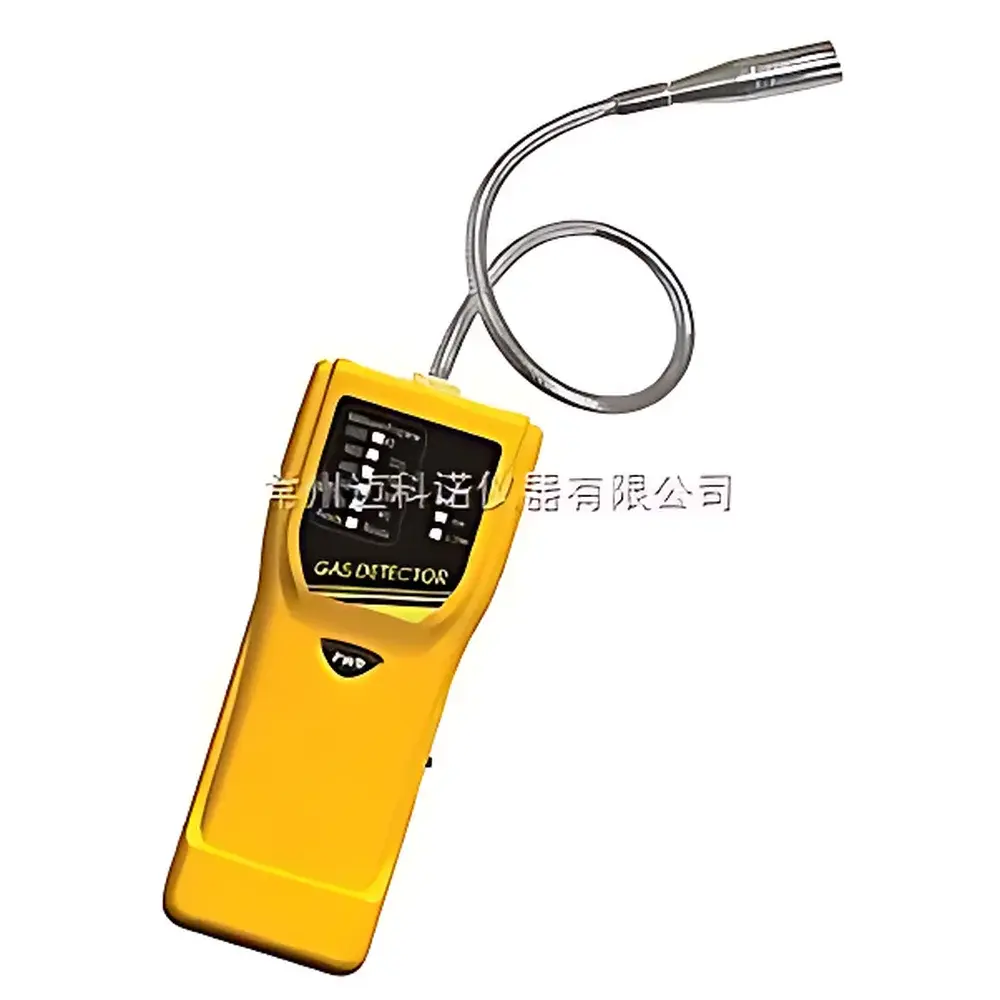
AZ7291 Portable Combustible Gas Detector
| Origin | Zhejiang, China |
|---|---|
| Manufacturer Type | Authorized Distributor |
| Origin Category | Domestic (China) |
| Model | AZ7291 |
| Price | Upon Request |
| Detection Gases | Methane (CH₄), Propane (C₃H₈) |
| Detection Range | 40–640 ppm (both gases) |
| Display | 8-segment LED bar graph (40, 80, 160, 320, 640 ppm) |
| Sensitivity | ±35 ppm |
| Response Time (T90) | <2 s |
| Warm-up Time | <60 s |
| Dimensions | 175 × 70 × 38 mm (L×W×T) |
| Power Supply | 4 × AAA batteries |
| Operating Temperature | –5 to +45 °C |
| Operating Humidity | 5–99 % RH (non-condensing) |
| Audio/Visual Alerts | Buzzer alarm, LED concentration bar, low-battery indicator, headphone jack, mute function |
Overview
The AZ7291 Portable Combustible Gas Detector is a compact, battery-powered safety instrument engineered for rapid, reliable detection of methane (CH₄) and propane (C₃H₈) in ambient air. It employs catalytic bead (pellistor) sensing technology — a well-established, intrinsically safe method widely adopted in industrial hygiene and confined-space entry protocols. The detector operates on the principle of catalytic oxidation: combustible gas molecules react exothermically on a heated platinum coil within the sensor element, inducing a measurable resistance change proportional to gas concentration. This analog signal is conditioned and mapped to a discrete 5-point LED bar graph, enabling immediate visual assessment of exposure severity without requiring numerical interpretation. Designed for field use by safety officers, maintenance technicians, utility inspectors, and HVAC service personnel, the AZ7291 prioritizes operational simplicity, robustness under variable environmental conditions, and compliance-ready functionality — including audible alarm muting and external audio output via standard 3.5 mm headphone jack for noisy environments.
Key Features
- Catalytic bead (pellistor) sensor with built-in temperature compensation for stable performance across –5 to +45 °C ambient range
- 5-level segmented LED bar graph (40, 80, 160, 320, 640 ppm) providing intuitive, at-a-glance concentration grading for both methane and propane
- Fast response time (T90 < 2 seconds) and sub-60-second warm-up enable immediate deployment upon power-on
- Dual-mode alarm system: adjustable audible buzzer (85 dB @ 30 cm) and high-visibility LED flash synchronized with concentration thresholds
- Mute function with visual confirmation (LED indicator) for temporary alarm suppression during controlled inspections
- Integrated headphone interface supporting external earpieces or noise-cancelling headsets — essential for operation in high-noise industrial zones or underground infrastructure
- Low-voltage detection circuitry with dedicated LED warning and automatic shutdown at end-of-battery-life to prevent false-negative readings
- Rugged ABS housing rated IP54 for dust and splash resistance; ergonomic form factor (175 × 70 × 38 mm) designed for one-hand operation and belt-clip portability
Sample Compatibility & Compliance
The AZ7291 is calibrated and validated for quantitative detection of methane and propane in clean, non-corrosive, non-silicon-laden air matrices. It is not intended for use in oxygen-deficient (23.5 % O₂) atmospheres, nor in environments containing high concentrations of lead, sulfur compounds, or halogenated hydrocarbons that may poison the pellistor element. While not certified to ATEX, IECEx, or UL 913 standards for hazardous area classification, the device meets general-purpose industrial safety requirements per GB/T 50493–2019 (Chinese Code for Design of Gas Detection and Alarm Systems for Petrochemical Enterprises) and aligns with OSHA 1910.120 and NFPA 70E guidance for pre-entry atmospheric monitoring. Its design supports GLP-aligned documentation practices, including manual log entry of calibration dates, bump test results, and alarm events.
Software & Data Management
The AZ7291 operates as a standalone, microcontroller-based instrument with no embedded Bluetooth, USB, or wireless data transmission capability. All operational data — including alarm triggers, mute activations, low-battery events, and sensor fault codes — are retained only as transient visual/audible indicators and are not stored internally. Users are expected to maintain external records per site-specific safety management systems (e.g., HSE logs, permit-to-work documentation). Calibration and functional bump testing must be performed using certified span gas (50% LEL CH₄ or C₃H₈ in air) and documented manually. The included user manual provides traceable calibration procedures compliant with ISO 6141 and ASTM D5402 guidelines for portable gas detector verification.
Applications
- Pre-entry verification of natural gas (methane) leaks in residential basements, utility vaults, and pipeline right-of-ways
- Routine inspection of propane-fueled equipment in catering vehicles, RVs, and off-grid residential installations
- Leak surveying during gas line commissioning, maintenance, or post-repair verification per API RP 1173
- Confined space atmospheric screening prior to worker entry (OSHA 1926.21, ANSI Z117.1)
- Emergency response triage by fire departments and municipal hazmat teams for initial vapor cloud assessment
- Facility-wide safety audits in food processing plants, breweries, and chemical storage areas where hydrocarbon fuels are handled
FAQ
What gases does the AZ7291 detect?
It is specifically calibrated for methane (CH₄) and propane (C₃H₈) in ambient air. It is not cross-sensitive to hydrogen, carbon monoxide, or volatile organic compounds (VOCs) under normal operating conditions.
Does the AZ7291 require periodic calibration?
Yes. Full calibration with certified test gas is recommended before each day’s use (bump test) and formally every 30 days, or after exposure to sensor-poisoning substances, mechanical shock, or extreme humidity.
Can the AZ7291 be used in explosive atmospheres?
No. It is not intrinsically safe (IS) certified. It must only be operated in non-classified areas or during preliminary surveys prior to entering potentially hazardous zones.
How long do the AAA batteries last?
Under typical intermittent-use conditions (5–10 minutes/day), battery life exceeds 12 months. Continuous operation reduces runtime to approximately 15–20 hours.
Is the sensor replaceable by the user?
The pellistor sensor is factory-installed and not user-replaceable. End-of-life units must be returned to authorized service centers for sensor replacement and full recalibration.
Related Products







