
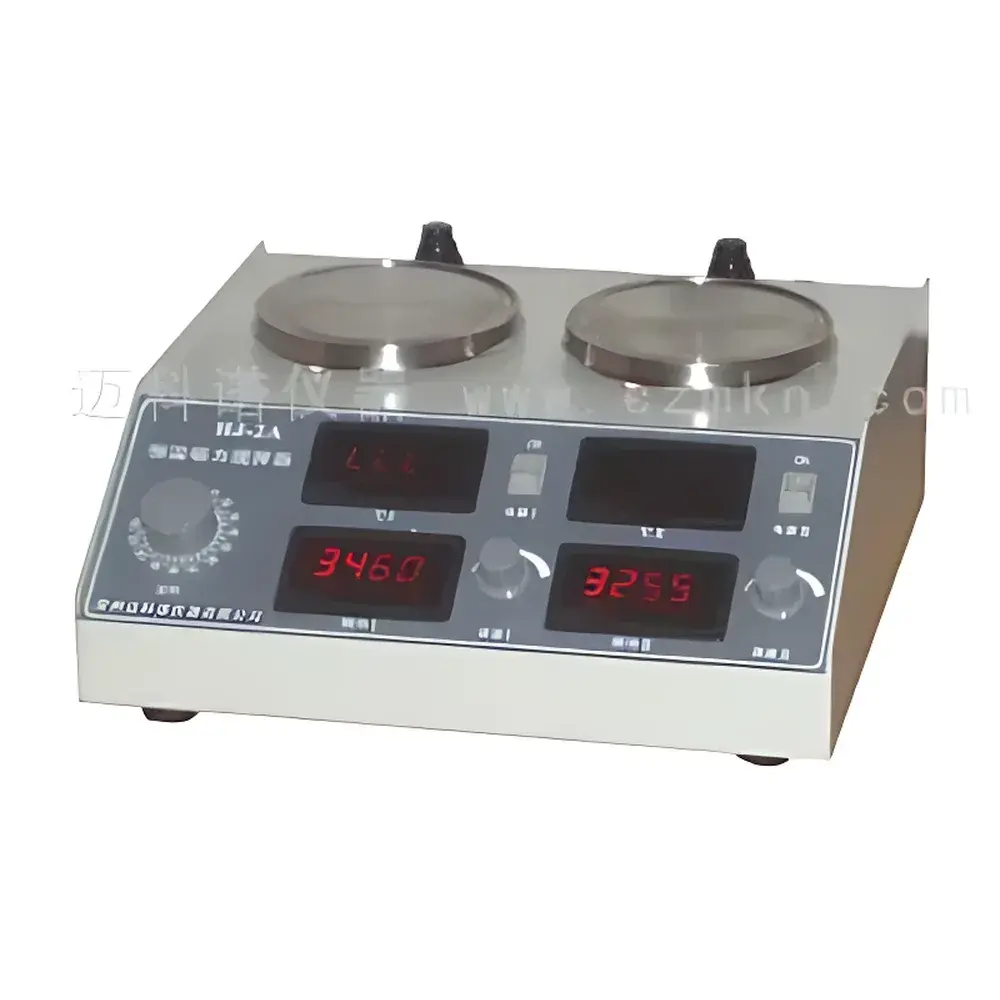
MKN HJ-2A Dual-Station Digital Temperature-Controlled Magnetic Stirrer
| Brand | MKN |
|---|---|
| Model | HJ-2A |
| Type | Dual-Station Magnetic Stirrer with Independent Heating & Digital Speed/Temperature Control |
| Power Supply | 220 V ±10%, 50–60 Hz |
| Stirring Capacity (per station) | 20–2000 mL |
| Motor Power | 25 W × 2 |
| Heating Power | 200 W × 2 |
| Speed Range | 0–2000 rpm (digital display, continuously adjustable) |
| Temperature Control Range | RT to 100 °C (digital PID control, ±0.5 °C accuracy at setpoint) |
| Timer Function | 0–120 min (digital countdown, auto-shutdown) |
| Stirrer Material Compatibility | PTFE-coated magnetic stir bars (chemically inert, heat-resistant up to 250 °C) |
| Construction | Aluminum alloy housing with ceramic-coated heating plates |
| Safety Features | Overheat protection, motor thermal cutoff, dual independent circuit isolation |
Overview
The MKN HJ-2A Dual-Station Digital Temperature-Controlled Magnetic Stirrer is an engineered solution for simultaneous, independent temperature-regulated mixing of two samples under controlled laboratory conditions. Designed around the principle of contactless magnetic coupling—where a rotating permanent magnet beneath the heating plate induces torque in a submerged PTFE- or glass-coated stir bar—the instrument delivers precise rotational agitation without mechanical shaft penetration. This architecture eliminates seal wear, contamination risk, and leakage concerns associated with overhead stirrers, making it particularly suitable for sealed-vessel applications such as reflux setups, inert-atmosphere reactions, and low-volume analytical digestions. Its dual-station configuration supports comparative studies, parallel synthesis, or quality control batch testing where identical thermal and hydrodynamic conditions must be maintained across replicates. The unit integrates digital PID temperature regulation with real-time speed feedback, enabling stable operation within ±0.5 °C of setpoint across the full 20–2000 mL working range per station.
Key Features
- Dual independent control channels: Each station features fully decoupled speed and temperature regulation—no cross-talk between stations during operation.
- Brushless DC motors: Provide silent, maintenance-free rotation with high torque consistency across the 0–2000 rpm range; motor life exceeds 10,000 hours under typical lab usage.
- Ceramic-coated aluminum heating plates: Deliver uniform thermal distribution and rapid heat-up response; surface temperature stability maintained within ±1 °C over extended dwell periods.
- Digital LED displays: Simultaneous readout of actual speed (rpm), set speed, actual temperature (°C), and set temperature for both stations—enabling immediate verification of operational parameters.
- Programmable timer with auto-shutdown: Supports timed operation from 1 minute to 120 minutes; terminates heating and stirring automatically upon completion to prevent sample degradation or evaporation.
- Overtemperature and overcurrent protection circuits: Integrated thermal fuses and current-limiting logic safeguard electronics and user safety during prolonged use or unexpected load changes.
Sample Compatibility & Compliance
The HJ-2A accommodates standard laboratory glassware including beakers (50–1000 mL), Erlenmeyer flasks, and round-bottom flasks fitted with appropriate PTFE-encapsulated stir bars. Its sealed-vessel compatibility extends to Schlenk tubes and pressure-rated vessels when used with compatible stir bars rated for vacuum or inert-gas environments. While not certified for IEC 61010-1 Class II or UL listing, the device conforms to general electrical safety principles aligned with EN 61326-1 (EMC for laboratory equipment) and meets basic requirements for GLP-compliant workflows when operated within validated parameter ranges. It supports documentation of operating conditions (setpoints, duration, observed values) via manual log entry—a prerequisite for audit-ready QC records in regulated environments.
Software & Data Management
The HJ-2A operates as a standalone instrument with no embedded firmware connectivity (e.g., USB, Bluetooth, or Ethernet). All parameter inputs and status monitoring occur via front-panel push-button interface and dual digital displays. For laboratories requiring electronic data capture, integration is achieved through external logging systems—such as USB-connected thermocouple/data acquisition modules or camera-based screen-recording protocols compliant with FDA 21 CFR Part 11 Annex 11 principles. The absence of proprietary software reduces validation burden and ensures long-term operability without dependency on vendor-specific drivers or cloud services.
Applications
- Standardization of buffer preparation in molecular biology labs, where pH-sensitive reagents require uniform heating and mixing prior to calibration.
- Parallel dissolution testing of pharmaceutical excipients under USP guidance, using identical thermal profiles across replicate vessels.
- Pretreatment of environmental water samples for heavy metal analysis (e.g., EPA Method 200.8), ensuring homogeneous acid digestion without introducing metallic contaminants.
- Controlled polymerization initiation in synthetic chemistry, where exothermic reaction onset is modulated via precise ramp-and-hold temperature profiles.
- Calibration of viscosity standards using temperature-dependent reference fluids (e.g., Cannon-Fenske oils), leveraging the unit’s stable thermal platform and low-speed reproducibility.
FAQ
Can the HJ-2A operate continuously for more than 120 minutes?
Yes—though the built-in timer caps at 120 minutes, the unit will continue running indefinitely if the timer is disabled; thermal and motor protection systems remain active during extended operation.
Is the heating plate surface resistant to strong acids like concentrated HNO₃ or HF?
The ceramic coating provides resistance to most common laboratory acids (including HCl, H₂SO₄, and HNO₃), but hydrofluoric acid (HF) will etch the coating and must be avoided.
What stir bar size is recommended for optimal performance at 2000 rpm in a 500 mL beaker?
A 30 mm × 8 mm PTFE-coated stir bar is empirically verified to maintain stable vortex formation and torque transfer without orbital deviation at maximum speed in that geometry.
Does the instrument support external temperature probe input for jacketed vessel control?
No—the HJ-2A relies solely on integrated surface-mounted NTC thermistors; it does not accept external PT100 or thermocouple inputs.
Are replacement stir bars and fuse kits available directly from MKN?
Yes—MKN supplies OEM-certified PTFE stir bars (part number MKN-STB-30×8) and 250 V/2 A ceramic fuses (MKN-FUSE-2A) through authorized distributors in APAC and EMEA regions.



