
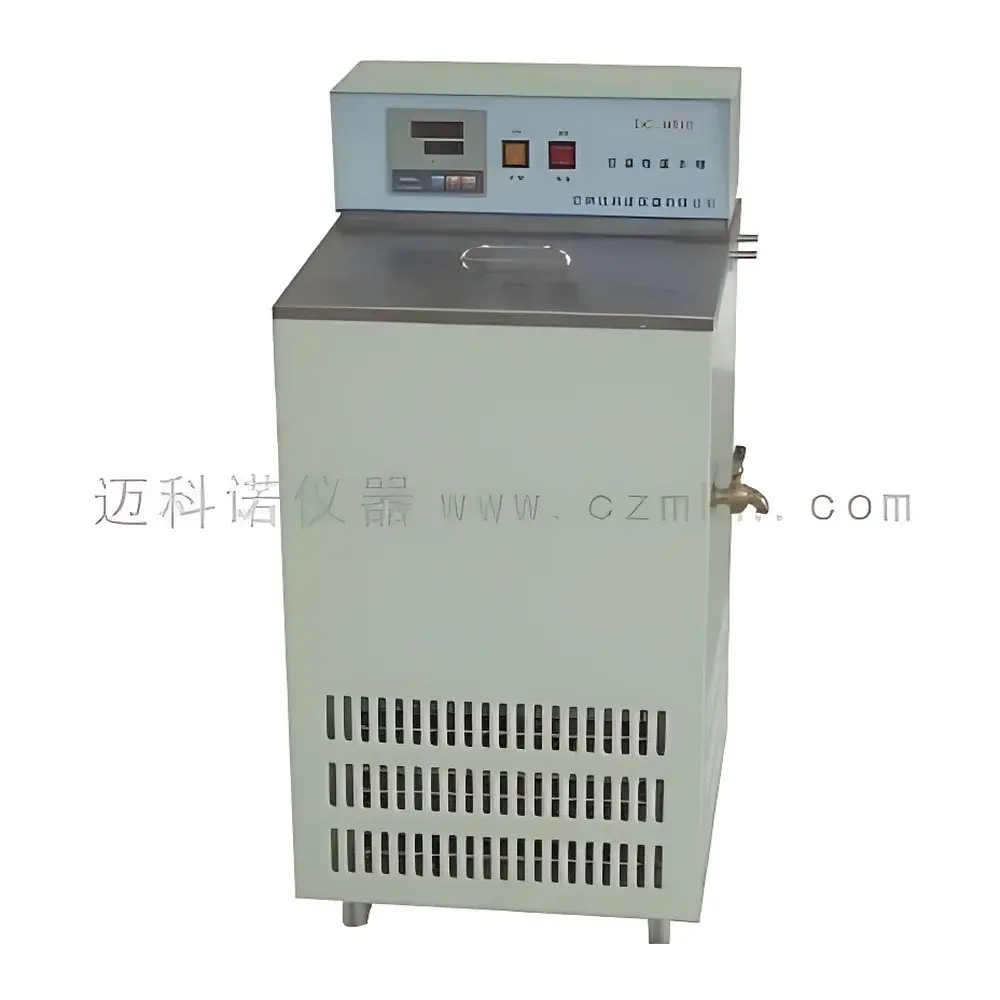
MKN DL-3005 Low-Temperature Circulating Chiller
| Brand | MKN |
|---|---|
| Model | DL-3005 |
| Temperature Range | −30 °C to +100 °C |
| Temperature Stability | ±0.5 °C (uniformity & sensitivity) |
| Bath Volume | 10 L |
| Pump Flow Rate | 6–8 L/min |
| Power Supply | 220 V ±10%, 50–60 Hz, 10 A |
| Control System | Microprocessor-based PID controller with LED digital display |
| Construction | 304 stainless steel inner tank and lid |
| Heating Method | Far-infrared heating element |
| Cooling Method | Compressor-based refrigeration system |
Overview
The MKN DL-3005 Low-Temperature Circulating Chiller is a precision-engineered thermal management system designed for laboratory-scale temperature control in demanding analytical, synthetic, and bioprocessing workflows. Operating on a dual-mode thermoregulation principle—combining compressor-driven refrigeration for sub-ambient cooling and far-infrared resistive heating for precise above-ambient control—the unit delivers stable, programmable temperature setpoints across a broad operational range of −30 °C to +100 °C. Its integrated circulation pump enables active heat transfer to external apparatus such as rotary evaporators, condensers, jacketed reactors, or spectrophotometer cells, making it an essential component in closed-loop cooling and heating applications where thermal consistency directly impacts reaction kinetics, solvent recovery efficiency, or sample integrity.
Key Features
- Stainless steel (AISI 304) bath tank and lid—resistant to corrosion from organic solvents, acids, and alkaline solutions commonly used in chemical synthesis and pharmaceutical processing
- Microprocessor-based PID temperature controller with high-resolution LED digital display—enabling real-time monitoring and repeatable setpoint accuracy within ±0.5 °C uniformity and sensitivity
- Compressor-based refrigeration circuit optimized for rapid thermal response and low-noise operation, achieving thermal equilibrium in under 15 minutes under standard load conditions
- Far-infrared heating module with adaptive power modulation—minimizing overshoot and ensuring smooth transitions between cooling and heating phases
- Adjustable flow rate (6–8 L/min) via calibrated centrifugal pump—compatible with tubing diameters from 6 mm to 10 mm ID and capable of sustaining pressure up to 0.3 MPa at full flow
- Robust electrical architecture compliant with IEC 61010-1 safety standards—featuring over-temperature cutoff, dry-run protection, and grounded chassis design
Sample Compatibility & Compliance
The DL-3005 is routinely deployed in environments requiring strict adherence to Good Laboratory Practice (GLP) and Good Manufacturing Practice (GMP) protocols. Its temperature stability and reproducibility support method validation per ISO/IEC 17025 and ASTM E2877 (Standard Guide for Thermal Stability Testing). The stainless steel bath is compatible with water, water-glycol mixtures (up to 40% v/v), ethanol, and acetone—though prolonged exposure to chlorinated solvents or strong oxidizers is not recommended. Units are CE-marked and conform to EMC Directive 2014/30/EU and Low Voltage Directive 2014/35/EU. While not inherently 21 CFR Part 11 compliant, audit trails and user-access logs may be implemented via optional RS485/Modbus RTU interface when integrated into validated networked lab systems.
Software & Data Management
The DL-3005 operates autonomously via its onboard microcontroller and requires no proprietary software for basic function. However, it supports analog voltage output (0–5 V DC) proportional to bath temperature and digital communication via RS485 serial port using Modbus RTU protocol. This allows integration into centralized Lab Information Management Systems (LIMS) or SCADA platforms for remote monitoring, alarm logging, and trend analysis. When paired with third-party data acquisition software (e.g., LabVIEW, MATLAB, or Python-based PyModbus), users can automate ramp-soak cycles, generate calibration reports, and export timestamped temperature histories compliant with internal QA documentation requirements.
Applications
- Cooling condenser jackets during rotary evaporation of heat-sensitive compounds (e.g., terpenes, oligonucleotides)
- Maintaining constant bath temperature for viscometry, density measurement, or refractometry
- Thermal conditioning of HPLC columns and detector cells to improve chromatographic resolution and baseline stability
- Providing controlled cooling for exothermic Grignard or lithiation reactions in sealed reactor vessels
- Supporting lyophilization pre-freezing stages and cold trap operation in vacuum drying systems
- Calibrating temperature probes and thermistors against NIST-traceable reference standards
FAQ
What is the minimum ambient operating temperature for the DL-3005?
The unit is rated for installation in environments between +10 °C and +35 °C; operation below +10 °C may impair compressor oil viscosity and reduce refrigerant efficiency.
Can the DL-3005 be used with ethylene glycol/water mixtures?
Yes—up to 40% (v/v) ethylene glycol is supported; higher concentrations increase viscosity and may reduce pump head and heat transfer coefficient.
Is external temperature probe input supported?
No—the system relies solely on its internal Pt100 sensor located in the bath sump; external probe feedback is not configurable.
Does the unit include overpressure protection for connected equipment?
The pump is equipped with mechanical pressure relief at 0.35 MPa, but users must install independent pressure regulators or rupture discs when interfacing with glassware or low-pressure reactors.
What maintenance intervals are recommended?
Compressor oil and refrigerant levels should be verified annually by qualified service personnel; stainless steel bath should be rinsed with deionized water after use with aggressive solvents to prevent passive layer degradation.
Related Products



