
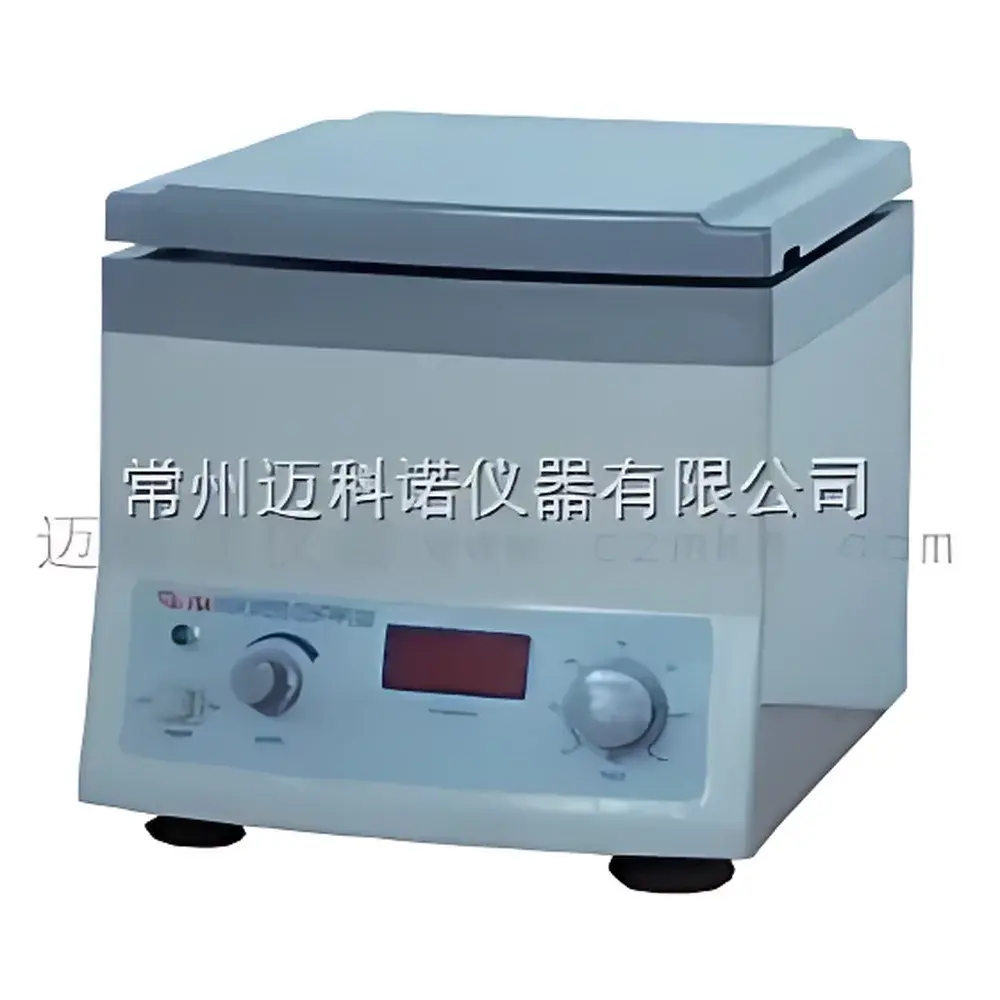
MKN TGL-16A Benchtop High-Speed Centrifuge
| Brand | MKN |
|---|---|
| Model | TGL-16A |
| Max Speed | 16,000 rpm (stepless speed control with digital speed display) |
| Relative Centrifugal Force (RCF) | 17,000 × g |
| Capacity | 12 × 1.5 mL or 12 × 0.5 mL or 8 × 5 mL tubes |
| Timer Range | 0–30 min |
| Noise Level | ≤60 dB(A) |
| Power Supply | AC 220 V, 50 Hz, 5 A |
| Rotor Material | Anodized aluminum alloy |
| Dimensions | Not specified |
| Weight | Not specified |
| Compliance | CE-marked for laboratory use per IEC 61010-1 |
Overview
The MKN TGL-16A Benchtop High-Speed Centrifuge is an engineered solution for rapid, reproducible separation of biological and chemical suspensions in routine laboratory workflows. It operates on the principle of centrifugal sedimentation—applying controlled radial acceleration to accelerate phase separation based on particle density, size, and shape. Designed for precision and operational safety, the instrument delivers consistent RCF up to 17,000 × g at a maximum rotational speed of 16,000 rpm, enabling efficient pelleting of cellular components, microorganisms, subcellular organelles, and macromolecular complexes. Its compact footprint and low thermal profile make it suitable for shared lab environments where bench space and ambient temperature stability are critical constraints.
Key Features
- Stepless speed control with real-time digital RPM and RCF readout ensures precise method replication across users and shifts.
- Automatic rotor imbalance detection and compensation system enhances mechanical longevity and minimizes vibration-induced sample disturbance.
- Anodized aluminum alloy rotor provides high tensile strength, corrosion resistance, and thermal stability—critical for repeated sterilization cycles and extended operational life.
- Brushless DC motor delivers quiet operation (≤60 dB[A]) and eliminates carbon brush wear, reducing maintenance frequency and downtime.
- Programmable timer (0–30 minutes) with automatic deceleration and rotor coast-down prevents over-centrifugation and preserves heat-sensitive analytes.
- Integrated safety interlock prevents lid opening during operation; rotor recognition logic ensures only certified rotors are engaged at rated speeds.
Sample Compatibility & Compliance
The TGL-16A supports standard microcentrifuge tube formats including 0.5 mL, 1.5 mL, and 5 mL conical or round-bottom polypropylene tubes. Its rotor geometry accommodates both fixed-angle and swing-out configurations (depending on installed rotor variant), supporting differential and density-gradient separations. The device complies with IEC 61010-1:2010 for electrical safety in laboratory equipment and meets CE marking requirements for electromagnetic compatibility (EMC Directive 2014/30/EU). While not inherently GLP/GMP-certified, its stable speed control, traceable timer function, and mechanical repeatability support audit-ready documentation when integrated into validated SOPs aligned with ISO/IEC 17025 or CLIA frameworks.
Software & Data Management
This model operates via embedded firmware without external PC dependency—ideal for environments requiring minimal IT integration. All operational parameters (speed, time, acceleration/deceleration ramp profiles) are stored in non-volatile memory and recalled per user-defined presets. Though no proprietary software suite is provided, the digital interface logs last-run settings and error codes (e.g., E1 = imbalance, E2 = overtemperature), facilitating root-cause analysis during troubleshooting. For laboratories subject to FDA 21 CFR Part 11 compliance, manual logbook entries—cross-referenced with timestamped run records and operator initials—are recommended as part of documented quality assurance procedures.
Applications
- Pre-analytical processing of clinical specimens: rapid separation of serum from whole blood (clotted samples), plasma from anticoagulated blood (EDTA/heparin), and buffy coat isolation.
- Microbial pelleting for DNA/RNA extraction protocols in molecular diagnostics and microbiology workflows.
- Protein precipitation and clarification steps in immunoassay development and ELISA sample preparation.
- Cellular fractionation—including nuclear, mitochondrial, and lysosomal isolations—when paired with sucrose or Percoll gradients.
- Quality control testing in pharmaceutical manufacturing for suspension homogeneity assessment and particulate removal verification.
FAQ
What is the maximum relative centrifugal force (RCF) achievable with the TGL-16A?
The instrument achieves a maximum RCF of 17,000 × g at 16,000 rpm using the standard 12-position fixed-angle rotor.
Is rotor calibration required before first use?
No factory calibration is needed; however, users must verify rotor integrity visually and confirm balance before each run. Periodic verification against NIST-traceable tachometers is advised annually.
Can this centrifuge be used for biosafety level 2 (BSL-2) applications?
Yes—when operated with sealed tube adapters and closed rotor lids, it meets containment requirements for BSL-2 agents per CDC/NIH guidelines, provided appropriate PPE and decontamination protocols are followed.
Does the TGL-16A support refrigerated operation?
No—it is a non-refrigerated unit. For temperature-sensitive applications, pre-chill samples and limit run duration to mitigate thermal drift.
How often should the rotor be inspected for fatigue or corrosion?
Inspect visually before every use; perform detailed examination (including thread integrity and anodization uniformity) every 500 operating hours or semiannually—whichever occurs first.



