
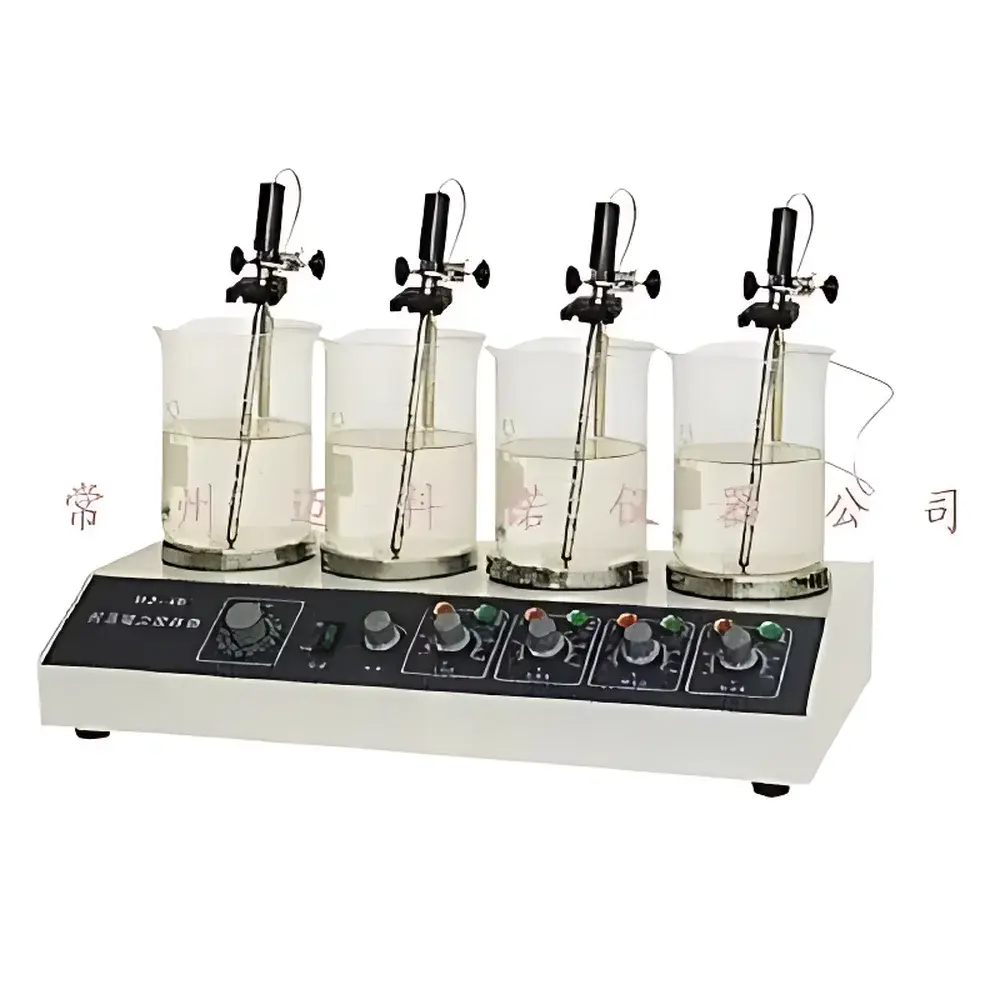
MKN HJ-4B Multi-Station Magnetic Hotplate Stirrer
| Brand | MKN |
|---|---|
| Model | HJ-4B |
| Power Supply | 220 V ±10%, 50 Hz |
| Temperature Control Range | RT to 100 °C |
| Timer Range | 0–120 min |
| Heating Power | 150 W × 4 stations |
| Stirring Speed | 0–2400 rpm (continuously variable) |
| Motor Power | 25 W × 4 stations |
| Number of Stations | 4 |
| Construction | Domestic (Jiangsu, China) |
| Distribution Type | Authorized Distributor |
Overview
The MKN HJ-4B Multi-Station Magnetic Hotplate Stirrer is an engineered laboratory platform designed for simultaneous, independent thermal control and precise magnetic stirring across four sample positions. Based on the principle of rotating magnetic field coupling—where a motor-driven permanent magnet beneath each heating zone induces rotation in PTFE-coated stir bars immersed in vessels—the instrument delivers consistent torque transfer without mechanical shaft penetration. This non-contact agitation method eliminates seal wear, contamination risk, and cross-sample interference, making it suitable for applications requiring sterile or inert environments. The integrated ceramic-coated aluminum hotplate provides uniform heat distribution with PID-regulated temperature stability (±1 °C at setpoint), while the four-channel architecture supports parallel processing under identical or individually configured conditions—critical for method development, reaction optimization, and comparative kinetic studies.
Key Features
- Four independent stirring and heating stations with fully decoupled control logic—each station permits separate adjustment of temperature and speed without affecting adjacent positions.
- Continuously variable speed regulation from 0 to 2400 rpm via precision potentiometer, enabling fine-tuned shear control for low-viscosity solvents or high-yield suspension homogenization.
- Dual-function digital display showing real-time temperature and rotational speed for each active station; timer function (0–120 min) supports unattended operation with automatic shutdown.
- Ceramic-surfaced heating plates resist chemical corrosion and thermal shock, supporting use with aqueous, organic, and mildly acidic media; surface temperature recovery time < 30 s after vessel placement.
- Low-noise brushless DC motors (25 W per station) ensure long-term operational reliability and minimal vibration transmission—essential when paired with sensitive analytical instrumentation such as spectrophotometers or pH meters.
- Robust aluminum chassis with reinforced corner bracing and non-slip silicone feet provides mechanical stability during extended high-speed operation.
Sample Compatibility & Compliance
The HJ-4B accommodates standard laboratory glassware including beakers (25–1000 mL), Erlenmeyer flasks, and round-bottom reaction vessels up to 80 mm base diameter. Stir bar compatibility spans lengths from 15 mm to 50 mm (recommended: 30 mm × 8 mm PTFE-coated). While not certified to IEC 61010-1 for hazardous area use, the unit conforms to general-purpose electrical safety requirements for Class I, Division 2 laboratory environments. Its design supports GLP-aligned workflows through repeatable parameter logging (via external data acquisition), and its stable thermal output facilitates adherence to ASTM E2912 (Standard Practice for Calibration of Magnetic Stirrers) when used with traceable reference thermometers.
Software & Data Management
The HJ-4B operates as a standalone analog-digital hybrid instrument with no embedded firmware or network interface. Parameter settings are retained only during active power cycles; however, its predictable response characteristics allow integration into automated lab systems via external programmable logic controllers (PLCs) or DAQ modules equipped with analog voltage inputs (0–5 V or 0–10 V) for speed/temperature feedback. For audit-trail compliance in regulated environments (e.g., ISO/IEC 17025-accredited labs), users may connect optional USB data loggers to record time-stamped temperature and timer status outputs. No proprietary software is required or provided.
Applications
- Simultaneous digestion and extraction of environmental samples (soil, water, sludge) per EPA Method 3050B and 3015A protocols.
- Buffer and reagent preparation in clinical diagnostics labs where batch consistency and thermal uniformity impact assay sensitivity.
- Catalyst screening in homogeneous catalysis research, leveraging independent station control to evaluate multiple metal-ligand combinations under identical thermal profiles.
- Preparation of polymer solutions and colloidal dispersions where shear history influences molecular weight distribution and particle agglomeration behavior.
- Teaching laboratories: ideal for undergraduate chemistry and materials science courses due to intuitive operation, visual feedback, and tolerance to variable user technique.
FAQ
Can the HJ-4B maintain temperature accuracy across all four stations simultaneously?
Yes—each station features an individual PT100 sensor and dedicated PID loop, ensuring ±1 °C stability at setpoints between 25 °C and 100 °C under standard atmospheric conditions.
Is it possible to operate only two stations while leaving the others inactive?
Yes. Power to each heating/stirring circuit is independently switched; unused stations draw negligible standby current and do not affect thermal crosstalk.
What is the maximum recommended viscosity for effective stirring at 2400 rpm?
Up to 1000 mPa·s using a 30 mm × 8 mm stir bar in a 250 mL beaker; higher viscosities require reduced speed or larger-diameter bars.
Does the unit support external temperature probe input for vessel-content monitoring?
No—temperature sensing is limited to the hotplate surface. For solution-phase measurement, users must integrate a separate calibrated probe with external readout.
Are replacement parts such as heating elements or control boards available?
Yes—MKN provides OEM-specified spare components including ceramic heater assemblies, speed control potentiometers, and PCBs, with documentation aligned to IEC 60950-1 serviceability guidelines.



