
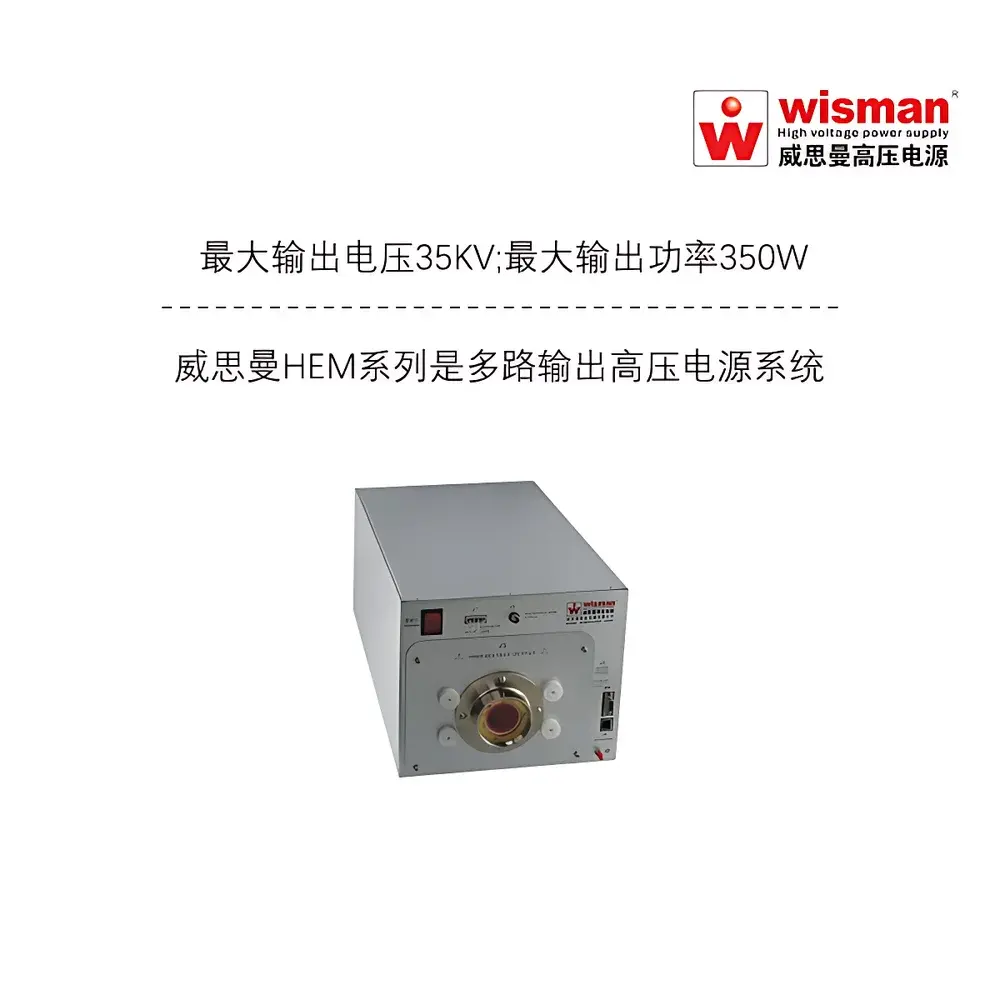
Wisman HEM Series Integrated High-Voltage Power Supply for SEM, Electron Beam, and Ion Beam Systems
| Brand | Wisman |
|---|---|
| Model | HEM |
| Output Voltage | −35 kV (Accelerator) |
| Output Current | 450 µA |
| Input | DC 24 V |
| Ripple | 70 mV<sub>P-P</sub> (0.1 Hz–1 MHz) |
| Line Regulation | ±100 mV (±10% input variation) |
| Load Regulation | ±0.01% |
| Stability | 1.5 V/10 h (after 2-h warm-up) |
| Tempco | 25 ppm/°C |
| Filament Supply | 0–5 V / 0–5 A |
| Suppressor Supply | −10 V to −2 kV / 300 µA |
| Extractor Supply | 0 to −15 kV / 400 µA |
| Interface | RS-232, Ethernet |
| Compliance | Designed for OEM integration in vacuum-based analytical instrumentation |
Overview
The Wisman HEM Series is an integrated, digitally controlled, multi-output high-voltage power supply engineered specifically for demanding electron-optical and ion-optical systems. It serves as a consolidated power solution for scanning electron microscopes (SEM), field-emission SEMs (FE-SEM), transmission electron microscopes (TEM), focused ion beam (FIB) systems, and ion beam etching or milling platforms. The unit operates on the principle of precision-regulated DC/DC conversion with galvanically isolated outputs, enabling simultaneous, independent control of acceleration, filament heating, suppression, extraction, and lens bias voltages—all within a single compact chassis. Its architecture leverages patented high-voltage floating topology and digital feedback control to maintain exceptional long-term stability and ultra-low noise performance under dynamic load conditions typical of beam-scanning and beam-blanking operations. Designed for vacuum-compatible environments, the HEM series meets the stringent electrical and thermal requirements of modern electron and ion column subsystems.
Key Features
- Integrated six-channel HV output system: accelerator (−35 kV), filament (0–5 V / 0–5 A), suppressor (−10 V to −2 kV), extractor (0 to −15 kV), and dedicated lens bias supplies—fully synchronized and independently programmable.
- Ultra-low output ripple: 70 mVP-P (0.1 Hz–1 MHz) on the −35 kV channel; 10 mAP-P on filament supply—critical for minimizing beam drift and image noise in high-resolution SEM imaging.
- Digital control interface via RS-232 and Ethernet (TCP/IP), supporting remote monitoring, real-time parameter adjustment, and script-driven sequencing for automated workflows.
- Comprehensive protection suite: overvoltage, overcurrent, short-circuit, and arc-detection with auto-recovery—essential for safeguarding sensitive electron optics during vacuum fluctuations or contamination events.
- Modular mechanical design with standardized rack-mount footprint (19″, 4U), enabling flexible integration into OEM instrument cabinets or third-party column assemblies.
- No-corona internal layout with optimized creepage/clearance distances and proprietary potting materials—validated for continuous operation at full rated voltage in cleanroom-class vacuum chambers.
- Thermal management via conduction-cooled baseplate and low-loss zero-current-resonant (ZCR) converter topology, ensuring <2% efficiency loss across operating range and <0.5°C internal temperature rise at full load.
Sample Compatibility & Compliance
The HEM series is compatible with standard SEM column configurations including thermionic tungsten, lanthanum hexaboride (LaB6), and cold field-emission (CFE) sources. Its output specifications align with ASTM E1508-22 (Standard Guide for Quantitative Analysis by Energy-Dispersive Spectroscopy) and ISO/IEC 17025:2017 requirements for traceable calibration of beam energy and current. While not certified to IEC 61010-1 as a standalone benchtop instrument, the HEM is designed to meet the safety and EMC requirements (EN 55011 Class B, EN 61326-1) when installed within fully compliant host systems. Its firmware supports audit-trail logging for GLP/GMP environments, and configuration parameters are stored in non-volatile memory with write-protection to ensure repeatability across production batches.
Software & Data Management
Wisman provides the HEM Control Suite—a Windows-based application supporting real-time voltage/current monitoring, waveform capture (up to 10 kS/s per channel), and sequence programming via ASCII command set (SCPI-compliant). All communication is encrypted and timestamped; log files export to CSV or HDF5 format for post-acquisition analysis in MATLAB or Python. For OEM integration, Wisman delivers full API documentation (C/C++, .NET, Python bindings) and a deterministic latency profile (<10 ms command-to-output response). Firmware updates are performed via signed binary packages with SHA-256 verification, satisfying FDA 21 CFR Part 11 requirements for electronic records and signatures when deployed in regulated medical device manufacturing or pharmaceutical QA labs.
Applications
- High-resolution secondary electron imaging in variable-pressure and low-vacuum SEMs.
- Beam deceleration and landing-energy control in monochromated FE-SEMs for surface-sensitive analysis.
- Ion source biasing and extraction in Ga⁺ FIB systems used for TEM sample preparation and circuit edit.
- Multi-kV lens stack powering in dual-beam (SEM/FIB) platforms requiring sub-100 ppm inter-channel voltage tracking.
- OEM integration into X-ray tube driver modules where precise kV ramping and hold stability are required for spectral fidelity in EDX and WDS detectors.
- Research-grade electron beam lithography (EBL) tools requiring nanosecond-level blanking synchronization between HV and deflection drivers.
FAQ
What vacuum compatibility level does the HEM series support?
The HEM chassis is rated for operation at pressures down to 1 × 10⁻⁶ mbar when mounted with conductive gasketing and properly grounded. Internal components use ceramic-insulated HV feedthroughs rated to 10⁻⁸ mbar.
Can the HEM be configured for positive high-voltage outputs?
Yes—custom variants support +35 kV acceleration with inverted polarity architecture; lead time increases by 6–8 weeks.
Is remote firmware update supported over Ethernet?
Yes, via secure HTTPS endpoint with certificate-based authentication and rollback capability.
Does Wisman provide calibration certificates traceable to NIST?
Yes—each unit ships with a factory calibration report (ISO/IEC 17025-accredited lab) valid for 12 months; recalibration services available globally.
What is the MTBF under continuous operation at 80% rated load?
Calculated MTBF exceeds 120,000 hours per MIL-HDBK-217F (ground benign environment), verified by accelerated life testing at 55°C ambient.



