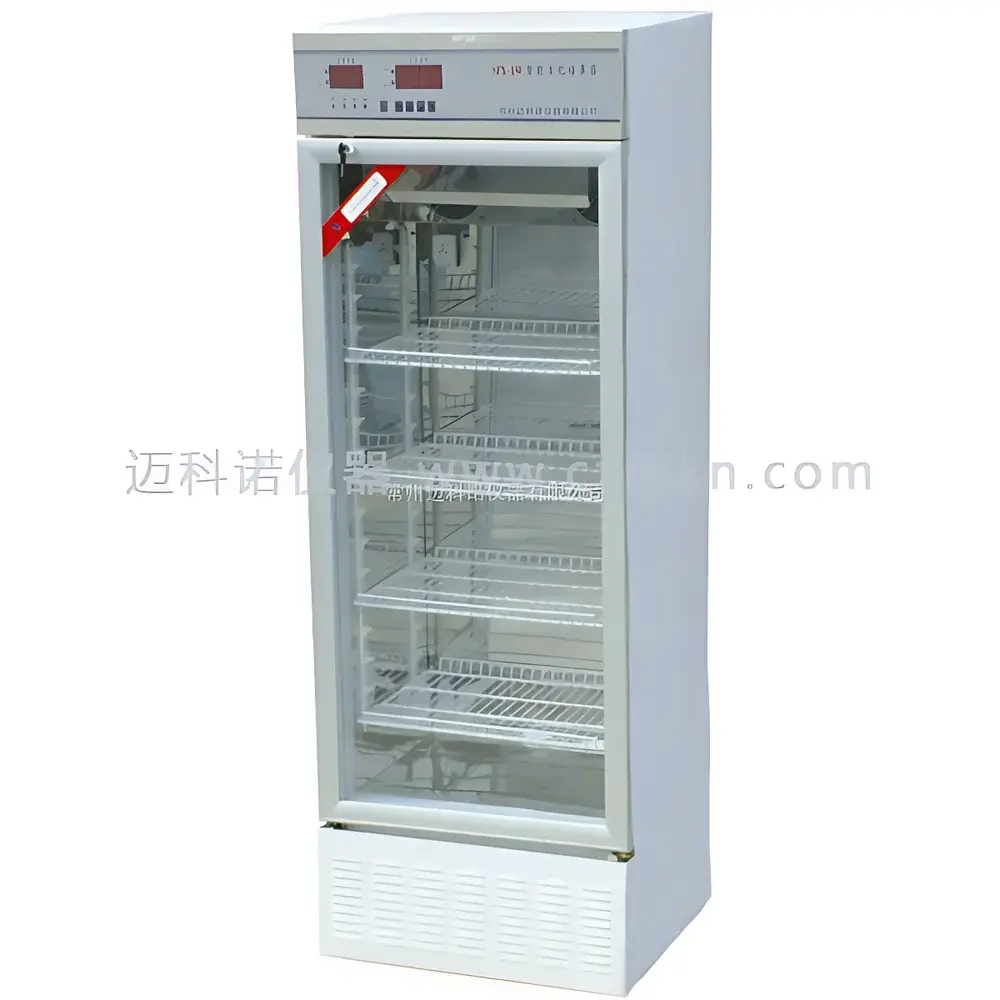
Maikenuo 250B Biochemical Incubator
| Origin | Zhejiang, China |
|---|---|
| Manufacturer Type | Authorized Distributor |
| Country of Origin | China |
| Model | 250B |
| Capacity | 250 L |
| Temperature Range | 5–50 °C |
| Temperature Control Accuracy | ±1 °C |
| Temperature Uniformity (Fluctuation) | ±1 °C |
| Power Supply | AC 220 V ±10%, 50 Hz ±2% |
| Rated Power | ≤500 W |
| Operating Ambient Temperature | 0–40 °C |
| Max. Relative Humidity | <85% RH |
| Construction | Exterior – Powder-coated carbon steel |
| Display | LED digital temperature readout |
| Control System | Microprocessor-based PID controller |
| Safety Features | Compressor delay protection, power failure recovery, over-temperature alarm |
Overview
The Maikenuo 250B Biochemical Incubator is a precision-engineered, dual-mode (heating and refrigeration) environmental chamber designed for stable, long-term temperature-controlled cultivation and storage of biological samples. Based on thermoelectric and compressor-assisted cooling combined with resistive heating, it maintains consistent thermal conditions across its 250 L working chamber—critical for applications requiring strict adherence to ISO 17025, CLSI, or GLP-compliant laboratory protocols. Unlike ambient-only incubators, the 250B actively regulates temperature within a broad operational range (5–50 °C), enabling both mesophilic microbial growth studies and low-temperature biochemical stabilization workflows. Its robust mechanical architecture—including insulated polyurethane walls, stainless steel interior, and microcirculation fan system—ensures uniform thermal distribution and minimal spatial gradients (<±1 °C), meeting typical requirements for QC microbiology, cell line maintenance, enzyme kinetics assays, and environmental simulation testing.
Key Features
- Microprocessor-based PID temperature control with LED digital display for real-time monitoring and intuitive setpoint adjustment
- Dual-mode thermal regulation: Peltier-assisted pre-cooling and high-efficiency hermetic compressor for rapid, stable cooling; calibrated resistive heating elements for precise warming
- Uniform airflow design featuring top-mounted axial circulation fan to minimize thermal stratification and ensure homogeneity across all shelf levels
- Integrated safety logic: automatic compressor delay on power-up (≥3 min), over-temperature cut-off, and voltage fluctuation tolerance (±10% on 220 V supply)
- Durable construction: powder-coated carbon steel exterior for corrosion resistance; electropolished 304 stainless steel interior for easy decontamination and chemical compatibility
- Energy-efficient operation: total rated power ≤500 W, compliant with IEC 61000-3-2 harmonic emission standards for laboratory equipment
Sample Compatibility & Compliance
The 250B accommodates standard microbiological vessels—including Petri dishes (up to 150 mm diameter), test tubes (16 × 150 mm), Erlenmeyer flasks (up to 1 L), and multi-well plates—on three adjustable stainless steel shelves. Its sealed chamber design prevents cross-contamination between samples and supports ISO 14644-1 Class 8 cleanroom-compatible operation when used in controlled environments. While not certified for sterile processing per ISO 13485, the unit meets general-purpose requirements outlined in ASTM E1229 (Standard Practice for Validation of Environmental Chambers) and aligns with USP recommendations for non-sterile environmental monitoring incubation. It is suitable for use in laboratories operating under GLP, CAP, or CLIA frameworks where documented temperature stability and traceable calibration are required.
Software & Data Management
The 250B operates via embedded firmware without external PC dependency. All temperature parameters—including setpoint, actual chamber reading, deviation history, and alarm logs—are retained in non-volatile memory with timestamping. Though no proprietary software interface is provided, the unit supports manual data logging via periodic LED readouts and external USB data loggers (e.g., HOBO UX100 series) connected to its analog output port (0–5 V DC proportional to temperature). For regulated environments, users may integrate the incubator into facility-wide monitoring systems using optional RS-485 Modbus RTU communication modules (sold separately), enabling audit-trail generation compliant with FDA 21 CFR Part 11 when paired with validated SCADA platforms.
Applications
- Microbiological culture incubation (bacteria, fungi, yeast) per ISO 6887, AOAC 977.27, and APHA Standard Methods
- Biochemical assay incubation: enzyme activity profiling, substrate degradation kinetics, and protein stability studies
- Environmental stress testing: temperature-dependent growth rate analysis of algae, soil microbes, or aquatic organisms
- QC/QA stability testing for pharmaceutical excipients, medical device packaging, and diagnostic reagents
- Educational labs: undergraduate and graduate-level life science courses requiring reproducible, low-cost incubation platforms
FAQ
What is the minimum operating temperature of the 250B incubator?
The verified lower limit is +5 °C under standard ambient conditions (25 °C, <60% RH); performance below this threshold is not guaranteed due to compressor efficiency limits.
Does the unit include calibration certification?
Factory calibration is performed using NIST-traceable reference probes; a Certificate of Conformance (CoC) is supplied with each unit. Optional UKAS-accredited calibration reports are available upon request.
Can the incubator be used for CO₂-sensitive cultures?
No—this is a non-CO₂, ambient-air incubator. For pH-sensitive mammalian cell culture, a dedicated CO₂ incubator is required.
Is remote monitoring supported out-of-the-box?
Basic remote status indication (power-on, alarm active) is possible via dry-contact relay outputs. Full telemetry requires add-on Modbus interface hardware and third-party SCADA integration.
What is the warranty coverage period and scope?
One-year limited warranty covering parts and labor for defects in materials or workmanship under normal laboratory use, excluding consumables, damage from misuse, or environmental exposure outside specified operating conditions (0–40 °C, <85% RH).
Related Products