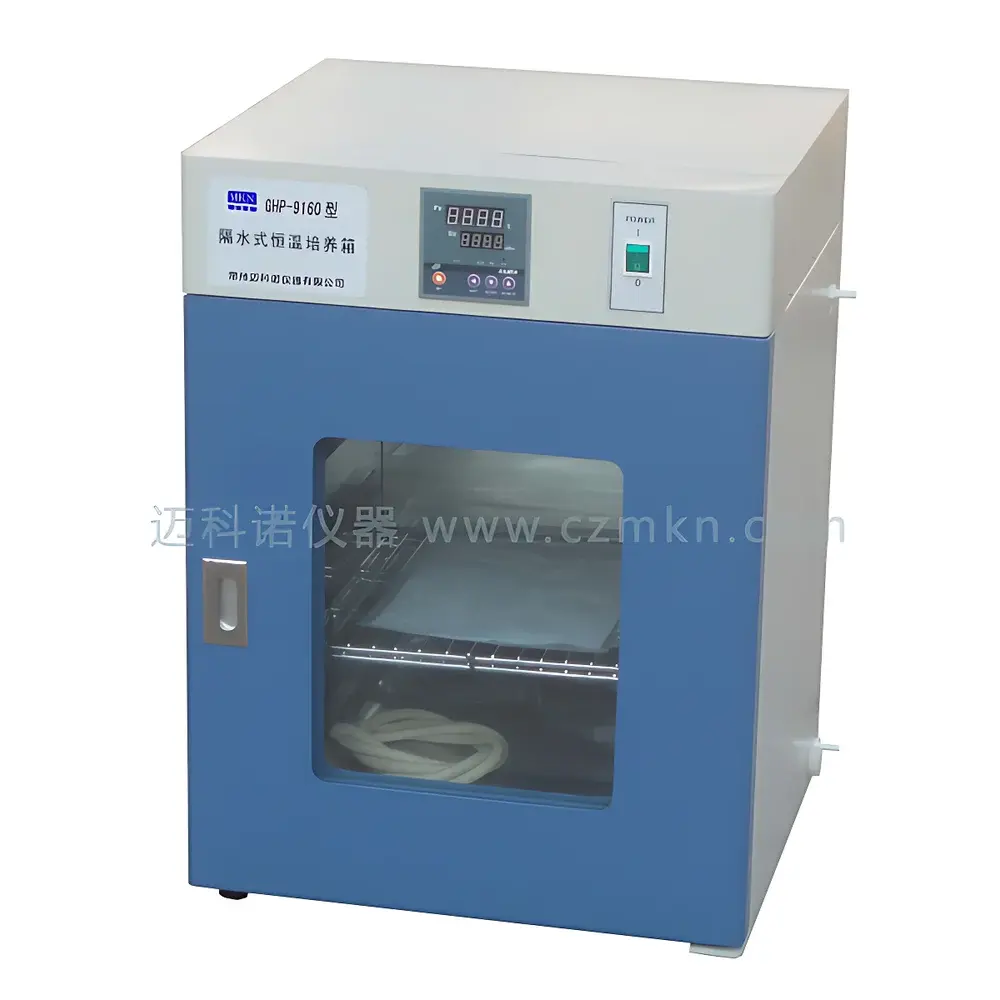
MKN GHP-80 Water-Jacketed Temperature-Controlled Incubator
| Brand | MKN |
|---|---|
| Origin | Zhejiang, China |
| Model | GHP-80 |
| Capacity | 80 L |
| Temperature Control Range (with humidification) | RT + 5°C to 65°C |
| Temperature Uniformity | ±0.3°C at 37°C |
| Humidity Range | 40–95% RH (non-condensing) |
| Construction | Stainless steel water jacket with argon arc welding |
| Door | Double-layer tempered glass with silicone rubber seal |
| Control System | Digital PID temperature controller with audible/visual alarm for over-temperature and low/high water level |
| Compliance | Designed per GB/T 23792–2009 (Chinese National Standard for Laboratory Incubators), suitable for GLP environments |
Overview
The MKN GHP-80 Water-Jacketed Temperature-Controlled Incubator is a precision-engineered laboratory incubation system designed for stable, uniform thermal environments in life science research and quality control applications. Unlike forced-air incubators, the GHP-80 employs a circulating water jacket surrounding the inner chamber — a classical design offering superior thermal inertia, minimal temperature fluctuation, and high resistance to external ambient disturbances. This architecture ensures consistent heat distribution across the entire 80 L working volume, making it especially suitable for sensitive cell culture, microbial growth studies, enzyme activity assays, and long-term stability testing where thermal overshoot or recovery lag must be avoided. The unit operates within a standard range of RT + 5°C to 65°C, with humidity maintained between 40% and 95% RH under non-condensing conditions — critical for maintaining physiological relevance in mammalian and bacterial cultures.
Key Features
- Robust stainless steel water jacket fabricated via argon arc welding — corrosion-resistant, leak-proof, and engineered for long-term reliability under continuous operation.
- Passive thermal stabilization: water jacket provides high thermal mass, eliminating rapid temperature transients and ensuring ±0.3°C uniformity at 37°C — validated per ISO 15195:2019 guidelines for incubator performance verification.
- Double-glazed observation door with integrated silicone rubber gasket — minimizes heat and moisture loss while enabling real-time visual monitoring without compromising chamber integrity.
- Digital PID temperature controller with independent water-level sensing circuitry — triggers simultaneous audible and visual alarms upon deviation from setpoint or abnormal water jacket level (low/high).
- No internal fans or air circulation — eliminates shear stress on adherent cell monolayers and prevents cross-contamination between samples placed at different shelf levels.
Sample Compatibility & Compliance
The GHP-80 accommodates standard tissue culture flasks (T25–T225), Petri dishes (up to 150 mm), multi-well plates, and microbiological tubes. Its static, non-ventilated chamber meets requirements for CO₂-free aerobic and anaerobic culture protocols when used with supplemental gas kits (not included). The device conforms to GB/T 23792–2009 for laboratory incubators and supports Good Laboratory Practice (GLP) workflows through traceable temperature logging (when paired with optional external data loggers). While not inherently compliant with FDA 21 CFR Part 11, its analog control architecture allows integration into validated systems via third-party electronic record solutions meeting audit trail and user access control requirements.
Software & Data Management
The GHP-80 operates via an embedded digital controller with LED display and tactile membrane keypad — no proprietary software or driver installation required. All operational parameters (setpoint, actual temperature, alarm status, water level indicator) are locally visible and manually adjustable. For regulatory documentation, users may connect calibrated external temperature/humidity data loggers (e.g., Vaisala HMP155 or Omega OM-EL-USB-2-LCD) to generate time-stamped, exportable CSV reports compatible with LIMS and ELN platforms. Alarm events are latched until acknowledged, supporting root-cause analysis during QA/QC investigations.
Applications
- Mammalian and insect cell line maintenance (e.g., HEK293, CHO, Sf9) under serum-containing or serum-free media.
- Bacterial and fungal cultivation for antibiotic susceptibility testing (AST), colony isolation, and bioburden assessment.
- Enzyme kinetics and protein stability studies requiring precise thermal hold conditions.
- Seed germination and plant tissue culture in agricultural biotechnology labs.
- Pharmaceutical stability testing per ICH Q1A(R2) guidance for intermediate storage conditions (e.g., 30°C/65% RH).
FAQ
What distinguishes a water-jacketed incubator from an air-jacketed model?
Water-jacketed units provide greater thermal stability due to the high specific heat capacity of water, resulting in slower temperature drift during power interruptions and reduced sensitivity to door openings.
Is the GHP-80 suitable for CO₂-controlled applications?
No — it lacks integrated CO₂ sensors, gas mixing valves, or humidity compensation algorithms. It is intended for ambient-air incubation only; external CO₂ enclosures or modular gas systems must be deployed separately.
Can the humidity function operate independently of heating?
No — humidification is enabled only when the heating system is active and chamber temperature exceeds ambient dew point; operation below RT + 5°C is not supported.
What maintenance is required for the water jacket?
Use deionized or distilled water to prevent mineral scaling; inspect water level weekly and replace fluid every 3–6 months depending on ambient humidity and usage frequency.
Does the unit support remote monitoring or network connectivity?
Not natively — it features no Ethernet, USB, or RS-232 interface. Integration with building management systems (BMS) requires external analog signal converters or IoT-enabled sensor bridges.