
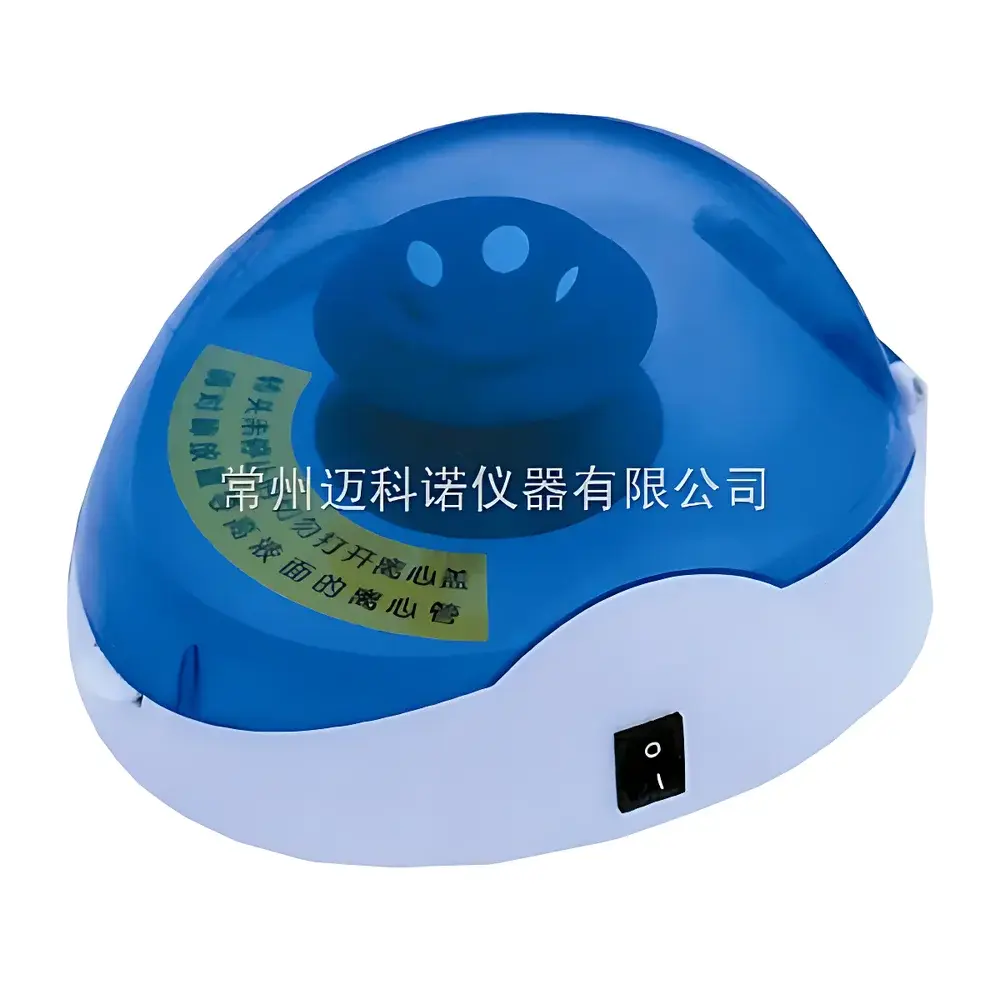
MKN Mini-40 Portable Palm-Sized Centrifuge
| Brand | MKN |
|---|---|
| Model | Mini-40 |
| Rotor Capacity | 6 × 1.5/2.0 mL tubes + 2 × 8 × 0.2 mL PCR strips |
| Optional Adapters | 6 × 0.2 mL, 6 × 0.5 mL |
| Maximum Speed | 4000 rpm |
| Relative Centrifugal Force (RCF) | 1800 × g |
| Noise Level | <45 dB(A) |
| Drive System | Brushless DC Motor |
| Rotor Material | Carbon Fiber |
| Dimensions | Compact palm-sized footprint (typical: ~120 × 120 × 135 mm) |
| Weight | ~0.9 kg |
Overview
The MKN Mini-40 Portable Palm-Sized Centrifuge is a compact, benchtop-ready microcentrifuge engineered for rapid, low-volume sample pelleting in resource-constrained or mobile laboratory environments. Unlike conventional centrifuges requiring dedicated bench space and AC power infrastructure, the Mini-40 operates on low-voltage DC input and delivers consistent centrifugal force via a brushless DC motor coupled with a lightweight carbon fiber rotor assembly. Its operational principle relies on radial acceleration to sediment particulates—including cells, precipitated nucleic acids, or protein aggregates—from small-volume liquid samples (0.2–2.0 mL) within seconds. Designed for point-of-use applications such as field diagnostics, teaching labs, clinical preprocessing stations, and cleanroom workflows, the Mini-40 meets the functional requirements of ISO 13485-aligned quality systems where portability, reproducibility, and minimal acoustic emission are critical.
Key Features
- Ultra-compact form factor: Fits comfortably in the palm of one hand; occupies <150 cm² footprint—ideal for laminar flow hoods, biosafety cabinets, or portable diagnostic kits.
- Carbon fiber rotor construction: Provides high strength-to-weight ratio, thermal stability across repeated thermal cycling, and resistance to chemical degradation from common reagents (e.g., ethanol, chloroform, dilute acids/bases).
- Brushless DC motor drive: Ensures maintenance-free operation, extended service life (>10,000 hours MTBF), and precise speed regulation without mechanical commutation wear.
- Patented acoustic damping architecture: Achieves sustained noise levels <45 dB(A) at 1 m distance—compliant with WHO-recommended ambient noise thresholds for laboratory workspaces.
- Dual-configuration rotor support: Interchangeable fixed-angle rotor accepts either six 1.5/2.0 mL microtubes or two 8-position 0.2 mL PCR strip carriers; optional adapters enable secure processing of 0.2 mL and 0.5 mL tubes without slippage or imbalance.
- Integrated safety logic: Automatic rotor detection, lid interlock, and over-speed protection prevent unbalanced operation and ensure compliance with IEC 61010-2-020 (safety requirements for laboratory centrifuges).
Sample Compatibility & Compliance
The Mini-40 accommodates standard polypropylene and polyethylene microcentrifuge tubes (1.5 mL, 2.0 mL), thin-walled PCR strips (0.2 mL), and low-retention assay tubes. It is validated for use with aqueous buffers, ethanol precipitations, enzyme reaction quenching steps, and pre-PCR cleanup protocols. The device conforms to electromagnetic compatibility (EMC) per EN 61326-1 and carries CE marking under the EU Machinery Directive 2006/42/EC. While not classified as a medical device under FDA 21 CFR Part 820, its design supports GLP-compliant documentation when integrated into validated workflows—particularly where audit trails for centrifugation parameters (time, speed, RCF) are maintained externally via lab notebook or LIMS entry.
Software & Data Management
The Mini-40 is a stand-alone analog-controlled instrument with no embedded firmware or digital interface. All operational parameters—speed (4000 rpm), run time (0–99 sec, adjustable in 1-sec increments), and automatic brake—are set via tactile rotary dial and LED indicators. This architecture eliminates software validation overhead and ensures deterministic behavior required in regulated QC/QA settings. For traceability, users may log run conditions manually or integrate timing data with external timers synchronized to NIST-traceable clocks. No connectivity (USB, Bluetooth, Wi-Fi) is provided, mitigating cybersecurity risks associated with networked lab instrumentation.
Applications
- Rapid spin-down of microvolume samples prior to pipetting, spectrophotometry, or electrophoresis loading.
- Pre-analytical preparation in molecular diagnostics: pelletting of extracted DNA/RNA, removal of residual ethanol, or concentration of viral particles from swab transport media.
- Teaching laboratories: hands-on demonstration of centrifugal separation principles without need for high-speed infrastructure or safety enclosures.
- Point-of-care testing (POCT) platforms: integration into portable analyzers requiring on-board sample conditioning before lateral flow or microfluidic detection.
- Cell culture support: quick harvesting of adherent or suspension cells from small-scale cultures (e.g., 24-well plates) for downstream lysis or staining.
FAQ
What is the maximum relative centrifugal force (RCF) achievable with the Mini-40?
The Mini-40 generates up to 1800 × g at its rated speed of 4000 rpm with the standard 1.5/2.0 mL rotor.
Can the Mini-40 be used with 0.5 mL tubes?
Yes—using the optional 6-position 0.5 mL adapter kit, which ensures secure positioning and balanced rotation.
Is the rotor autoclavable?
The carbon fiber rotor is not autoclavable; it is compatible with 70% ethanol wipe disinfection and UV-C surface decontamination per ISO 15883 guidelines.
Does the Mini-40 require calibration?
No routine calibration is specified by the manufacturer; however, periodic verification of rotational speed using a calibrated tachometer is recommended per ISO/IEC 17025 internal quality control procedures.
What power supply does the Mini-40 use?
It operates on 12 V DC input via included switching power adapter (100–240 V AC, 50/60 Hz input); no battery option is available.



