
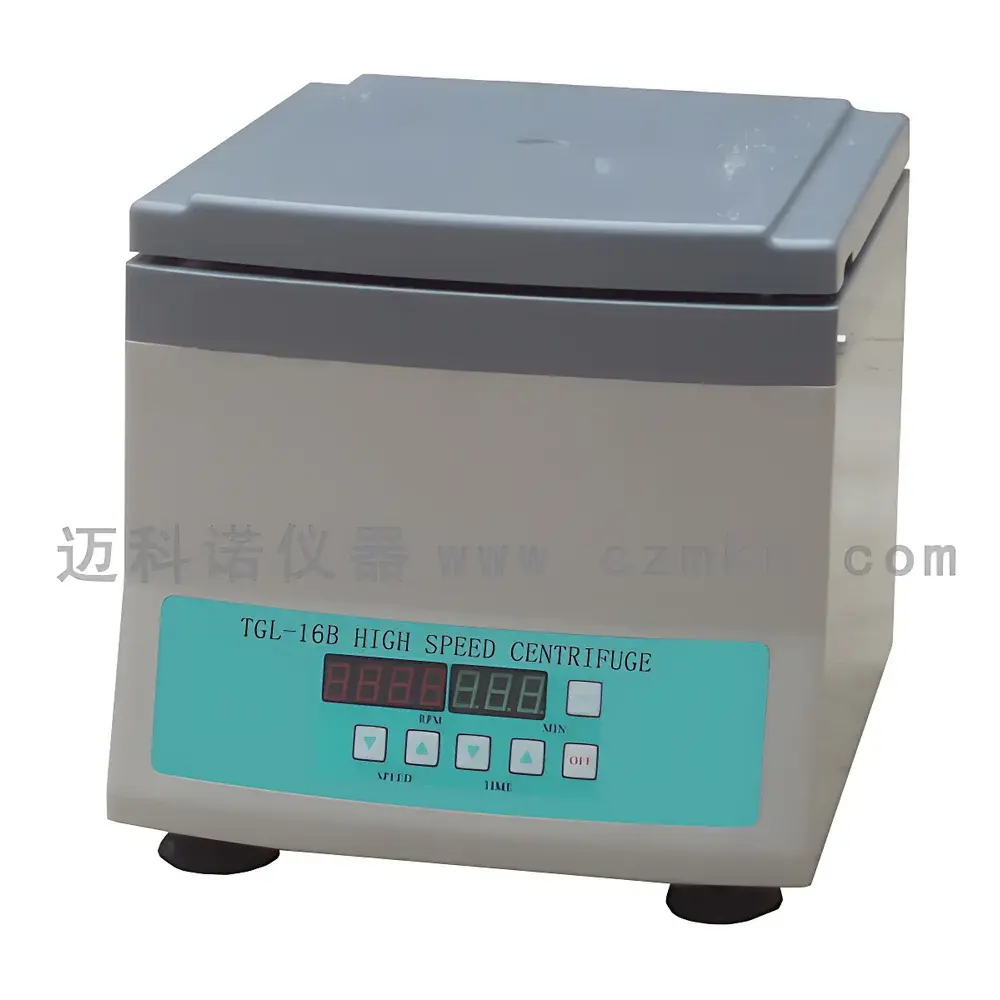
MKN TGL-16B Digital Benchtop High-Speed Centrifuge
| Brand | MKN |
|---|---|
| Model | TGL-16B |
| Max Speed | 16,000 rpm |
| RCF | 17,000 × g |
| Capacity | 12 × 1.5 mL / 12 × 0.5 mL / 8 × 5 mL |
| Timer Range | 0–30 min |
| Noise Level | ≤60 dB(A) |
| Power Supply | AC 220 V, 50 Hz, 5 A |
Overview
The MKN TGL-16B Digital Benchtop High-Speed Centrifuge is a precision-engineered laboratory instrument designed for rapid, reproducible separation of biological and chemical samples via centrifugal force. Operating on the principle of sedimentation under controlled rotational acceleration, it enables efficient pelleting of cellular components, subcellular organelles, macromolecules, and particulates from suspensions. Its compact benchtop footprint, brushless DC motor, and microprocessor-controlled speed regulation ensure stable rotor dynamics across the full operational range—critical for applications demanding high reproducibility in routine clinical and research workflows. The unit is engineered for continuous-duty operation in ISO-certified laboratories, with thermal management systems minimizing sample temperature drift during extended runs.
Key Features
- Digital touch interface with real-time RPM and RCF display, enabling precise parameter recall and repeatable method execution
- Stepless speed control (0–16,000 rpm) with ±50 rpm accuracy at maximum setting, compliant with IEC 61010-1 safety standards
- Automatic rotor imbalance detection and dynamic compensation system to maintain mechanical stability under asymmetric loading conditions
- Aluminum alloy rotor chamber and swing-out rotor assembly—corrosion-resistant, autoclavable (rotor only), and optimized for minimal vibration transmission
- Integrated brushless motor with electromagnetic braking: deceleration time <15 s from max speed, reducing turnaround between runs
- Thermally insulated housing with passive convection cooling—surface temperature rise limited to <12 °C above ambient after 30-min continuous operation
Sample Compatibility & Compliance
The TGL-16B accommodates standard microcentrifuge tubes (0.5 mL, 1.5 mL) and conical polypropylene tubes (5 mL), supporting common protocols in hematology, immunology, and molecular diagnostics—including serum/plasma separation, antibody purification, and nucleic acid precipitation. Rotors are calibrated per ISO 21501-4 for dimensional tolerance and balance class G2.5. The device conforms to CE marking requirements (2014/30/EU EMC Directive and 2014/35/EU LVD), carries RoHS 2011/65/EU certification, and meets UL 61010-1 third-party verification for electrical safety in laboratory environments. While not FDA 510(k)-cleared as an IVD device, its performance aligns with CLSI EP15-A3 guidelines for centrifuge verification in clinical testing.
Software & Data Management
As a standalone instrument without network connectivity or embedded data logging, the TGL-16B relies on manual protocol documentation per GLP/GMP Annex 11 principles. All operational parameters (speed, time, RCF) are retained in volatile memory until power cycle; users are advised to record settings externally using lab notebooks or LIMS-integrated SOP templates. For audit readiness, the unit supports traceable calibration via external tachometer verification (e.g., ISO 17025-accredited speed validation). Optional accessories include a certified calibration certificate (NIST-traceable tachometer verification) and printed operating manuals compliant with ISO/IEC 17025 documentation hierarchy.
Applications
- Routine clinical separation of whole blood into serum or plasma layers (ASTM D7281-18 compliant handling)
- Pelleting of bacterial cultures prior to lysis in protein expression workflows
- Clarification of cell lysates and supernatant harvesting in ELISA and Western blot preparation
- Isolation of exosomes and extracellular vesicles using differential centrifugation protocols (10,000–16,000 × g range)
- Preparative centrifugation of polymer solutions and colloidal dispersions in materials science QA/QC labs
- High-throughput sample concentration in pharmaceutical stability studies (ICH Q5C-compliant storage condition support)
FAQ
What is the maximum relative centrifugal force (RCF) achievable with this model?
The TGL-16B delivers up to 17,000 × g at 16,000 rpm with the standard 12-position rotor (1.5 mL configuration). RCF values are calculated per ISO 8573-1 and displayed dynamically on the digital interface.
Can this centrifuge be used for biosafety level 2 (BSL-2) applications?
Yes—when operated with sealed tube carriers and closed rotor lids, it meets CDC/NIH BSL-2 containment recommendations for aerosol suppression during spin-down of potentially infectious samples.
Is rotor balancing required before each run?
No—the instrument features active imbalance compensation; however, symmetric tube placement remains mandatory per ISO 15197:2015 Annex C guidance to prevent premature bearing wear.
Does the unit support regulatory-compliant audit trails?
Not natively. As a Class I non-connected device, it requires external documentation (e.g., electronic lab notebook entries or LIMS-based run logs) to satisfy FDA 21 CFR Part 11 electronic record requirements.
What maintenance intervals are recommended for long-term reliability?
Biannual inspection of rotor threads, bearing play, and brake pad integrity is advised. Annual recalibration of speed accuracy against a NIST-traceable reference tachometer ensures continued compliance with ISO/IEC 17025 metrological traceability requirements.



