
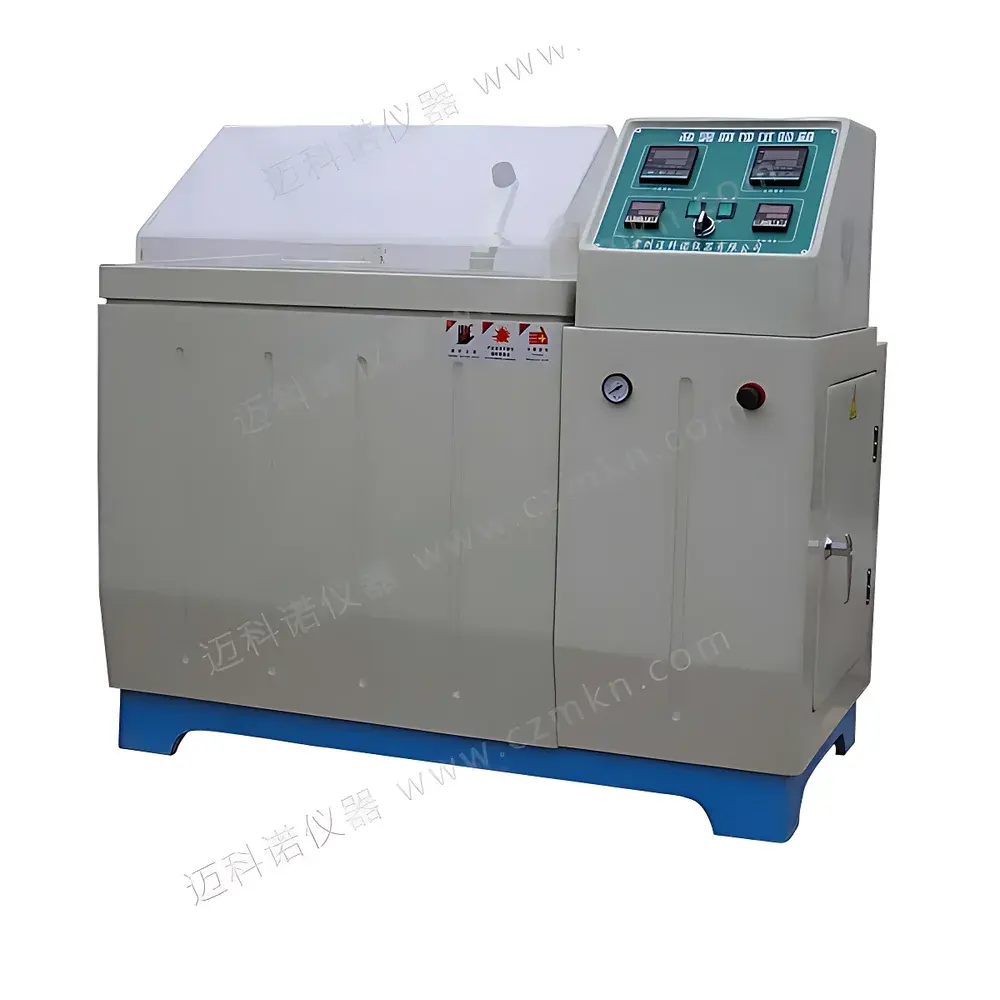
YWX-075 Export-Grade Salt Spray Test Chamber
| Origin | Zhejiang, China |
|---|---|
| Manufacturer Type | Authorized Distributor |
| Origin Category | Domestic (China) |
| Model | YWX-075 |
| Pricing | Available Upon Request |
| Temperature Range | RT+10°C to 55°C |
| Temperature Uniformity | ≤ ±2°C |
| Temperature Fluctuation | ≤ ±0.5°C |
| Salt Spray Deposition Rate | 1–2 mL / 80 cm²·h |
| Saturated Air Pressure | 0.8–2.0 ± 0.01 kg/cm² |
| Test Chamber Temperature (Neutral Salt Spray) | 35 ± 1°C |
| Air Saturation Tower Temperature (NSS) | 47 ± 1°C |
| Test Chamber Volume | 500 L |
| Water Reservoir Capacity | 40 L |
| Power Supply | 220 V, 50 Hz (Optional 380 V, 50 Hz, 3-phase 4-wire) |
Overview
The YWX-075 Export-Grade Salt Spray Test Chamber is an engineered environmental test system designed to replicate aggressive marine atmospheric conditions for accelerated corrosion assessment of metallic substrates, coated surfaces, and protective treatments. It operates on the principle of continuous or cyclic nebulization of a standardized sodium chloride solution—atomized via compressed air through a quartz-glass nozzle—into a thermally controlled chamber where specimens are exposed under precisely regulated temperature, humidity, and spray deposition conditions. This methodology conforms to internationally recognized accelerated corrosion testing protocols, including ISO 9227 (Artificial Atmosphere Corrosion Tests — Salt Spray Tests), IEC 60068-2-11 (Environmental Testing — Part 2-11: Tests — Test Ka: Salt Mist), and GB/T 2423.17 (Environmental Testing for Electrical and Electronic Products — Test Ka: Salt Mist). The chamber serves as a core tool in reliability validation workflows across aerospace, automotive, defense, electronics, and industrial coating sectors—supporting both Neutral Salt Spray (NSS) and Acetic Acid Salt Spray (AASS) test methods per ISO 9227 Annex A.
Key Features
- Corrosion-resistant construction: Inner and outer chambers fabricated from imported high-density PVC rigid plastic board—exhibiting exceptional resistance to HCl, NaCl, and acidic aerosols, with long-term dimensional stability and surface gloss retention.
- Hermetic water-sealed design with transparent PVC lid: Enables real-time visual monitoring of specimen condition and spray distribution without compromising chamber integrity or test repeatability.
- Quartz-glass nozzle assembly: Eliminates salt crystallization and clogging; ensures consistent droplet size distribution and uniform spray density across the test area.
- Tower-type spray system: Delivers fine, gravity-settled mist with adjustable spray interval and continuous operation capability—optimized for compliance with ISO 9227 deposition rate requirements (1–2 mL/80 cm²·h).
- Precision PID temperature control: High-stability chamber heating system with ±0.1°C controller accuracy (standard domestic unit; optional Fuji or RKC digital controllers available).
- Dual-stage air pressure regulation with gas spring-assisted lid actuation: Ensures stable saturation tower pressure (0.8–2.0 ± 0.01 kg/cm²) and ergonomic, safe access during sample loading/unloading.
- Integrated safety interlocks: Multi-layer protection against dry-run (low-water cutoff), overtemperature (thermal fuse), and phase loss (for 3-phase configurations).
Sample Compatibility & Compliance
The YWX-075 accommodates flat, cylindrical, or irregularly shaped specimens up to 75 × 110 × 60 cm (W × D × H), with support for standard ASTM G85 Annex A2 (AASS) and ISO 9227 NSS test configurations. Its internal volume (500 L) and calibrated spray field meet minimum spatial requirements for statistically valid corrosion evaluation per ISO 9227 Clause 6.2. All critical subsystems—including temperature sensors, pressure regulators, and spray nozzles—are traceable to national metrological standards. The chamber design complies with GB/T 10587 (Technical Specifications for Salt Spray Test Chambers), ensuring mechanical robustness, thermal homogeneity, and long-term operational reproducibility. For regulated industries, the system supports GLP-compliant documentation when paired with external data loggers and audit-trail-capable software (see Software & Data Management section).
Software & Data Management
While the YWX-075 features a standalone analog/digital PID controller as standard, it is fully compatible with third-party PC-based data acquisition systems via RS-485 or 4–20 mA analog outputs. Optional integration enables time-synchronized logging of chamber temperature, saturation tower temperature, and spray cycle status—essential for FDA 21 CFR Part 11–compliant validation reports. When deployed in GMP or ISO/IEC 17025-certified laboratories, users may configure external software (e.g., LabVIEW, WinCC, or custom SCADA) to generate electronic records with user authentication, change history, and electronic signatures. Calibration certificates for integrated sensors are provided upon request and align with ISO/IEC 17025 traceability requirements.
Applications
- Evaluation of electroplated zinc, nickel, chromium, and cadmium coatings on steel and aluminum substrates.
- Performance verification of organic coatings (epoxy, polyurethane, acrylic) and conversion coatings (chromate, phosphate) per ASTM B117 and ISO 9227.
- Quality assurance of passivation layers on stainless steels and anodized aluminum in aerospace and medical device manufacturing.
- Comparative lifetime modeling of anti-corrosion oils, greases, and volatile corrosion inhibitors (VCIs).
- Supporting MIL-STD-810H Method 509.6 (Salt Fog) and DEF STAN 00-35 (UK MoD Environmental Testing) qualification programs.
FAQ
What international standards does the YWX-075 comply with?
It meets ISO 9227, IEC 60068-2-11, ASTM B117 (via configuration alignment), GB/T 2423.17, and GB/T 10587 for structural and performance specifications.
Can the chamber perform Acetic Acid Salt Spray (AASS) testing?
Yes—when configured with pH-adjusted 5% NaCl + glacial acetic acid solution and set to 50 ± 1°C chamber temperature and 63 ± 1°C saturation tower temperature per ISO 9227 Annex A2.
Is remote monitoring supported out of the box?
No native Ethernet or Wi-Fi interface is included; however, analog outputs and RS-485 ports allow seamless integration with PLCs, SCADA systems, or cloud-connected DAQ hardware.
What maintenance intervals are recommended for optimal repeatability?
Daily: Check water level and nozzle cleanliness. Weekly: Inspect PVC seals and saturation tower water purity. Quarterly: Calibrate temperature sensors and verify spray deposition rate using standardized funnels per ISO 9227 Section 7.
Does the unit include calibration documentation?
A factory calibration report for chamber and saturation tower temperature sensors is supplied. Full ISO/IEC 17025-accredited calibration services are available upon request.



