
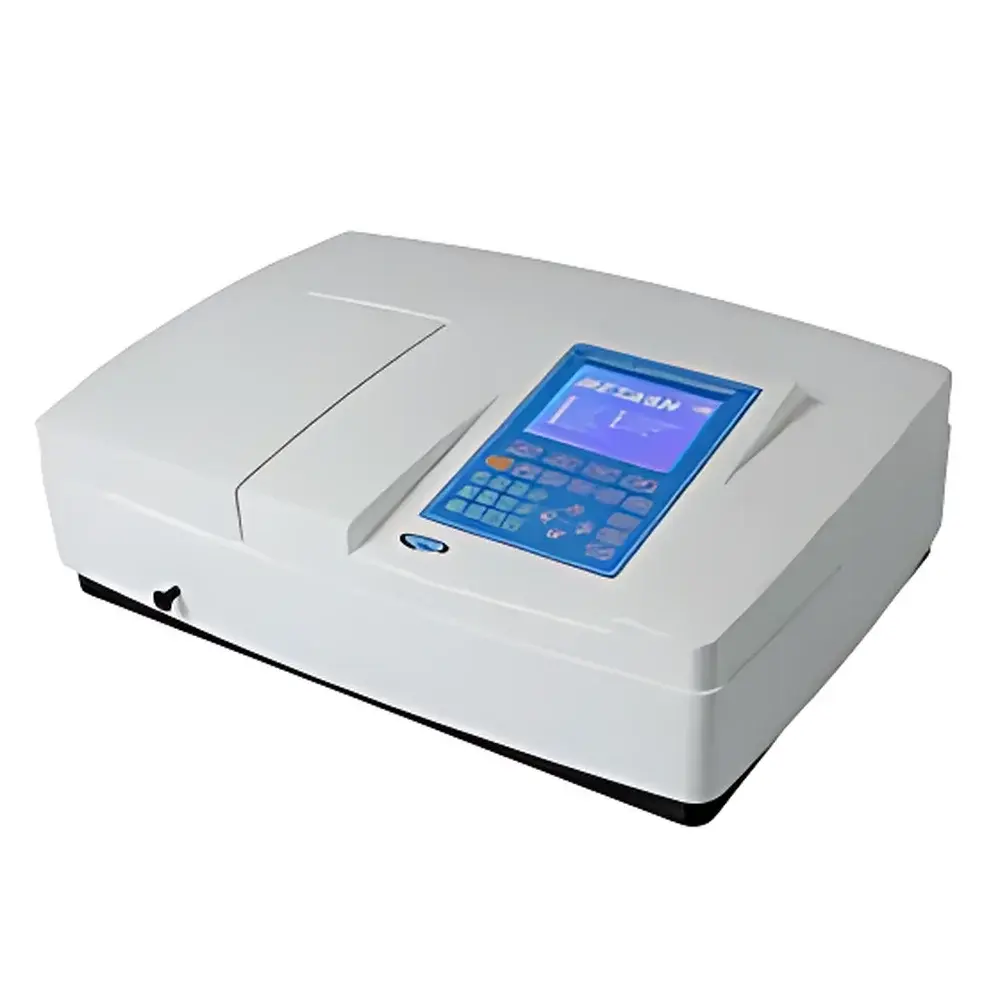
UV-6100S Ultraviolet-Visible Spectrophotometer
| Brand | Jihepu |
|---|---|
| Origin | Shandong, China |
| Model | UV-6100S |
| Optical System | Double-beam |
| Detector | Photodiode Array (PDA) |
| Wavelength Range | 190–1100 nm |
| Spectral Bandwidth | 0.5 / 1.0 / 2.0 / 4.0 nm (selectable) |
| Wavelength Accuracy | ±0.3 nm |
| Wavelength Repeatability | ≤0.1 nm |
| Photometric Accuracy | ±0.3% T |
| Photometric Repeatability | ≤0.1% T |
| Stray Light | ≤0.05% T |
| Baseline Flatness | ±0.001 A |
| Noise Level | ±0.0005 A/h |
| Stability | ±0.0005 A/h (at 500 nm) |
| Photometric Range | 0–200% T, –0.3–3 A, 0–9999 C |
| Data Interface | USB |
| Display | 320 × 240 pixel high-brightness LCD (6-inch) |
| Light Sources | Imported long-life tungsten lamp and deuterium lamp |
| Dimensions | 625 × 430 × 210 mm |
| Weight | 28 kg |
Overview
The Jihepu UV-6100S Ultraviolet-Visible Spectrophotometer is a double-beam, microprocessor-controlled analytical instrument engineered for precision absorbance, transmittance, and concentration measurements across the ultraviolet, visible, and near-infrared spectral regions (190–1100 nm). It operates on the principle of Beer–Lambert law-based photometric analysis, utilizing a stable dual-optical-path design to compensate for source drift and environmental fluctuations in real time. The instrument employs a high-resolution photodiode array (PDA) detector coupled with imported deuterium and tungsten-halogen lamps, ensuring broad spectral coverage and long-term radiometric stability. Its rigid optical architecture—mounted on a 16-mm machined aluminum base—is mechanically isolated from chassis vibration and thermal expansion, delivering exceptional baseline stability (<±0.0005 A/h at 500 nm) and low noise performance (±0.0005 A/h), critical for trace-level quantification and kinetic monitoring.
Key Features
- Double-beam optical configuration with real-time reference compensation for enhanced photometric reproducibility and drift resistance
- Selectably variable spectral bandwidths (0.5, 1.0, 2.0, and 4.0 nm) optimized for resolution–throughput trade-offs in routine QC or high-resolution spectral profiling
- High-precision wavelength drive system based on synchronous sine-bar mechanism, achieving ±0.3 nm accuracy and ≤0.1 nm repeatability
- 24-bit high-speed analog-to-digital conversion enabling fine-grained signal digitization and improved dynamic range
- Suspended optical bench design: all critical optics are rigidly fixed to a stress-relieved, CNC-machined aluminum baseplate, eliminating coupling of mechanical perturbations into the light path
- Integrated 6-inch 320 × 240-pixel backlit LCD display supporting full local operation without PC dependency
- Comprehensive onboard functionality including photometric mode, quantitative analysis (single/multi-point calibration), spectral scanning, kinetics, multi-wavelength measurement, DNA/protein A260/A280 ratio calculation, and report printing via parallel port
Sample Compatibility & Compliance
The UV-6100S accommodates standard 10-mm rectangular cuvettes (quartz, glass, or plastic) and supports optional accessories such as Peltier temperature-controlled cells, fiber-optic probes, and micro-volume adapters. Its optical design enables reliable measurements of aqueous, organic, and mildly corrosive solutions, suspensions (with appropriate filtration), and biological macromolecules. While not certified for regulated GMP environments out-of-the-box, the instrument’s hardware architecture—including stable lamp output, calibrated wavelength referencing, and audit-ready data export—supports alignment with ISO/IEC 17025 method validation requirements. When used with validated software protocols, it meets technical prerequisites for ASTM E275, USP , and ISO 6059 compliance testing in academic, industrial QC, and R&D laboratories.
Software & Data Management
The UV-6100S ships with proprietary spectral acquisition and analysis software compatible with Windows OS (7/10/11), accessible via USB interface. The software enables full remote control, spectral overlay, peak identification, derivative spectroscopy, time-resolved kinetics plotting, and customizable report generation with embedded metadata (date/time, operator ID, instrument serial number, method parameters). Raw absorbance and transmittance data are saved in ASCII-compatible formats (.txt, .csv) for third-party statistical or chemometric processing. Though not natively 21 CFR Part 11 compliant, the software supports user-defined password protection, session logging, and manual electronic signature workflows—facilitating GLP-aligned documentation practices when deployed within controlled IT environments.
Applications
- Quantitative determination of pharmaceutical actives and excipients per USP/EP monographs
- Enzyme kinetics and ligand-binding assays in biochemistry research
- Water quality analysis (nitrate, phosphate, COD estimation via colorimetric methods)
- Polymer characterization (concentration, degradation index, additive content)
- Food and beverage QA/QC (colorants, preservatives, vitamin content)
- DNA/RNA purity assessment (A260/A280, A260/A230) and oligonucleotide quantification
- Educational laboratory instruction in analytical chemistry and molecular spectroscopy
FAQ
What is the minimum detectable absorbance change supported by the UV-6100S?
The instrument achieves a noise level of ±0.0005 A/h, permitting reliable detection of absorbance changes ≥0.001 A under optimized conditions (e.g., matched cuvettes, stabilized ambient temperature).
Can the UV-6100S be integrated into automated liquid handling workflows?
Yes—via its USB interface and SCPI-compatible command set, the instrument supports basic external triggering and data polling, though advanced robotic integration requires custom driver development.
Is quartz cuvette compatibility confirmed across the full 190–1100 nm range?
Standard synthetic fused silica cuvettes are required for measurements below 220 nm; standard quartz cuvettes transmit reliably down to ~195 nm. For sub-195 nm work, vacuum UV-grade optics are necessary and not supported by this model.
Does the UV-6100S support wavelength calibration verification using NIST-traceable standards?
Yes—the instrument accepts holmium oxide and didymium filters for periodic wavelength verification per ISO 6059 recommendations; calibration certificates for such standards may be sourced separately.
What maintenance intervals are recommended for lamp replacement and optical cleaning?
Deuterium lamp lifetime is rated at ≥1,000 hours; tungsten lamp >5,000 hours. Optical surfaces require cleaning only if contamination is visually confirmed—typically every 6–12 months in clean-lab environments—using spectroscopic-grade methanol and lint-free wipes.





