
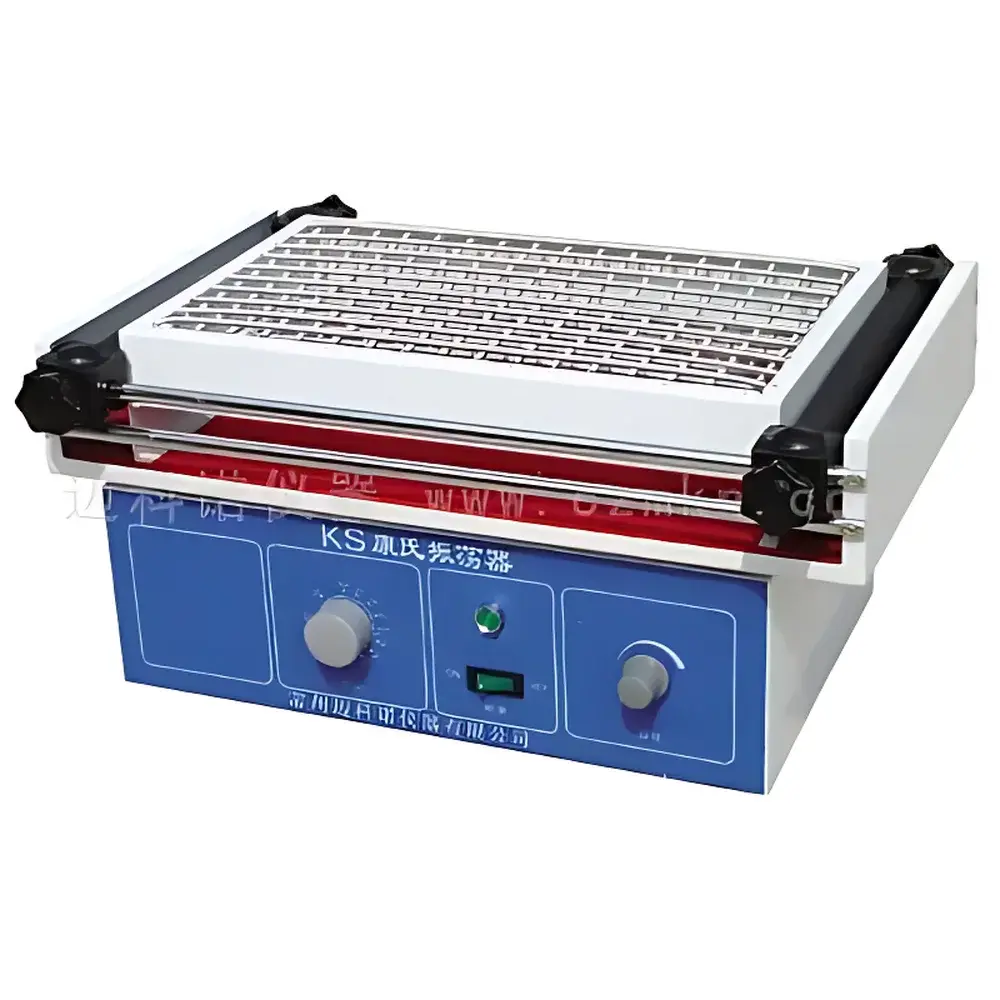
MKN KS Kuhner-Style Orbital Shaker
| Brand | MKN |
|---|---|
| Model | KS |
| Type | Orbital Shaker for Life Science Applications |
| Power Supply | AC 220 V ±10%, 50 Hz ±2% |
| Speed Range | 0–320 rpm (infinitely variable) |
| Oscillation Amplitude | 20 mm (reciprocating motion) |
| Timer Range | 0–120 min |
| Tray Dimensions | 400 × 260 mm |
| Origin | Jiangsu, China |
| Compliance | CE-marked per IEC 61010-1 for laboratory equipment safety |
Overview
The MKN KS Kuhner-Style Orbital Shaker is a precision-engineered benchtop shaker designed for consistent, low-shear mixing in life science and bioprocessing laboratories. Unlike rotary or vortex shakers, the KS employs a true reciprocating orbital motion—characterized by a 20 mm horizontal displacement—optimized for gentle yet effective suspension of microbial cultures, cell lines, and reagent solutions. Its mechanical architecture follows established Kuhner-style kinematics, ensuring minimal vibration transmission to adjacent instrumentation and high reproducibility across repeated runs. The unit operates within a validated speed range of 0–320 rpm, supporting applications from slow-adaptation inoculation protocols to rapid solubilization steps. Constructed with a rigid steel frame and reinforced polymer housing, the KS shaker delivers long-term stability under continuous operation, making it suitable for both routine QC workflows and extended incubation-based assays.
Key Features
- Infinitely variable speed control via analog potentiometer—enabling precise ramping and stable setpoint maintenance without digital overshoot.
- Reciprocating orbital drive mechanism with 20 mm amplitude—minimizing foaming and shear stress on sensitive biological samples such as mammalian cells or filamentous fungi.
- Integrated mechanical timer (0–120 minutes) with audible end-of-cycle alert—supporting unattended operation while maintaining GLP-compliant process documentation.
- Universal spring-loaded platform (400 × 260 mm) compatible with standard Erlenmeyer flasks (50–2000 mL), test tubes, Petri dishes, and multi-well plates via optional adapters.
- Thermally stable motor housing with overheat protection—certified to IEC 61010-1 for safe use in ambient lab environments (10–40 °C, ≤80% RH non-condensing).
- Low-noise operation (<55 dB(A) at 1 m)—designed for shared laboratory spaces where acoustic interference must be minimized during microscopy or electrophysiology workflows.
Sample Compatibility & Compliance
The KS shaker accommodates a broad spectrum of sample containers without requiring proprietary fixtures. Its spring-clamp system secures round-bottom flasks, conical tubes, and shallow trays with uniform clamping force across load variations up to 5 kg. The device conforms to ISO/IEC 17025-relevant environmental testing conditions when used in accredited calibration labs. While not intrinsically rated for Class II biosafety cabinets, its compact footprint (W450 × D320 × H180 mm) and absence of external ventilation ducts allow safe integration into laminar flow hoods when operated at speeds ≤200 rpm. All electrical components meet RoHS 2011/65/EU directives, and the unit carries CE marking under Directive 2014/30/EU (EMC) and 2014/35/EU (LVD).
Software & Data Management
The KS operates as a standalone analog instrument—intentionally omitting embedded microprocessors or USB interfaces to maximize electromagnetic compatibility (EMC) resilience in proximity to sensitive detection systems (e.g., fluorescence plate readers or patch-clamp amplifiers). For laboratories requiring electronic audit trails, the shaker may be integrated into facility-wide monitoring networks via optional 4–20 mA analog output modules (sold separately), enabling real-time speed logging in SCADA or LIMS platforms compliant with FDA 21 CFR Part 11 Annex 11 requirements. Calibration records—including speed verification using NIST-traceable tachometers—are maintained per ISO/IEC 17025 clause 7.7, with annual recalibration recommended for GMP-regulated environments.
Applications
- Microbial culture propagation in E. coli, Bacillus, and yeast strains under aerobic conditions.
- Antibiotic susceptibility testing (AST) using broth microdilution protocols per CLSI M07-A11 guidelines.
- Protein solubilization and ligand-binding equilibration in buffer exchange workflows prior to SEC or IEX chromatography.
- Cell detachment and passaging support for adherent mammalian lines (e.g., HEK293, CHO-K1) using enzymatic dissociation buffers.
- Standardized mixing of ELISA coating solutions, wash buffers, and substrate reagents to ensure inter-assay consistency.
- Environmental simulation studies involving temperature-coupled agitation (when placed inside validated incubator-shaker chambers).
FAQ
Is the KS shaker compatible with CO₂ incubators?
Yes—provided the incubator’s internal dimensions accommodate the unit’s footprint and airflow patterns are not obstructed. Maximum operating temperature is limited to 40 °C; prolonged exposure above this threshold voids warranty coverage.
Can the oscillation direction be reversed or adjusted?
No—the KS employs a fixed-direction reciprocating motion optimized for forward compatibility with standard flask geometries. Directional reversal is neither mechanically supported nor recommended for protocol reproducibility.
What is the maximum load capacity per flask position?
The platform supports up to 5 kg total distributed load. Individual flask weight limits depend on neck diameter and center-of-gravity height; for 1000 mL Erlenmeyer flasks, maximum fill volume is 700 mL at 250 rpm to prevent spillage.
Does MKN provide IQ/OQ documentation packages?
Yes—upon request, MKN supplies vendor-verified Installation Qualification (IQ) and Operational Qualification (OQ) templates aligned with ASTM E2500-13 and EU GMP Annex 15 frameworks. Execution requires on-site technician support billed separately.
Is firmware upgrade capability available?
Not applicable—the KS contains no programmable logic controller (PLC) or firmware. All operational parameters are governed by analog circuitry, eliminating cybersecurity risks associated with networked lab devices.





