
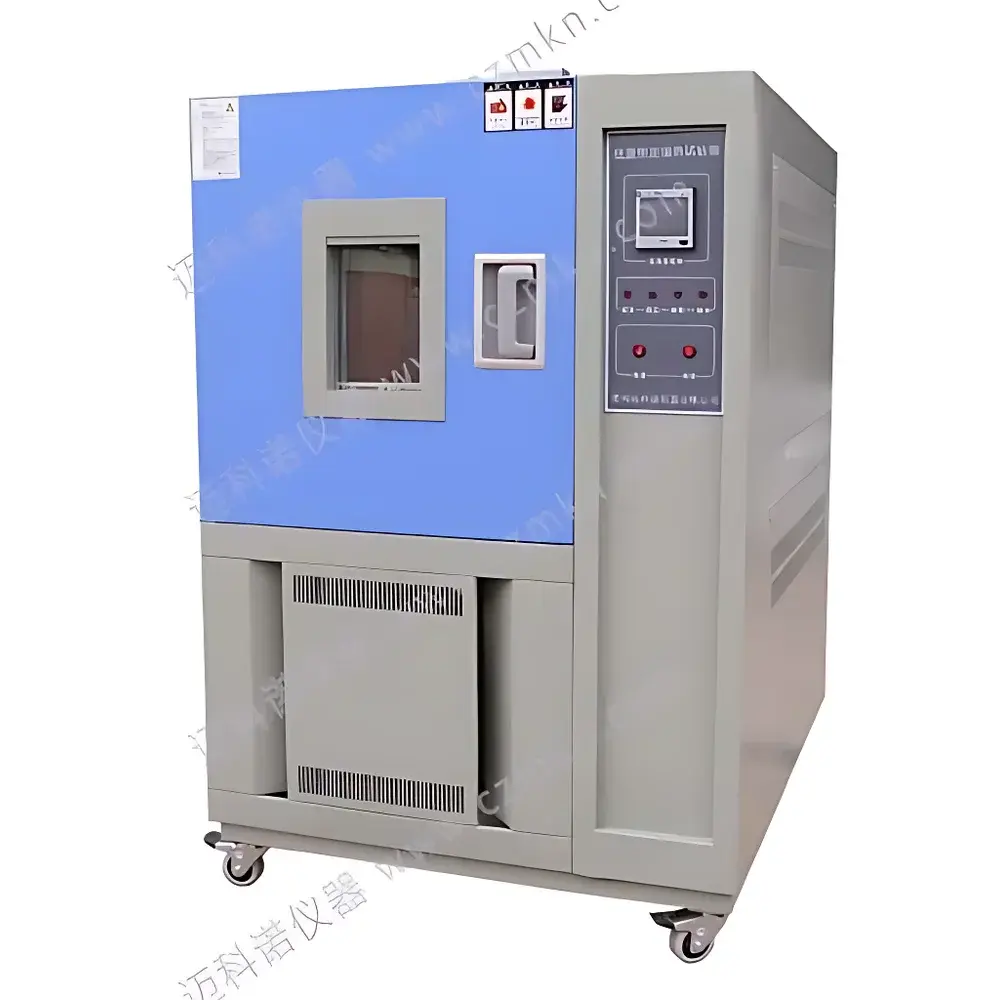
MKN HS Series Constant Temperature & Humidity Test Chamber
| Brand | MKN |
|---|---|
| Model | HS Series |
| Temperature Range | RT+10°C to 100°C (HS) |
| Humidity Range | 85–98% RH (HS) |
| Temperature Uniformity | ≤±2°C |
| Temperature Fluctuation | ≤±0.5°C |
| Humidity Deviation | +2/−3% RH |
| Interior Material | High-grade stainless steel (SUS304) |
| Exterior Material | A3 steel with epoxy powder coating |
| Heating System | Stainless steel finned heater |
| Humidification Method | Shallow-tray surface evaporation |
| Refrigeration | Single-stage or cascade (dual-stage) system with imported compressor |
| Control System | Fuji Electric PID digital controller with PT100 platinum resistance sensor |
| Compliance | GB/T 2423.3 (IEC 60068-2-3), GB/T 10586 |
Overview
The MKN HS Series Constant Temperature & Humidity Test Chamber is an engineered environmental simulation system designed for precise, long-duration exposure testing under stabilized thermal and hygroscopic conditions. Based on the fundamental principles of convective heat transfer and controlled vapor-phase equilibrium, the chamber maintains rigorously defined temperature and relative humidity setpoints across its working volume—enabling standardized evaluation of material stability, coating integrity, electronic component reliability, and packaging performance under accelerated aging protocols. Its architecture adheres to the physical and metrological requirements specified in GB/T 2423.3 (equivalent to IEC 60068-2-3) for constant damp heat testing and GB/T 10586 for environmental test chamber technical specifications. The system operates without active air humidification via steam generation; instead, it employs shallow-tray surface evaporation—a passive, low-maintenance method that ensures stable RH profiles with minimal condensation risk and no mineral deposit accumulation.
Key Features
- Robust dual-layer construction: interior chamber fabricated from mirror-finished SUS304 stainless steel for corrosion resistance and cleanability; outer enclosure formed from A3 structural steel with electrostatic epoxy powder coating for mechanical durability and chemical resistance.
- Precision climate control: Fuji Electric high-stability PID digital controller integrated with PT100 Class A platinum resistance temperature sensors and capacitive humidity transducers for closed-loop regulation of both temperature and RH.
- Thermal management system: finned stainless steel heating elements combined with multi-circuit evaporator coils and imported hermetic compressors—configured either as single-stage or cascade refrigeration depending on model variant—to achieve rapid thermal response and sustained stability at extreme operating points.
- Uniform airflow design: single-cycle forced convection driven by extended-shaft, low-noise stainless steel centrifugal fans with optimized blade geometry, ensuring ≤±2°C temperature uniformity and minimal stratification across the full test volume.
- Integrated safety architecture: comprehensive protection suite including over-temperature cutoff, dry-run prevention for humidifier, compressor high-pressure interlock, leakage current detection, fast-acting fusing, and water-level monitoring—all compliant with IEC 61000-6-2 electromagnetic compatibility standards.
Sample Compatibility & Compliance
The HS Series accommodates a broad spectrum of test specimens—from printed circuit boards and polymer housings to aerospace fasteners and pharmaceutical packaging—without requiring custom fixtures. Standard internal dimensions range from 400 × 500 × 500 mm (HS-010) to 1000 × 1000 × 1000 mm (HS-100), all featuring reinforced observation windows (250 × 300 mm tempered double-glazed unit with anti-condensation heating), one Φ50 mm cable/port access opening, two adjustable stainless steel sample shelves, and LED interior lighting. All units are factory-calibrated and documented per ISO/IEC 17025 traceable procedures. The chamber satisfies mandatory conformity requirements for laboratory-based environmental qualification per GB/T 2423.3, GB/T 10586, and supports audit readiness for GLP and GMP-regulated environments—including data integrity provisions compatible with FDA 21 CFR Part 11 when paired with optional validated software modules.
Software & Data Management
While the base configuration utilizes standalone Fuji PID controllers with local display and manual setpoint entry, optional Ethernet-enabled data logging modules provide real-time acquisition of temperature and humidity values at user-defined intervals (1 s to 60 min). Logged datasets are exportable in CSV format and support time-synchronized timestamping with NTP synchronization capability. For regulated laboratories, MKN offers optional IQ/OQ documentation packages and validation-ready firmware versions that maintain full audit trails—including operator ID, parameter changes, alarm events, and calibration history—with immutable storage and password-protected access levels aligned with ALCOA+ principles.
Applications
- Accelerated reliability assessment of electronic assemblies under prolonged 85°C/85% RH stress (JEDEC JESD22-A101 qualification).
- Evaluation of moisture barrier efficacy in flexible packaging films and blister packaging used in pharmaceutical manufacturing.
- Stability testing of adhesives, sealants, and composite laminates exposed to tropical climatic profiles.
- Pre-compliance screening of automotive ECUs and connectors per ISO 16750-4 humidity resistance requirements.
- Material degradation studies involving hygroscopic swelling, hydrolytic cleavage, or corrosion initiation in metallic and coated substrates.
FAQ
What standards does the HS Series comply with?
It conforms to GB/T 2423.3 (identical to IEC 60068-2-3) for constant damp heat testing and GB/T 10586 for environmental test chamber performance criteria.
Is cascade refrigeration available across all models?
Cascade (dual-stage) refrigeration is standard on DHS-type variants and optional on HS models requiring sub-zero capability or enhanced low-humidity stability.
Can the chamber be integrated into a centralized lab monitoring network?
Yes—via optional RS485 Modbus RTU or Ethernet TCP/IP interfaces, enabling integration with SCADA systems and enterprise LIMS platforms.
What is the typical recalibration interval for factory-installed sensors?
Annual recalibration is recommended; MKN provides traceable calibration certificates and on-site service contracts for accredited verification.
Are custom interior configurations supported?
Yes—non-standard shelf layouts, additional port openings, inert gas purging options, and specialized mounting rails are available under MKN’s non-standard equipment customization program.



