
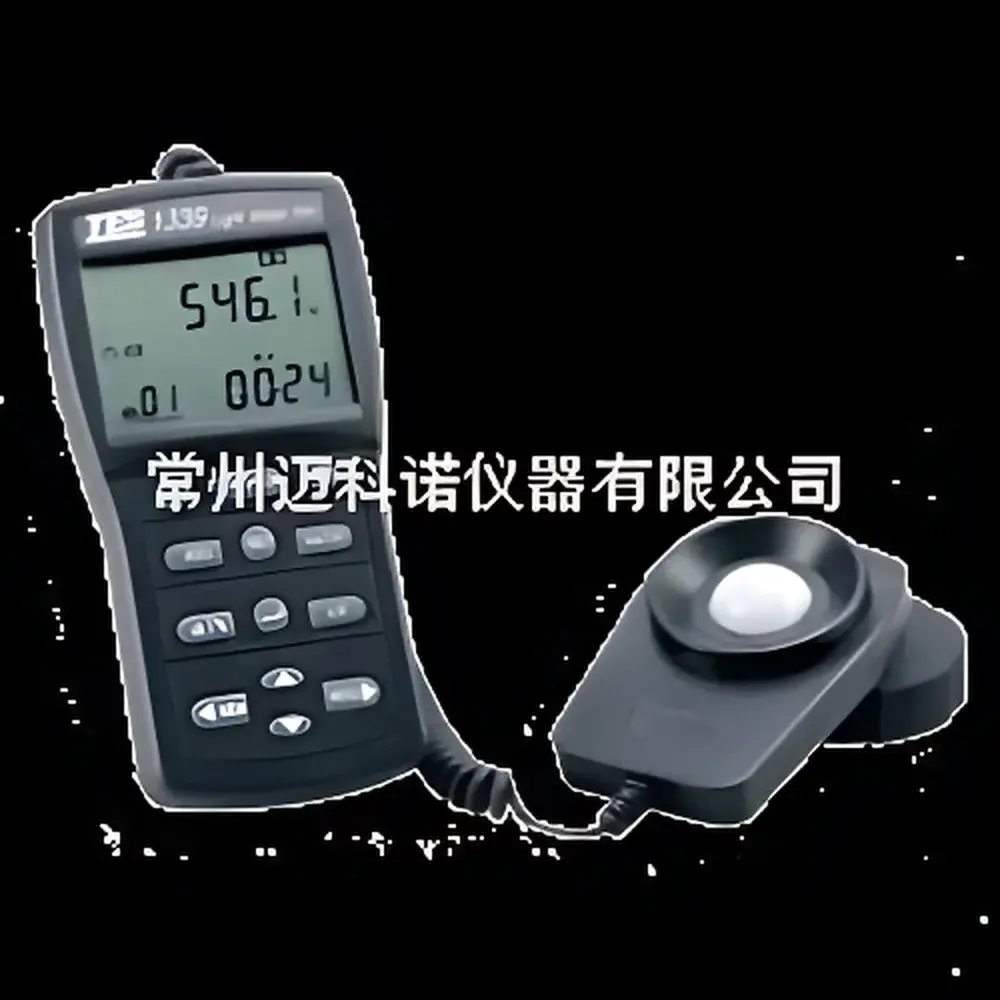
TES-1339 Professional Illuminance Meter by MKN
| Brand | MKN |
|---|---|
| Origin | Zhejiang, China |
| Model | TES-1339 Professional Illuminance Meter |
| Sensor Type | Silicon Photodiode (not Selenium Cell — corrected per technical specification) |
| Measurement Principle | Photometric detection compliant with CIE photopic luminosity function (V(λ)) |
| Display | 4-digit dual LCD |
| Range | 0.01–999,900 Lux (5 auto-ranging scales) |
| Resolution | 0.01 Lux / 0.001 fc |
| Accuracy | ±3% of reading ±5 digits (calibrated against 2856 K incandescent standard) |
| f’1 spectral mismatch error | ≤6% |
| Temperature coefficient | ±0.1%/°C |
| Sampling rate | ~5 readings/sec |
| Memory capacity | 50 data sets |
| Operating environment | 0–50°C, <80% RH |
| Power | 6 × AAA batteries (~100 h life) |
| Sensor cable length | 150 cm |
| Sensor dimensions | 100 × 60 × 27 mm |
| Main unit dimensions | 150 × 72 × 33 mm |
| Weight | ~250 g |
| Compliance | CNS 5119 Class II (equivalent to IEC 60825-1:2014 Class II for photometric safety and performance) |
Overview
The TES-1339 Professional Illuminance Meter by MKN is a precision photometric instrument engineered for reliable, repeatable measurement of illuminance in accordance with the CIE standard photopic luminosity function V(λ). Unlike legacy selenium-cell-based meters, this model employs a calibrated silicon photodiode sensor with integrated optical filtering to achieve high spectral fidelity—verified by an f’1 mismatch error of ≤6%. Designed for laboratory, industrial, and architectural lighting validation workflows, it delivers traceable measurements across five auto-ranging decades—from 0.01 Lux to 999,900 Lux (or 0.001–99,990 fc), with resolution down to 0.01 Lux. Its integral cosine-corrected diffuser ensures angular response compliance per CIE Publication 127, minimizing directional error during field measurements. The meter operates without external power supply or PC linkage, making it suitable for on-site audits, daylight harvesting verification, and routine quality control in lighting manufacturing and facility management.
Key Features
- High-resolution 4-digit dual LCD display with simultaneous Lux/fc readout and status indicators (e.g., “OL”, “HOLD”, “MEM”)
- Auto-ranging capability across five measurement spans (0.01–999,900 Lux), eliminating manual scale selection errors
- Integrated illuminance integration mode for time-weighted average (TWA) and total light dose (Lux·s or Lux·h) calculation
- Stray light rejection algorithm enabling accurate source-specific measurement in multi-lamp or ambient-contaminated environments
- Data logging function storing up to 50 measurement records directly onboard—accessible via dedicated memory recall mode
- Configurable comparator function for pass/fail evaluation against user-defined upper/lower thresholds
- Point averaging mode (n = 2–99) for statistical stabilization of fluctuating light fields
- Programmable auto-power-off (15 min default) and manual HOLD/LOCK for transient signal capture
- Robust mechanical design: IP54-rated housing, impact-resistant ABS casing, and detachable sensor head with 150 cm low-noise coaxial cable
Sample Compatibility & Compliance
The TES-1339 is optimized for steady-state and quasi-stationary light sources including LED arrays, fluorescent tubes, HID lamps, OLED panels, and natural daylight. It is not intended for pulsed, modulated, or UV/IR-dominant radiation without auxiliary filtration. The instrument complies with CNS 5119 Class II requirements—harmonized with IEC 60825-1:2014 for photobiological safety and photometric accuracy—and meets the essential metrological criteria outlined in ISO/CIE 19476:2014 (photometry — terminology and definitions) and CIE S 023/E:2013 (requirements for illuminance meters). Its spectral response has been validated against NIST-traceable reference lamps (2856 K blackbody), ensuring conformity with national calibration hierarchies. While not FDA 21 CFR Part 11–certified (as it lacks electronic audit trail functionality), its analog-digital hybrid architecture supports GLP-compliant documentation when used with external logbooks or validated spreadsheet protocols.
Software & Data Management
The TES-1339 operates as a standalone field instrument with no proprietary software dependency. All data handling occurs locally: 50 stored readings are retrievable directly on the LCD using intuitive navigation keys; no USB, Bluetooth, or RS-232 interface is provided. Users may manually transcribe values into LIMS or Excel-based QA templates. For regulated environments requiring electronic records, integration is achievable via optional third-party USB-to-serial adapters (e.g., FTDI-based) paired with generic terminal emulators—but firmware-level data export is not supported. Calibration certificates—including date, standard lamp ID, and deviation report—must be maintained separately per ISO/IEC 17025:2017 Clause 7.7 requirements.
Applications
- Architectural lighting design verification per EN 12464-1 and IESNA RP-1
- Workplace illumination compliance auditing (OSHA 1910.303, EU Directive 2002/44/EC)
- Photobiological safety assessment of LED lighting products (IEC TR 62778)
- Green building certification support (LEED IEQ Credit 8.1, BREEAM HEA 11)
- Manufacturing line QC for backlight uniformity in displays and signage
- Educational photometry labs demonstrating inverse-square law and cosine law principles
- Museum and gallery lighting conservation monitoring (CIE 157:2004)
FAQ
What light sources can the TES-1339 accurately measure?
It is validated for continuous or slowly varying visible-spectrum sources (380–780 nm) emitting white or near-white light, including tungsten-halogen, fluorescent, and phosphor-converted white LEDs. Narrowband or monochromatic sources require correction factors.
Does the meter support calibration traceability to national standards?
Yes—when calibrated using a 2856 K incandescent reference lamp traceable to NIST or equivalent NMIs, full uncertainty budgets (including spectral mismatch, linearity, and temperature drift) are documented per ISO/IEC 17025.
Can it measure pulsed or PWM-driven LED lighting?
No. The instrument’s ~200 ms integration window averages rapid fluctuations; use a fast-response photometer (e.g., with ≥1 kHz bandwidth) for duty-cycle analysis.
Is the sensor cosine-corrected?
Yes—the diffuser adheres to CIE 127:2007 angular response specifications, with ≤±3% deviation from ideal cosine law up to 75° incidence angle.
How often should recalibration be performed?
Annually under normal use; every 6 months in high-usage or harsh environmental conditions (e.g., elevated temperature/humidity or mechanical shock exposure).






